

Your vs. You’re
Introduction
If you write an essay, one small spelling error can weaken your credibility fast. Your and you’re look similar, but they do not mean the same thing. For medical students, doctors, and researchers, this mistake can appear in emails, manuscripts, and conference materials. It may seem minor, but it signals weak proofreading and slows reader trust. This guide explains the difference clearly, with practical rules you can use in academic writing.
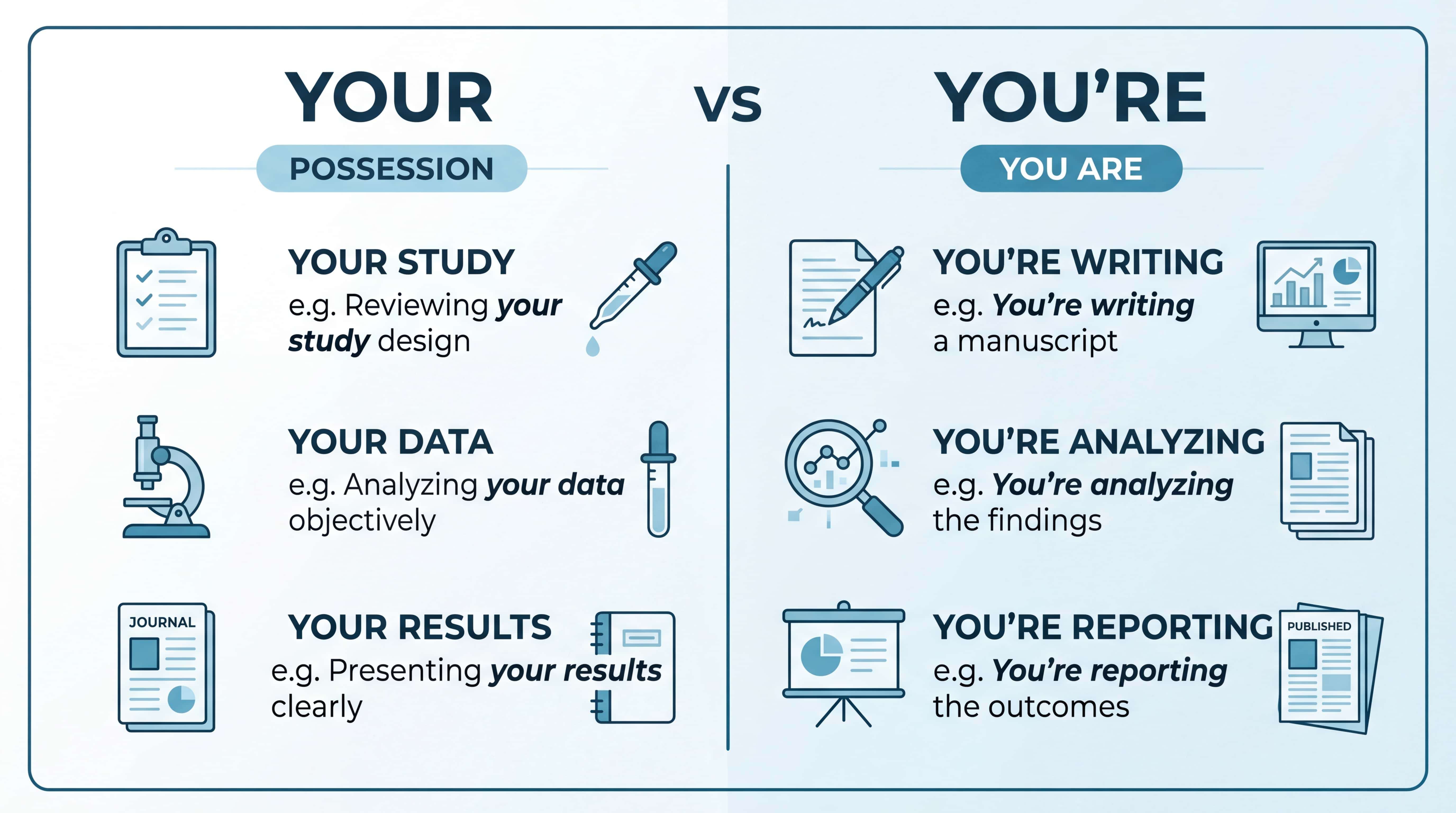
1. The Core Difference Between Your and You’re
1.1 What “your” means
“Your” is a possessive determiner. It shows that something belongs to you or relates to you.
Examples:
- your essay
- your patient
- your research data
- your conclusion
In each case, “your” points to ownership or association. In scientific and medical writing, this form is common because you often refer to materials, methods, results, or documents linked to the reader or author.
1.2 What “you’re” means
“You’re” is a contraction of “you are.” It is not possessive. It always expands to two words.
Examples:
- you’re correct
- you’re writing an essay
- you’re reviewing the manuscript
- you’re responsible for the final draft
A simple test works well. Replace “you’re” with “you are.” If the sentence still makes sense, the form is correct. If not, you probably need “your.”
1.3 Why this matters in an essay
In an essay, the wrong form can change meaning instantly. Compare:
- Your manuscript needs revision.
- You’re revising the manuscript.
The first sentence refers to possession. The second describes an action.
This is why the distinction matters. It affects clarity, professionalism, and trust.
2. How to Use Each Word Correctly in Academic Writing
2.1 Use “your” for possession
Use “your” when something belongs to the person being addressed.
Common academic examples:
- your hypothesis
- your figure legend
- your reference list
- your clinical notes
- your essay outline
If you can place a noun after the word, “your” is often the correct choice.
2.2 Use “you’re” for “you are”
Use “you’re” when you can expand it to “you are.”
Examples:
- you’re correct about the dose
- you’re submitting the essay today
- you’re expected to cite recent studies
- you’re making a strong argument
A fast proofreading rule: read the sentence aloud with “you are.” If the sentence sounds natural, “you’re” is right.
2.3 A practical comparison table
| Form | Meaning | Example |
|---|---|---|
| your | belonging to you | your essay |
| you’re | you are | you’re editing the essay |
This simple check prevents many errors in academic drafting.
3. Common Mistakes in Essays and Research Writing
3.1 Confusing possession with a verb phrase
Writers often choose the wrong form when they move quickly.
Wrong:
- You’re manuscript is ready.
Correct:
- Your manuscript is ready.
The error happens because the writer hears the sentence and focuses on sound, not function. In editing, function matters more than sound.
3.2 Relying only on spellcheck
Spellcheck often misses this mistake because both forms are valid English words. It may not know which one you intended.
That means proofreading by eye is essential. This is especially true in an essay, where small errors can stand out to reviewers, supervisors, or journal editors.
3.3 Overlooking the error in formal contexts
In medicine and research, small language errors can create a poor first impression. A grant application, case report, or thesis chapter should read with precision.
Use these quick examples:
- Your data support the argument.
- You’re ready to present the data.
- Your abstract is concise.
- You’re improving the structure of the abstract.
The difference is small, but the impact is real.
4. A Fast Proofreading Method for Medical and Research Writers
4.1 Use the substitution test
Replace “you’re” with “you are.”
If the sentence works, keep “you’re.”
If not, use “your.”
Example:
- You’re going to revise the essay. → You are going to revise the essay.
- Your essay needs one more citation. → You are essay needs one more citation. This fails, so “your” is correct.
4.2 Read for grammar, not just meaning
Many writers understand the message but miss the grammar. That is risky in academic writing. A sentence may sound fine in your head but still contain a form error.
To reduce mistakes:
- Read the sentence slowly.
- Check whether a noun follows the word.
- Test whether “you are” fits.
- Review the final draft one line at a time.
4.3 Build a short editing checklist
For every essay or manuscript, check these items:
- possession words
- contractions
- comma use
- subject-verb agreement
- unclear pronouns
- repeated word choice
One minute of focused review can prevent repeated errors throughout a document.
5. Why Precision Matters for Medical Students, Doctors, and Researchers
5.1 Language accuracy supports authority
In scientific communication, readers expect clarity. A clean sentence helps them focus on the evidence, not the wording. That is important in medical writing, where decisions may depend on careful interpretation.
When you choose the correct word, you show control over language and respect for the audience.
5.2 Errors reduce trust in otherwise strong work
A single “your” vs. “you’re” mistake will not ruin a strong paper. But repeated errors can make a draft look careless. Reviewers may assume the author rushed the work.
In a competitive environment, details matter. Precision is part of professionalism.
5.3 Strong editing habits improve speed over time
Good writers do not rely on luck. They use systems. The more often you check common confusions, the faster you will spot them.
This applies not only to essays, but also to:
- case reports
- research manuscripts
- abstracts
- personal statements
- slide decks
The habit of careful proofreading improves every form of academic writing.
6. Tools That Can Help You Write More Cleanly
6.1 Use structured support, not guesswork
If you draft often under time pressure, a writing support tool can help you catch errors before submission. That is where scifocus.ai can add value.
It can support a more efficient workflow by helping you refine academic language, reduce avoidable mistakes, and improve the clarity of your essay or manuscript.
6.2 Why this matters in practice
Medical and research writing demands accuracy. You may be drafting after clinical work, lab analysis, or long hours of reading. In that setting, a focused platform can save time and reduce avoidable revision cycles.
A better workflow means:
- fewer grammar mistakes
- cleaner sentence structure
- stronger readability
- faster final editing
That kind of support is useful when every paragraph must earn attention.
Conclusion
The difference between your and you’re is simple, but it matters in every essay and every academic draft. Use your for possession. Use you’re for “you are.” If you want a fast check, try the substitution test and read each sentence with care.
For medical students, doctors, and researchers, this small habit improves clarity and strengthens professional credibility. If you want more efficient support for academic writing, consider scifocus.ai as a practical tool to help refine your draft before submission.

Did you like this article? Explore a few more related posts.
Start Your Research Journey With Scifocus Today
Create your free Scifocus account today and take your research to the next level. Experience the difference firsthand—your journey to academic excellence starts here.