

What Is Sample Size in Research
Introduction
Sample size in research is not a guess. It is a statistical decision that shapes validity, precision, and trust. For medical students, doctors, and researchers, choosing the wrong sample size can lead to weak findings, wasted resources, or rejected manuscripts. In a research essay, this topic matters because sample size affects every major conclusion. If the sample is too small, the study may miss real effects. If it is too large, time and cost rise unnecessarily.
1. What Sample Size Means in Research
1.1 The basic definition
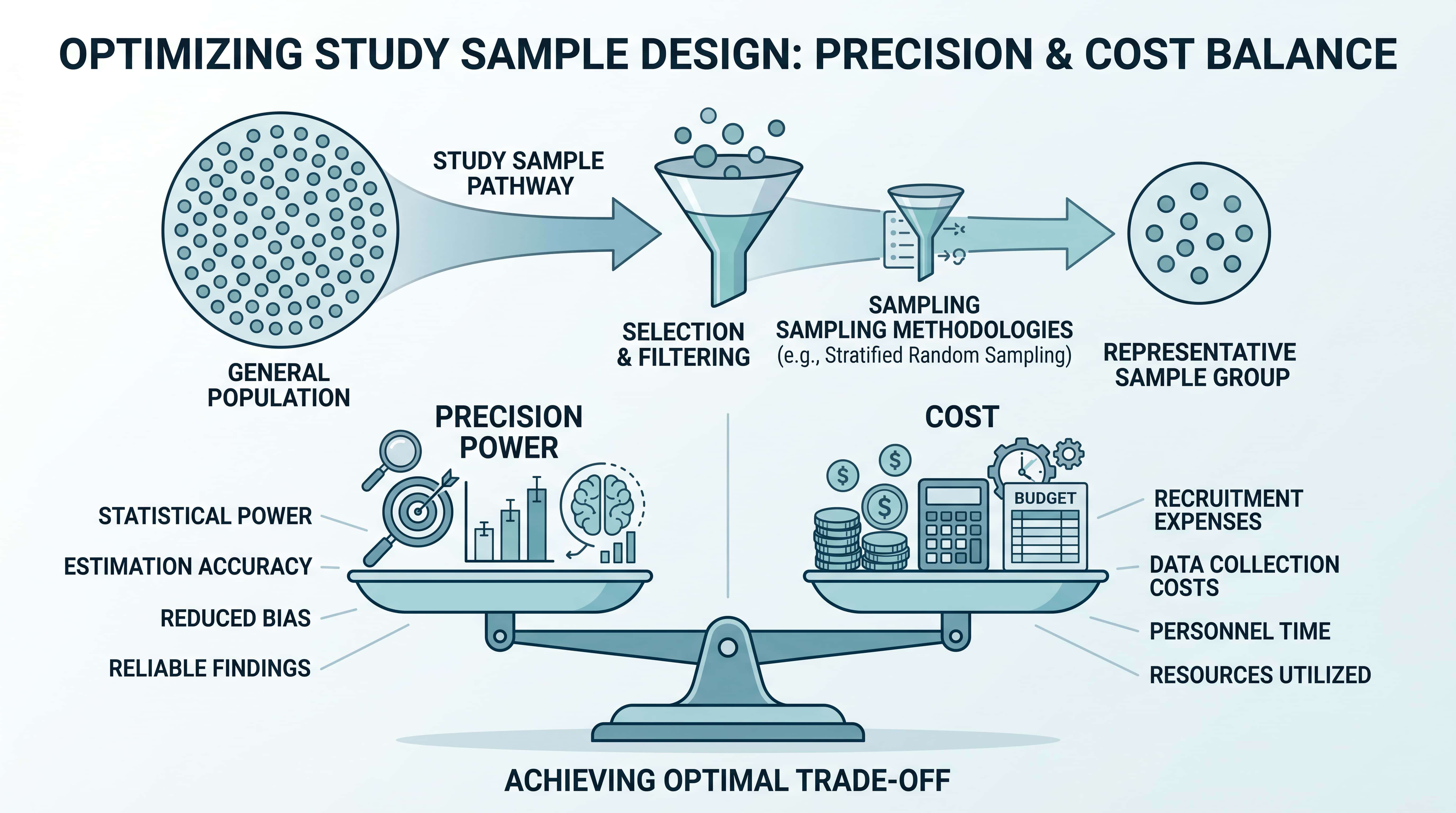
Sample size is the number of participants, records, or observations included in a study. It is the actual group used to estimate a population parameter, compare groups, or test an hypothesis. In clinical and epidemiologic research, sample size is chosen before data collection begins.
The core purpose of sample size is to make the study results reliable enough to represent the target population. A sample that is too small can produce unstable estimates. A sample that is large enough improves precision and reduces random error.
1.2 Why it matters
Sample size is not just a technical detail. It is part of study quality. Reviewers often ask whether the study had enough participants to support the conclusions. This is especially important in cross-sectional studies, case-control studies, cohort studies, and clinical essays based on retrospective data.
A strong sample size plan supports:
- more precise estimates
- better statistical power
- more credible confidence intervals
- fewer false-negative results
In short, sample size determines whether a research essay is statistically defensible.
2. The Main Factors That Affect Sample Size
2.1 Expected prevalence or effect size
The first factor is the expected value of the outcome. For a prevalence study, this may be the expected proportion of disease in a population. For a comparison study, it may be the expected difference between groups. If the expected effect is small, a larger sample is usually needed.
For example, if a study expects a disease prevalence of 6.4% and wants a margin of error of 3%, the sample must be much larger than in a study with a wider error tolerance. Smaller detectable differences require larger samples.
2.2 Margin of error and standard deviation
For proportion studies, margin of error refers to the maximum acceptable difference between the sample estimate and the true population value. For continuous variables, it is the acceptable difference between the sample mean and the population mean.
The knowledge base makes one key point clear: the smaller the acceptable error, the larger the sample size. This is because precision increases when the confidence interval narrows.
For continuous data, the standard deviation also matters. A larger standard deviation means more variability in the population, so more participants are needed to estimate the mean accurately.
2.3 Confidence level
Most medical studies use a 95% confidence level. That corresponds to a conventional alpha of 0.05. A higher confidence level usually requires a larger sample because the estimate must be more certain.
2.4 Dropout, nonresponse, and invalid data
The calculated sample size is not always the final number to recruit. In real studies, some participants do not respond, withdraw, or provide unusable data.
A practical study plan often adjusts for:
- nonresponse rate
- invalid questionnaire rate
- loss to follow-up
For example, if the required sample is 5,619 and the nonresponse rate is 10%, the adjusted target becomes 5,619 ÷ 0.9 = 6,244. If only 90% of questionnaires are valid, the final target increases further.
3. Common Sample Size Approaches by Study Design
3.1 Cross-sectional studies
Cross-sectional research often estimates prevalence or mean values. It does not usually test causality. It answers a simple question: what is the situation at this point in time?
For a proportion-based cross-sectional study, researchers need:
- an expected proportion
- a margin of error
- a confidence level
For example, if a study estimates the prevalence of hyperuricemia in middle-aged and older adults, it may use prior literature to set the expected proportion and then calculate the needed sample. This is a standard and defensible way to plan a prevalence study.
For continuous outcomes, such as mean serum selenium level, the main inputs are:
- expected standard deviation
- acceptable error
- confidence level
3.2 Case-control studies
Case-control studies may use matched or unmatched designs. Sample size depends on the expected exposure rate, the ratio of cases to controls, and the desired statistical power.
There is no universal sample size formula for all case-control studies. The design must come first. This is why the research question and methodology should be defined before numbers are calculated.
3.3 Cohort studies
Cohort studies usually compare incidence or risk over time. Sample size depends on the expected event rate, follow-up duration, exposure distribution, and effect size.
If the expected outcome is rare, the study may need a larger sample or longer follow-up. In practice, cohort studies often require careful planning because missing data can reduce statistical power.
4. How to Think About Sample Size in a Research Essay
4.1 Start with the research question
A sample size should never be chosen in isolation. It must match the study aim. Are you estimating prevalence? Comparing two groups? Measuring a mean? Testing association?
Each question leads to a different calculation path. The research design determines the sample size method, not the other way around.
4.2 Use literature, not intuition
The knowledge base shows a practical rule: researchers should rely on prior studies, expert judgment, or pilot data when setting assumptions. If no agreed margin of error exists, researchers may choose a reasonable approximation based on the type of data.
Examples include:
- proportion studies: choose an error based on clinical relevance
- continuous studies: use a fraction of the standard deviation
- comparative studies: define the smallest meaningful difference
This is where a well-written essay should be specific. Mention the source of assumptions. State the confidence level. State the error margin. Show the logic.
4.3 Report the calculation clearly
A good manuscript should describe:
- study design
- assumed prevalence or mean
- acceptable error
- confidence level
- software or formula used
- adjustment for nonresponse or missing data
Transparent reporting improves trust and makes the study easier to review.
5. Practical Examples From Medical Research
5.1 Example of a prevalence study
A cross-sectional study wants to estimate the prevalence of hyperuricemia in middle-aged and older adults. Prior literature suggests a prevalence of 6.4%. The researchers set a 95% confidence level and a 3% margin of error.
This type of setup can lead to a large required sample. In the knowledge base example, the base sample size was 5,619. After adjusting for 10% nonresponse and 90% valid questionnaires, the final target rose to 6,938.
This example shows why sample size planning must include real-world losses, not just the statistical minimum.
5.2 Example of a mean-based study
A study aims to estimate average serum selenium level in a population. Prior data show a standard deviation around 20 g/L. With a 95% confidence level and a small acceptable error, the required sample can be large, especially when the target population is effectively infinite.
If the population is finite, the required sample may be lower. That is another reason the target population must be defined early.
6. Tools and Software Used for Sample Size Calculation
6.1 PASS and similar software
The knowledge base uses PASS software for sample size estimation. This is common in clinical research. Software helps when the formula is complex, especially for multiple study designs or confidence interval methods.
For one proportion, software may allow different methods such as:
- Exact, based on binomial probabilities
- Wilson score, often more accurate for small samples
- Simple asymptotic, based on normal approximation
Different methods can produce slightly different results, so the chosen method should be stated clearly.
6.2 Why software does not replace understanding
Software is useful, but it does not replace statistical judgment. Researchers still need to know:
- which design they are using
- which parameter drives the calculation
- why a specific margin of error was selected
A strong essay should not present a number without explanation. It should show the reasoning behind the number.
7. How SciFocus.ai Can Help Researchers Save Time
7.1 From planning to writing
Many clinicians and researchers struggle not because sample size is impossible, but because the process is fragmented. They must search literature, choose formulas, justify assumptions, and then write the methods section clearly.
SciFocus.ai can help streamline this workflow. It supports researchers who need structured, publication-ready writing for a research essay, especially when translating statistics into a clear academic narrative.
7.2 Why this matters for medical users
For medical students, doctors, and research teams, the real pain point is often not the calculation alone. It is the full chain:
- selecting the right design
- estimating the right sample
- writing the methods accurately
- keeping the manuscript consistent
A tool like SciFocus.ai can reduce drafting friction and help turn technical calculations into a polished, publication-oriented essay. That means less time formatting and more time focusing on study quality.
Conclusion
Sample size in research is a core part of study design. It affects precision, power, validity, and credibility. The right sample size depends on the study question, the expected outcome, the allowable error, the confidence level, and practical losses such as nonresponse. A well-planned sample size makes a research essay stronger, clearer, and easier to defend.
If you are preparing a medical research essay and want faster, more structured writing support, consider using SciFocus.ai to help organize your ideas, sharpen your methods section, and improve workflow efficiency.
Did you like this article? Explore a few more related posts.
Start Your Research Journey With Scifocus Today
Create your free Scifocus account today and take your research to the next level. Experience the difference firsthand—your journey to academic excellence starts here.