
What Is Peer Review?
Introduction
Peer review is the quality filter behind most credible scientific essays and journal articles. For medical students, physicians, and researchers, understanding peer review is essential because it affects what gets published, what gets trusted, and what gets cited. If you write, submit, or read scientific work, you need to know how this process works, why preprints are different, and where review can fail.
1. What Peer Review Means
1.1 A structured evaluation before publication
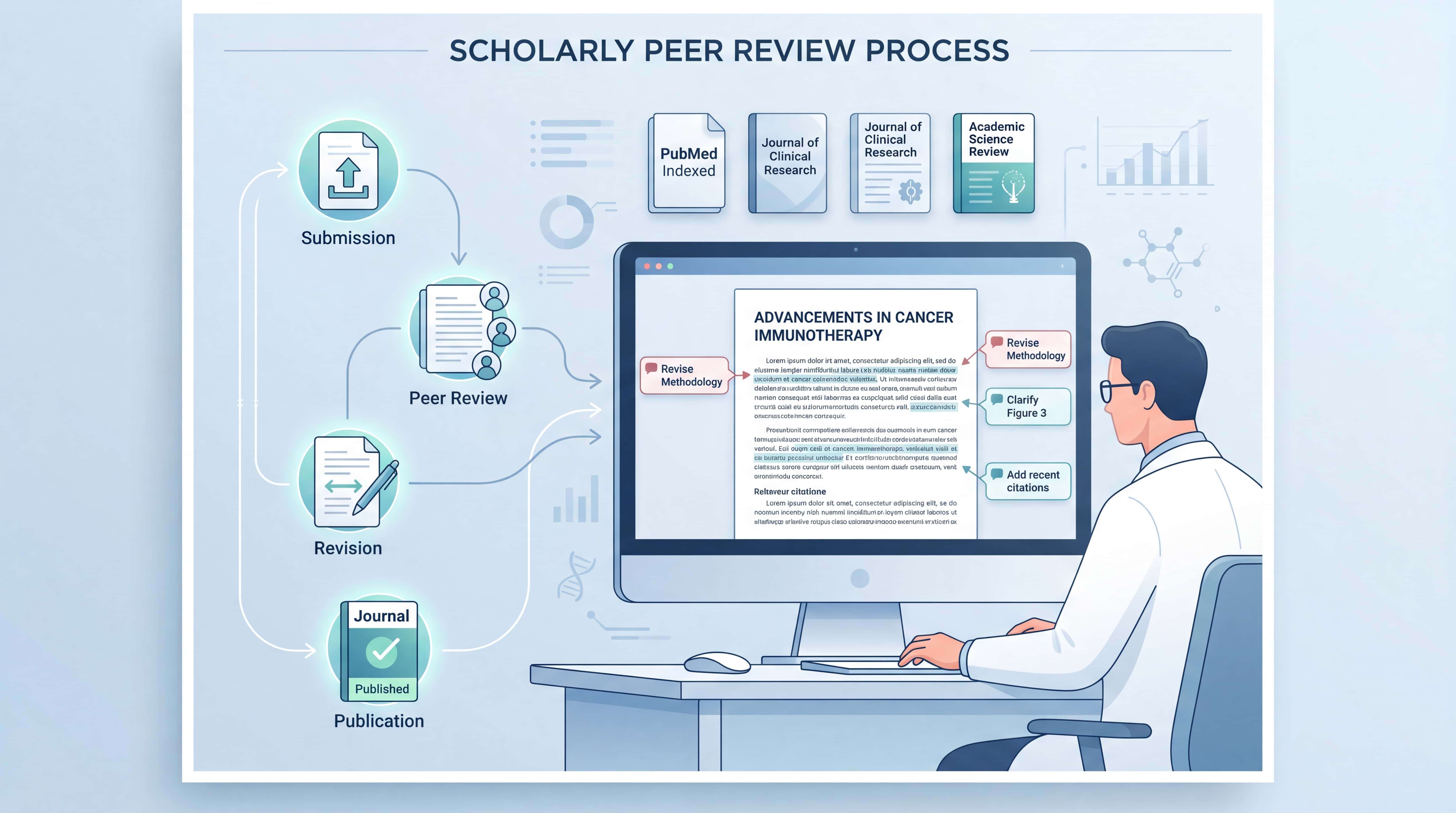
Peer review is the formal assessment of a manuscript by independent experts before a journal decides whether to publish it. The goal is simple. It checks whether the work is original, methodologically sound, and important enough for the journal’s audience.
In practice, this means editors send the essay or paper to two or more reviewers with relevant expertise. Reviewers examine the study design, data, interpretation, ethics, and clarity. Their role is not to rewrite the manuscript. Their role is to judge quality and identify weaknesses.
Peer review is not a guarantee of truth, but it is one of the strongest tools science uses to reduce error.
1.2 Why it matters in medicine and research
In clinical fields, weak evidence can affect patient care. A flawed trial, incorrect analysis, or unsupported conclusion can mislead readers and influence decisions. That is why peer review matters so much for medical writing.
For researchers, peer review also improves a manuscript before publication. Many authors revise their essay after comments from reviewers and make the logic clearer, the methods tighter, and the discussion more balanced. This process can raise the value of the final paper.
2. How the Peer Review Process Works
2.1 The usual journal workflow
Most journals follow a similar sequence:
- Submission by the authors.
- Editorial screening for scope, format, and basic quality.
- Reviewer invitation and evaluation.
- Decision by the editor.
- Revision, rejection, or acceptance.
Some journals use single-blind review, where reviewers know the authors’ names. Others use double-blind review, where identities are hidden on both sides. A few use open review, where reports may be public.
After submission, many journals also run plagiarism checks. If the article was already shared as a preprint, that usually does not automatically cause failure in originality checks. The key is transparency. Authors should disclose the preprint and follow the target journal’s policy.
2.2 What reviewers look for
Reviewers typically focus on a few core points:
- Is the research question clear?
- Is the design appropriate?
- Are the data reliable?
- Are the statistics valid?
- Do the conclusions match the results?
- Is the writing precise and ethical?
A strong essay in science is not just well written. It must also be well supported. Reviewers are trained to detect unsupported claims, weak controls, missing limitations, and overstatement.
If the evidence does not support the conclusion, peer review should catch it.
3. Peer Review, Preprints, and Journal Articles
3.1 Why preprints are not the same as reviewed articles
A preprint is a research paper shared publicly before formal peer review. It is used to speed up communication and allow early feedback. Common servers include arXiv, bioRxiv, and medRxiv.
A preprint is useful, but it is not yet the same as a peer-reviewed journal article. The main difference is review. If the work has not gone through peer review, it should be treated as provisional evidence, not final proof.
For medical readers, this distinction is critical. A preprint may be helpful for early awareness, but clinical decisions should not rely on it alone.
3.2 Why journals still care about review status
Journals want to know whether a manuscript has been shared elsewhere and whether it has already received external feedback. Some journals welcome preprints. Others have limits. That is why authors should always read the instructions for authors before submission.
This is especially important for an essay destined for a medical or scientific journal. The submission path, word limits, reference style, figure rules, and disclosure requirements all matter. A good paper can still be delayed if the formatting is wrong.
4. Common Peer Review Outcomes
4.1 Acceptance, revision, or rejection
After review, journals usually make one of four decisions:
- Accept.
- Minor revision.
- Major revision.
- Reject.
Direct acceptance after the first round is rare. In many journals, most manuscripts need revision. A minor revision means the paper is close to publishable. A major revision means the study may still be publishable, but the authors must address substantial concerns.
A rejection is disappointing, but it is common. It does not always mean the work is poor. It may mean the paper is not the right fit, the novelty is limited, or the methods need more work.
4.2 How authors should respond
A strong response letter is professional, specific, and respectful. The best approach is to answer every comment one by one. If a suggestion cannot be implemented, explain why clearly and calmly.
Good revision habits include:
- Separating reviewer comments from author responses.
- Highlighting changes in the manuscript.
- Keeping tone neutral and factual.
- Avoiding emotional language.
- Correcting new language issues after revision.
A careful response to peer review often matters as much as the original draft.
5. Writing a Strong Scientific Essay for Peer Review
5.1 Clarity is a technical skill
Many manuscripts fail because the writing is unclear, not because the science is weak. In medical writing, short sentences often work better than long ones. Use direct language. Remove unnecessary phrases. Keep the logic visible.
A practical writing order can help:
- Introduction.
- Methods.
- Results.
- Discussion.
- Abstract.
- Title page and acknowledgments.
This order is efficient because it follows the logic of the research itself. It also makes revision easier.
5.2 Tools and support that improve submission quality
Before submission, authors should check journal scope, formatting rules, and reference style. Tools like EndNote can reduce citation errors. Language editing by colleagues, native speakers, or professional services can also improve readability.
For teams under time pressure, platforms like scifocus.ai can support the writing process by helping researchers organize drafts, improve clarity, and prepare manuscripts more efficiently. Used well, this can save time during revision and reduce avoidable language problems.
Better writing does not replace peer review. It helps your manuscript survive it.
6. What Medical Readers Should Take Away
6.1 Peer review is important, but not perfect
Peer review is a quality control system, not a flawless system. Reviewers can disagree. Editors can make different decisions. Good papers can be rejected. Weak papers can occasionally slip through.
Still, the process remains central to scientific publishing because it adds expert scrutiny before publication. For readers, it provides a useful signal of reliability. For authors, it is a chance to improve.
6.2 Practical implications for students, doctors, and researchers
If you are a medical student, peer review teaches you how evidence is judged. If you are a physician, it helps you evaluate the trustworthiness of what you read. If you are a researcher, it shapes how you write, submit, and revise.
That is why understanding peer review is not optional. It is part of scientific literacy.
Conclusion
Peer review is the expert evaluation that helps journals decide whether a scientific essay or manuscript is ready for publication. It is central to research integrity, especially in medicine. It also helps separate preprints from fully reviewed articles, and it explains why revision is a normal part of publishing.
For authors, the best strategy is clear writing, transparent disclosure, careful formatting, and a professional response to reviewer comments. If you want to write faster and submit with more confidence, scifocus.ai can help streamline drafting, editing, and manuscript preparation so you spend less time fixing avoidable problems and more time improving the science.

Did you like this article? Explore a few more related posts.
Start Your Research Journey With Scifocus Today
Create your free Scifocus account today and take your research to the next level. Experience the difference firsthand—your journey to academic excellence starts here.