

What Is Passive vs Active Voice?
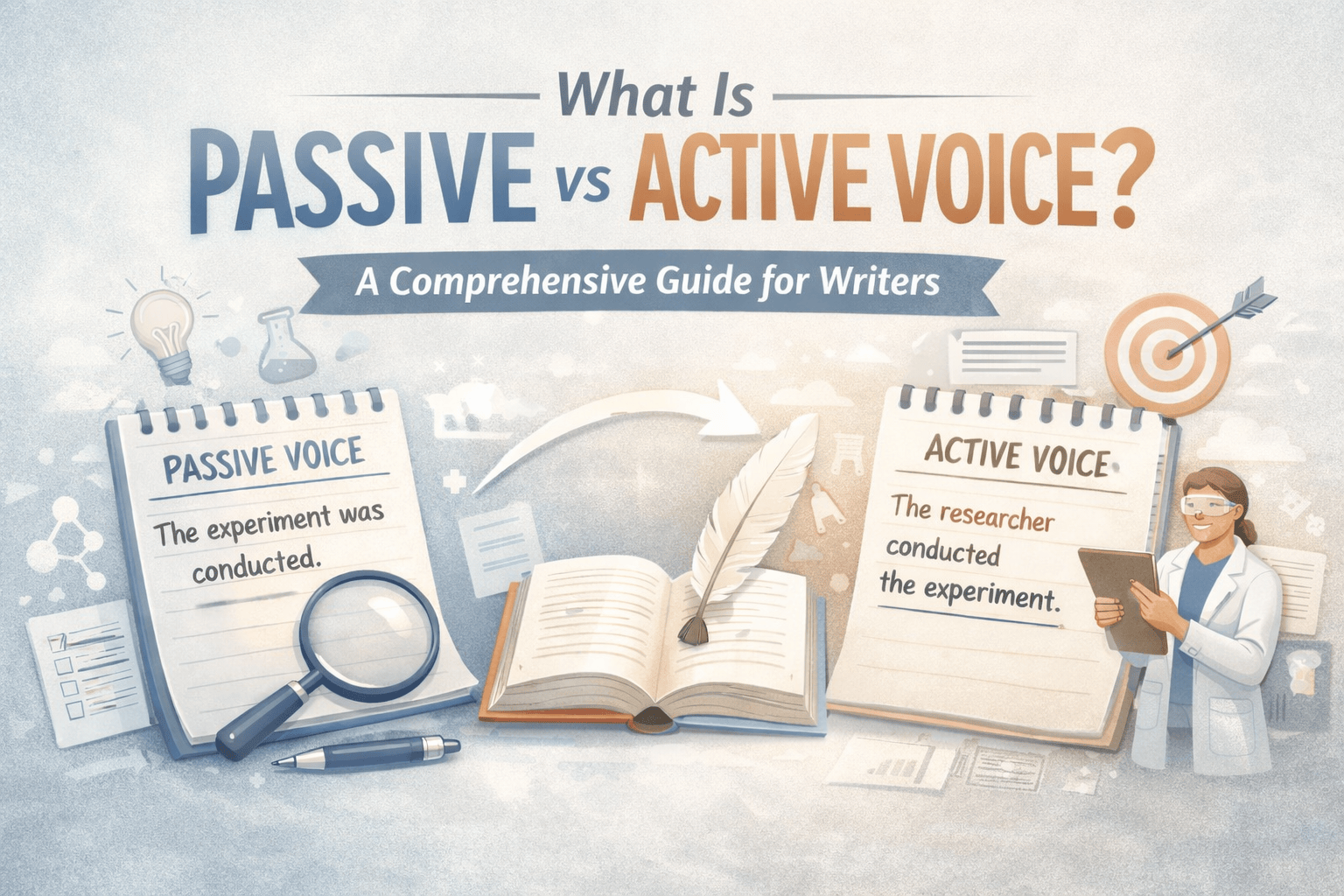
Active voice puts the subject first and shows who is performing the action, while passive voice emphasizes the action itself or the recipient of the action. Choosing the right voice is essential for clear, effective, and professional writing.
For researchers, students, and writers who want to explore examples and practice exercises in depth, Scifocus provides tools to quickly search, summarize, and organize authoritative examples and grammar guidelines.
What Is Active Voice and Why Is It Important?
Active voice occurs when the subject of a sentence performs the action. It’s direct, efficient, and engaging, making it the preferred choice in most academic, professional, and casual writing.
Example:
- Active: The researcher conducted the experiment.
- Passive: The experiment was conducted by the researcher.
Active voice places the subject—the doer—front and center. According to the Purdue OWL, active voice is often more concise, allowing readers to quickly grasp who is responsible for an action. This clarity is invaluable in scientific reports, technical documentation, and professional communications.
Active voice also enhances persuasiveness and engagement. When the subject is clearly responsible, the writing conveys confidence and authority. This is why academic journals frequently favor active constructions in methodology, results, and conclusions.
What Is Passive Voice and When Should You Use It?
Passive voice flips the sentence structure: the subject receives the action rather than performing it. It emphasizes the action or the recipient instead of the actor.
Example:
- Passive: The hypothesis was tested over six weeks.
- Active: The team tested the hypothesis over six weeks.
Passive voice is particularly useful in research, scientific papers, and formal documents where objectivity is important. By focusing on the action rather than the individual, writing appears neutral and impersonal. As EF English Resource notes, passive constructions are key in formal English, especially when describing procedures or results.
When to Use Passive Voice:
- Unknown actor: The manuscript was submitted last week.
- Emphasis on result: The vaccine was developed in record time.
- Polite or diplomatic tone: Mistakes were noted in the report.
For practicing passive voice, you can try the Scifocus Grammar Checker to identify and revise passive constructions in your text.
How Can I Recognize Passive Voice?
Identifying passive voice is easier than it seems. Look for a form of “to be” (is, are, was, were, has been) followed by a past participle. Often, a “by” phrase signals the actor, but it’s not always present.
Example checklist:
- The data were analyzed by the team. Passive
- The team analyzed the data. Active
Passive constructions frequently appear in academic abstracts:
- Significant correlations were observed between variables A and B.
- Active alternative: Researchers observed significant correlations between variables A and B.
Recognizing passive voice allows you to control emphasis. Are you highlighting the researcher or the research result? That distinction guides your sentence choice.
Why Does Choosing the Right Voice Matter?
Voice affects readability, tone, and focus. Active voice is direct and engaging; passive voice is formal and neutral.
Example comparison:
- Active: Dr. Smith published the results.
- Passive: The results were published by Dr. Smith.
In scientific writing, passive voice conveys objectivity:
- Passive: The drug was administered to all participants.
- Active: Researchers administered the drug to all participants.
While active voice emphasizes agency, passive voice emphasizes methodology and results. Context should dictate your choice. According to Grammarly, clarity and reader comprehension are the priority.
How Can I Balance Active and Passive Voice?
Balancing voices enhances readability, emphasis, and stylistic variety.
Strategies:
- Use active voice for clarity and directness: The study confirmed the hypothesis.
- Use passive voice for objectivity and focus on results: The hypothesis was confirmed by the study.
- Alternate voices for rhythm: A mix prevents monotony in longer documents.
Illustrative table:
| Sentence Type | Example | Focus |
|---|---|---|
| Active | Researchers analyzed the data. | Actor/Subject |
| Passive | The data were analyzed by researchers. | Action/Result |
| Active | The team presented findings clearly. | Actor |
| Passive | Findings were presented clearly by the team. | Result |
This table shows how balancing voices can emphasize either the actor or the result depending on your goal.
What Are Common Mistakes Writers Make?
- Overusing passive voice: Makes writing evasive or unclear. Example: Mistakes were made.
- Inconsistent voice usage: Switching mid-paragraph can confuse readers.
- Neglecting clarity: Complex passive constructions obscure meaning.
Prioritize clarity. If the reader struggles to identify the actor or action, restructure the sentence. Overly passive academic writing can reduce the impact of research findings.
How Can I Practice Active vs Passive Voice?
Practice is key. Suggestions:
- Rewrite passive sentences from scientific articles in active voice.
- Convert active sentences in essays or blogs to passive to emphasize results.
- Alternate voices in reports to observe rhythm and emphasis.
Use Scifocus Grammar Checker for hands-on practice and automated feedback.
Are There Tools to Help Identify Passive Voice?
Several tools can assist in identifying and revising passive constructions, but Scifocus offers a unique, research-focused advantage.
With Scifocus, you can:
- Automatically detect passive sentences in your text.
- Receive intelligent suggestions for converting passive voice to active voice.
- Access structured examples from academic papers and authoritative sources to guide your revisions.
- Practice exercises directly in the platform to reinforce learning and improve clarity.
Unlike generic grammar tools, Scifocus is designed for writers, researchers, and students who need precise, context-aware feedback for academic or professional writing. It not only identifies passive constructions but also helps you understand why certain structures are preferable in different contexts.
Try it now via the Scifocus Grammar Checker to enhance readability and writing precision.
Can Passive Voice Improve Academic Writing?
Yes. In scientific and technical writing, passive voice:
- Maintains objectivity by emphasizing actions/results.
- Standardizes reporting methods and findings.
- Reduces focus on individual actors, aligning with formal conventions.
Example in context:
- Passive: Samples were collected from 200 participants.
- Active: Researchers collected samples from 200 participants.
The passive form aligns with standard academic style, highlighting methodology rather than the researcher.
FAQs About Passive vs Active Voice
1. What is passive vs active voice in writing?
Active voice emphasizes the subject performing the action; passive voice emphasizes the action or recipient.
2. How do I identify a passive sentence?
Look for a form of “to be” + past participle; often a “by” phrase indicates the actor.
3. When should passive voice be used in academic writing?
Use it when the actor is unknown, irrelevant, or objectivity is required.
4. Does active voice improve readability?
Yes, active sentences are generally clearer, more direct, and engaging.
5. Can I mix active and passive voice effectively?
Yes. Strategic mixing enhances clarity, emphasis, and stylistic variation without confusing readers.
For academics, writers, and researchers seeking authoritative examples, structured exercises, or grammar tools, Scifocus is an efficient platform to search, summarize, and practice active vs passive voice effectively.
Did you like this article? Explore a few more related posts.
Start Your Research Journey With Scifocus Today
Create your free Scifocus account today and take your research to the next level. Experience the difference firsthand—your journey to academic excellence starts here.