

What Is Paraphrasing?
Introduction
In medical and research writing, an essay or article often needs to explain another author’s findings without copying the original wording. That is where paraphrasing matters. If you write too close to the source, you risk plagiarism. If you only summarize, you may lose important detail. Paraphrasing helps you restate ideas accurately, clearly, and ethically.
1. What Is Paraphrasing?
1.1 A Clear Definition
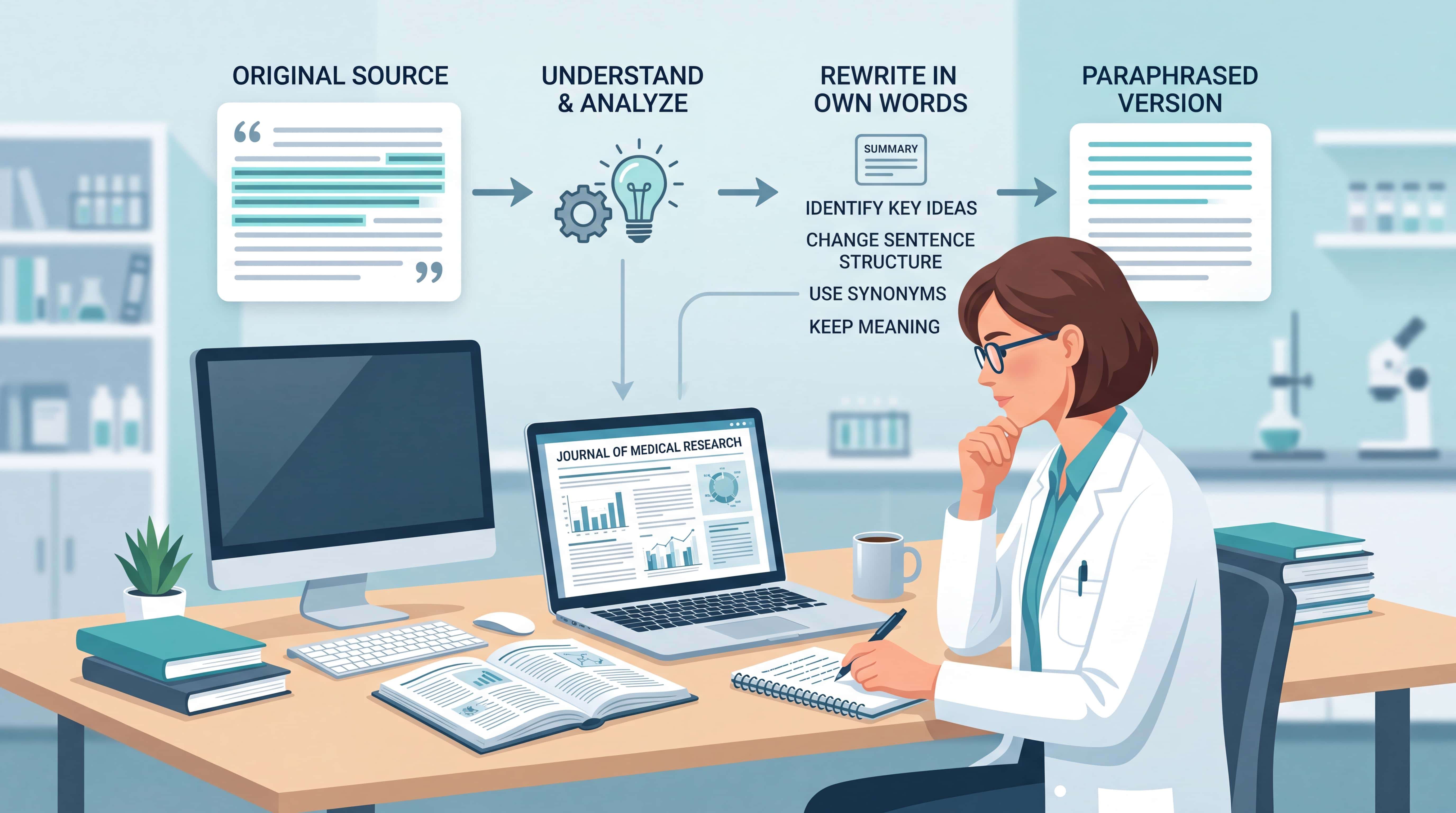
Paraphrasing means rewriting someone else’s idea in your own words while keeping the original meaning. It is not direct quoting. It is not a short summary either. It sits between the two.
In academic writing, especially in medicine and science, paraphrasing is used when you need to explain a study result, compare evidence, or support a discussion section. The goal is to preserve meaning while changing the wording and sentence structure.
1.2 Why It Matters in Scientific Writing
Researchers and clinicians often need to report prior findings in a discussion section. For example, you may need to connect your results with previous studies using phrases like:
- others have shown
- Smith reported
- their findings demonstrate
- our previous study showed
These signals tell readers that you are discussing prior evidence, not presenting your own data.
Paraphrasing is essential because scientific readers expect precision. They want to know what was found, how it relates to your work, and why it matters. A good essay does this without overusing quotation marks or copying full sentences.
2. Paraphrasing, Quoting, and Summarizing
2.1 Direct Quoting
Direct quotation means using the exact words from the source. You must use quotation marks and cite the source. This is appropriate for well-known phrases, key terms, or exact statements that must remain unchanged.
For example, some scientific expressions are so established that they are best quoted directly. But in most medical papers, quoting should be limited. Too many direct quotes can make your writing feel weak and unoriginal.
2.2 Paraphrasing
Paraphrasing is the most common option in research writing. You rewrite the idea in a new form. That means changing:
- vocabulary
- sentence order
- grammar structure
- clause arrangement
A weak paraphrase may still look too similar to the source. A strong paraphrase changes the surface form while keeping the scientific meaning.
2.3 Summarizing
Summarizing is different. It removes most details and keeps only the main point. Use it when the original text is long and you only need the core conclusion.
For example, a long paragraph about a transgenic mouse study may be reduced to one sentence that states the main biological conclusion. Summarizing is useful when detail is unnecessary. Paraphrasing is better when detail still matters.
3. How to Paraphrase Correctly
3.1 Start by Understanding the Source
Never rewrite line by line. First, read the original carefully until you can explain it aloud without looking at the text. If you do not fully understand the source, your paraphrase will likely stay too close to the original.
A practical method is simple:
- Read the source once.
- Identify the main claim.
- Close the source.
- Rewrite from memory.
- Compare and revise.
This method reduces accidental copying.
3.2 Change More Than a Few Words
Replacing only a few words is not enough. That often creates patchwriting, which can still be viewed as plagiarism. A proper paraphrase should change both wording and structure.
You can revise by:
- switching from active to passive voice
- changing clause order
- using different transition words
- replacing repeated terms with accurate alternatives
- shortening or expanding the sentence where needed
For example, instead of copying a sentence about hepatitis C risk factors, you can restate it by changing the order of the facts and using new sentence structure. A real paraphrase should sound like a new sentence written for a new purpose.
3.3 Keep the Meaning Exact
In medicine and research, small changes can create large errors. Do not distort the findings just to make the sentence look different. Keep these items accurate:
- the population studied
- the intervention or exposure
- the outcome
- the direction of the effect
- the limitations
If a study says “associated with,” do not rewrite it as “caused by” unless causation was actually proven. Precision matters.
4. Common Paraphrasing Techniques
4.1 Use Signaling Phrases
Academic readers need to know when you are referring to prior work. Helpful phrases include:
- others have shown that
- previous studies reported that
- our earlier work demonstrated that
- the findings suggest that
- in contrast, another study found that
These phrases improve clarity and help you position your argument. They also make your essay easier to follow.
4.2 Use Transition Words Wisely
Transitions help you connect ideas logically. In scientific writing, some of the most useful ones are:
- therefore
- however
- in addition
- likewise
- furthermore
- moreover
- in contrast
- nevertheless
Use them with purpose. Do not add transitions just to sound academic. Each one should show a real relationship between sentences.
For example:
- Use “however” when two findings conflict.
- Use “therefore” when one result supports a conclusion.
- Use “in addition” when you add another point.
- Use “in contrast” when you compare opposing results.
4.3 Adjust Sentence Structure
One of the safest ways to paraphrase is to rebuild the sentence. You can:
- move the key finding to the front
- split a long sentence into two shorter ones
- combine two short clauses into one precise statement
- shift from noun-heavy to verb-based structure
This is especially useful in medical writing, where long sentences often become difficult to read. A clean structure improves both readability and credibility.
5. Paraphrasing in Medical and Research Contexts
5.1 In the Discussion Section
The discussion section is where paraphrasing appears most often. You compare your findings with previous research. You may need to explain agreement, contradiction, or clinical relevance.
A strong discussion section often uses expressions such as:
- our results are consistent with
- this finding aligns with
- previous evidence indicates
- unlike earlier reports
- these data support the view that
This style helps you build a logical argument. It also shows that you understand the field, not just the source text.
5.2 In Literature Review and Background Writing
When writing the background of an essay, paraphrasing allows you to synthesize multiple studies without turning the paragraph into a list of quotations. This is important for doctors, students, and researchers who need to show the state of the field.
A literature review should not look like copied notes. It should read like a structured analysis of evidence.
5.3 In Avoiding Plagiarism
Most journals use plagiarism-checking software. Many editors will pay attention to repeated phrases, especially when several words appear in the same order as the source. Even when the plagiarism threshold varies by journal, the safest approach is the same: rewrite properly and cite clearly.
If a sentence is too close to the source, revise it again. If the idea is not yours, cite it.
6. Practical Rules for Better Paraphrasing
6.1 Do
- Read the source until you understand the idea.
- Rewrite using your own sentence structure.
- Keep technical meaning accurate.
- Use citations for the source idea.
- Check your final wording against the original.
6.2 Do Not
- Copy long phrases and change only a few words.
- Keep the same sentence order.
- Replace every term with a synonym if the meaning becomes less precise.
- Overquote when paraphrasing is enough.
- Forget to cite the source.
These rules are especially important in medical writing, where accuracy is non-negotiable.
6.3 A Simple Quality Test
Ask yourself three questions:
- Does the new sentence look structurally different?
- Does it keep the same scientific meaning?
- Could a reader trace the idea to the original source through citation?
If the answer to all three is yes, your paraphrase is likely strong.
7. Why Tools Can Help
7.1 Speed and Consistency
For busy medical students, physicians, and researchers, rewriting every sentence manually can take time. Tools like scifocus.ai can support drafting, restructuring, and polishing academic text more efficiently.
Used well, such tools can help you:
- clarify complex sentences
- improve transitions
- reduce accidental overlap with sources
- keep a consistent academic tone
7.2 The Right Way to Use AI Support
AI should assist your thinking, not replace it. The final responsibility still belongs to the writer. Review each sentence for accuracy, especially when discussing research findings, clinical results, or statistical claims.
The best workflow is human judgment plus intelligent support. That combination helps you write faster while protecting quality and integrity.
Conclusion
Paraphrasing is a core skill in scientific writing. It helps you restate evidence clearly, compare studies accurately, and avoid plagiarism. For medical students, doctors, and researchers, it is not just a language technique. It is part of responsible scholarship. If you want to write a stronger essay, build better discussion sections, and work more efficiently, consider using scifocus.ai to support your drafting and revision process.
Did you like this article? Explore a few more related posts.
Start Your Research Journey With Scifocus Today
Create your free Scifocus account today and take your research to the next level. Experience the difference firsthand—your journey to academic excellence starts here.