

What Is ORCID and How Do You Use It for Your Academic Identity
Introduction
If you publish, review, or apply for grants, your name alone is often not enough. Common names, spelling differences, and changing affiliations can split your record across platforms. That is why the essay of academic identity management starts with a stable, verified identifier. ORCID gives researchers a persistent digital ID that helps connect publications, grants, and institutional records to the right person. For medical students, doctors, and researchers, this is more than convenience. It affects discoverability, credibility, and reporting.
1. What ORCID Is and Why It Matters
1.1 A persistent identifier for researchers
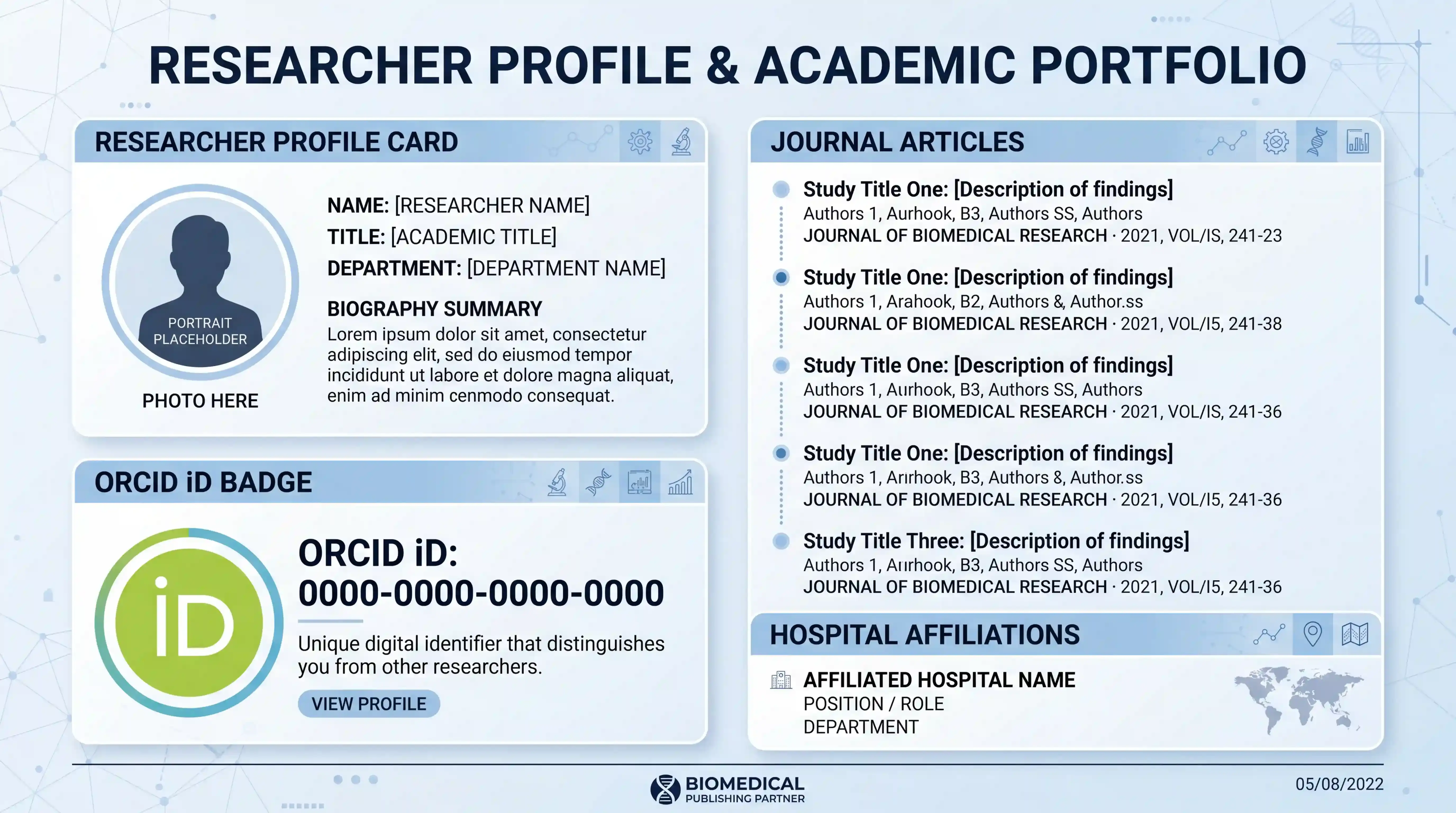
ORCID stands for Open Researcher and Contributor ID. It is a unique digital identifier that distinguishes one researcher from another. Unlike a name, it does not change when you move institutions, change your surname, or publish in different journals.
This matters because academic publishing is global and fragmented. A single researcher may appear under different name formats across databases, journals, and grant systems. ORCID helps solve that problem by creating one consistent profile.
1.2 Why clinicians and researchers should care
For medical professionals, the value is practical. You may publish case reports, clinical studies, conference abstracts, or systematic reviews. You may also work across departments or institutions. ORCID makes it easier to link all of that work to one identity.
It is especially useful when:
- submitting manuscripts
- applying for research funding
- adding publications to institutional systems
- tracking coauthor contributions
- managing your academic profile across platforms
A complete ORCID record supports recognition, transparency, and long-term research visibility.
2. How ORCID Supports Your Academic Identity
2.1 It reduces confusion in publication records
Academic databases do not always identify authors accurately. Two researchers can share a name. One researcher can also appear in multiple formats, such as initials, full names, or transliterated versions. This creates errors in citation tracking and profile matching.
ORCID provides a stable link between your identity and your work. Once connected, it can help journals and institutions import your information consistently. That improves discoverability and reduces manual corrections.
2.2 It strengthens trust and professionalism
In academic publishing, identity verification matters. A clear ORCID record signals that you are a real, traceable contributor. It also supports transparent authorship, which is important in medicine and biomedical research.
You should register using English information. Use the English spelling from your passport or official documents when possible. This helps international systems read your name consistently. For global platforms, this is the most reliable approach.
3. How to Create and Use ORCID Correctly
3.1 Registration steps
Setting up ORCID is straightforward. You only need a few minutes.
- Go to the ORCID registration page.
- Enter your name and email address.
- Create a password.
- Complete the basic profile fields.
- Verify your email.
- Copy your ORCID iD into journal, grant, and institutional profiles.
Use accurate English information during registration. Your profile should match your official academic and identity documents as closely as possible. That reduces confusion later.
3.2 What information to include
A strong ORCID profile is not just an ID number. It is a professional record. You can add:
- education history
- employment history
- publications
- peer review activity
- grants and funding
- keywords and research interests
You do not need to add everything at once. Start with the essentials. Then update the record as your career grows.
3.3 Best practices for maintenance
A useful ORCID profile must stay current. Review it regularly, especially after:
- a new publication
- an institutional move
- a name change
- a grant award
- a completed review activity
The most common mistake is registering once and never updating the record. A neglected profile weakens the benefit of having one.
4. ORCID in Medical Publishing and Research Workflows
4.1 Manuscript submission and journal systems
Many journals now ask for ORCID during submission. This is common in biomedical publishing because it helps editors and indexing systems match the correct author to the correct paper. It can also reduce delays during submission.
In practice, ORCID helps with:
- author disambiguation
- metadata accuracy
- manuscript tracking
- integration with publisher systems
If a journal requests unusual personal data, be cautious. In most academic submission systems, you typically only need your name, affiliation, and email. A request for sensitive personal information beyond standard academic details should be reviewed carefully.
4.2 Research tools and institutional platforms
ORCID is increasingly used across universities, hospitals, and research platforms. It can connect your work across systems and reduce duplicate data entry. For busy clinicians and researchers, that saves time and improves record consistency.
It also supports collaboration. When coauthors share verified identities, it becomes easier to build transparent research histories and attribute contributions correctly.
5. Common Mistakes to Avoid
5.1 Using inconsistent name formats
Do not register one way and publish another without linking the records. Use one consistent English name format. If your publications vary, make sure they are all connected to the same ORCID iD.
5.2 Leaving the profile incomplete
A blank ORCID record is not useful. At minimum, add your name, affiliation, and key outputs. The value comes from the connection between your identity and your work.
5.3 Sharing sensitive information unnecessarily
ORCID is designed for research identity, not for collecting unnecessary personal data. In scholarly workflows, you generally do not need to provide sensitive IDs such as national identification numbers. Only share what is required by a trusted, legitimate system.
6. How SciFocus.ai Can Help You Manage Academic Identity
6.1 Reduce time spent on repetitive academic tasks
For researchers preparing an essay or manuscript, the hardest part is often not writing alone. It is organizing references, structuring arguments, and keeping profiles, submissions, and outputs aligned. This is where a platform like SciFocus.ai can help.
It can support your workflow by helping you organize research materials, refine academic writing, and keep your content process more efficient. For medical students and clinicians, that means less time spent on manual drafting and more time on analysis.
6.2 Build a cleaner path from draft to publication
A strong academic identity is not only about ORCID. It is also about how you present your work. SciFocus.ai can help you move from rough notes to structured academic writing faster, which is useful when preparing an essay, abstract, or paper draft.
When your writing process is organized, your publication process becomes easier to manage. Pairing ORCID with a research writing tool like SciFocus.ai gives you a more complete academic workflow.
Conclusion
ORCID is a simple but powerful tool for academic identity. It helps medical students, doctors, and researchers connect their work to one stable identifier. That improves visibility, accuracy, and trust across journals, grants, and institutional systems. If you want your academic record to be clear and discoverable, start with ORCID and keep it updated. For a smoother writing and publishing workflow, explore how SciFocus.ai can support your next academic essay, manuscript, or research project.
Did you like this article? Explore a few more related posts.
Start Your Research Journey With Scifocus Today
Create your free Scifocus account today and take your research to the next level. Experience the difference firsthand—your journey to academic excellence starts here.