

What Is a Data Management Plan and Why Do You Need One
Introduction
A data management plan is not paperwork for compliance alone. It is the structure that keeps a clinical or research study accurate, traceable, and usable. Without one, data can be incomplete, inconsistent, or impossible to analyze. For medical students, doctors, and researchers, that creates delays and weakens evidence. A strong data management plan protects data quality from collection to final analysis.
1. What a Data Management Plan Actually Is
1.1 A roadmap for handling research data
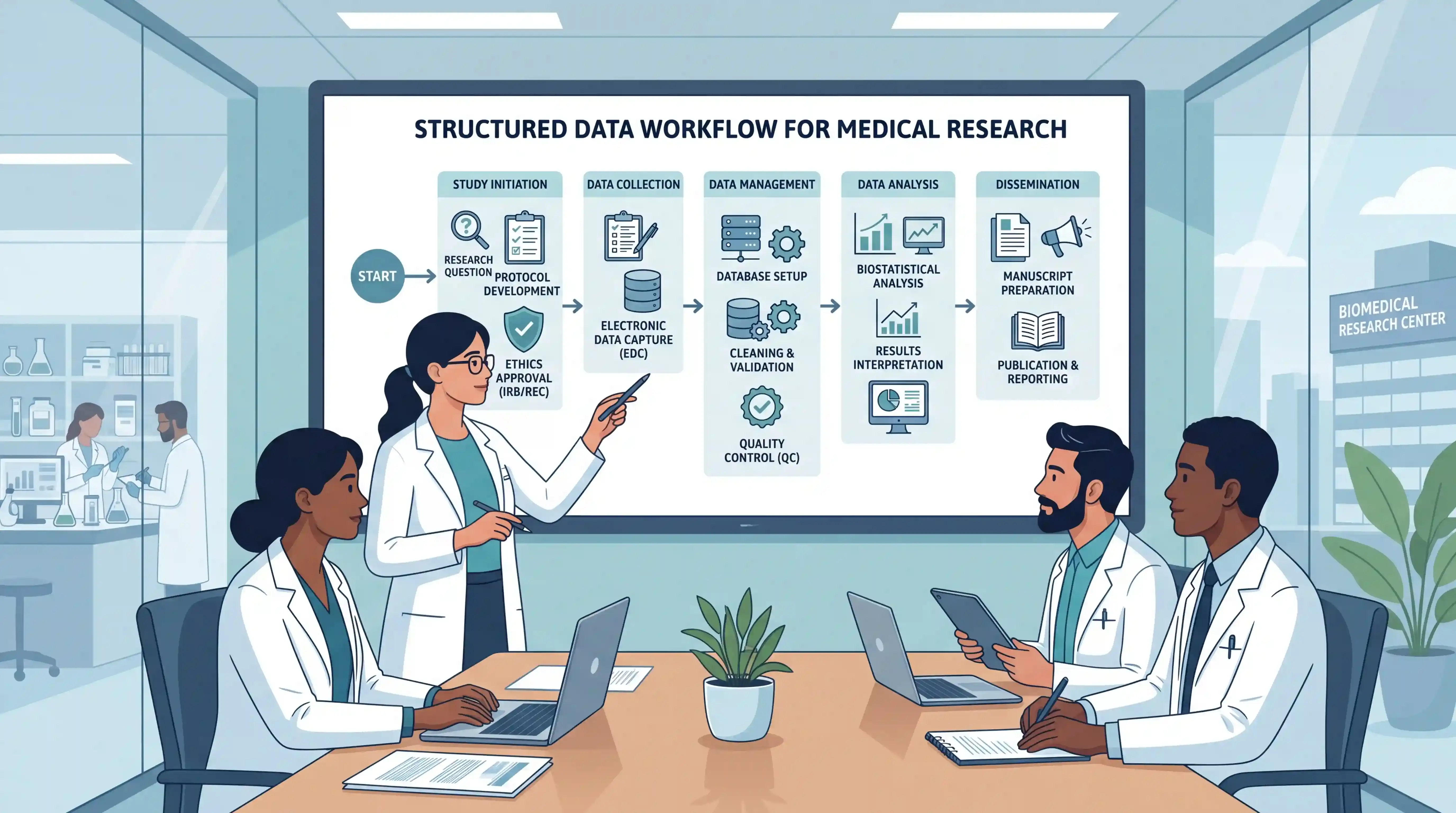
A data management plan is a document that defines how study data will be collected, stored, cleaned, checked, and locked for analysis. In clinical research, it should be created early, ideally during study design. That is because statistical analysis depends on the quality of the underlying data.
In practice, the plan answers key questions. What variables will be collected? Who will enter the data? How will missing values be handled? What checks will confirm consistency? If these steps are not planned in advance, the database often becomes difficult to trust.
1.2 Why a plan is different from a raw hospital system
An electronic medical record or HIS system is a database, but it is not automatically a research database. It contains raw clinical information, not a structured dataset ready for analysis. A research database requires top-level design, defined variables, and clear operational rules.
This distinction matters for retrospective and prospective studies alike. A usable research database should allow direct export, clean variable definitions, and reliable cross-checking. That is why a data management plan is not optional. It turns raw records into analyzable evidence.
2. Why You Need One in Clinical Research
2.1 Data quality determines research quality
Clinical research follows a simple rule: garbage in, garbage out. If the original data are inaccurate, the final paper will not be strong, even if the statistical method is advanced. Good analysis cannot rescue poor data.
A data management plan reduces that risk by standardizing collection and entry. It supports range checks, logic checks, and consistency checks. It also helps teams confirm that database entries match source documents. These steps are essential before statistical analysis begins.
2.2 It supports retrospective and prospective studies
For young doctors and early-stage researchers, retrospective studies are often the best starting point. They are easier to launch, but they still require a structured database. At minimum, a follow-up database should be built for the target disease or patient group.
A well-designed plan also prepares the team for future prospective work. Observational data can help summarize outcomes, compare treatment patterns across centers, and generate hypotheses for randomized trials. In some fields, high-quality observational databases have even supported publications in top journals. The database is not just storage. It is a research asset.
2.3 It improves value beyond a single project
A strong plan can also support biomaterials and long-term follow-up. If tissue, blood, or other biospecimens are collected with proper ethics approval and informed consent, the database becomes more valuable. It can bridge clinical research and translational research.
That added value matters in medicine. A database with pathology, follow-up, and molecular data can support more than one paper. It can support new questions later, especially when disease course, biomarkers, and outcomes are linked in one system.
3. What Should Be Included in the Plan
3.1 Define variables before collection starts
The first step is to decide what data you actually need. Variables should be selected based on the research question, not convenience. In clinical studies, that usually includes demographics, diagnosis, treatment details, outcomes, and follow-up variables.
The definitions must be clear and operational. For example, if a variable is binary, continuous, or ordinal, that should be stated in advance. Closed-ended questions are often easier to manage than vague free-text fields. Clear variable definitions reduce ambiguity and improve consistency.
3.2 Build the CRF and choose the database tool
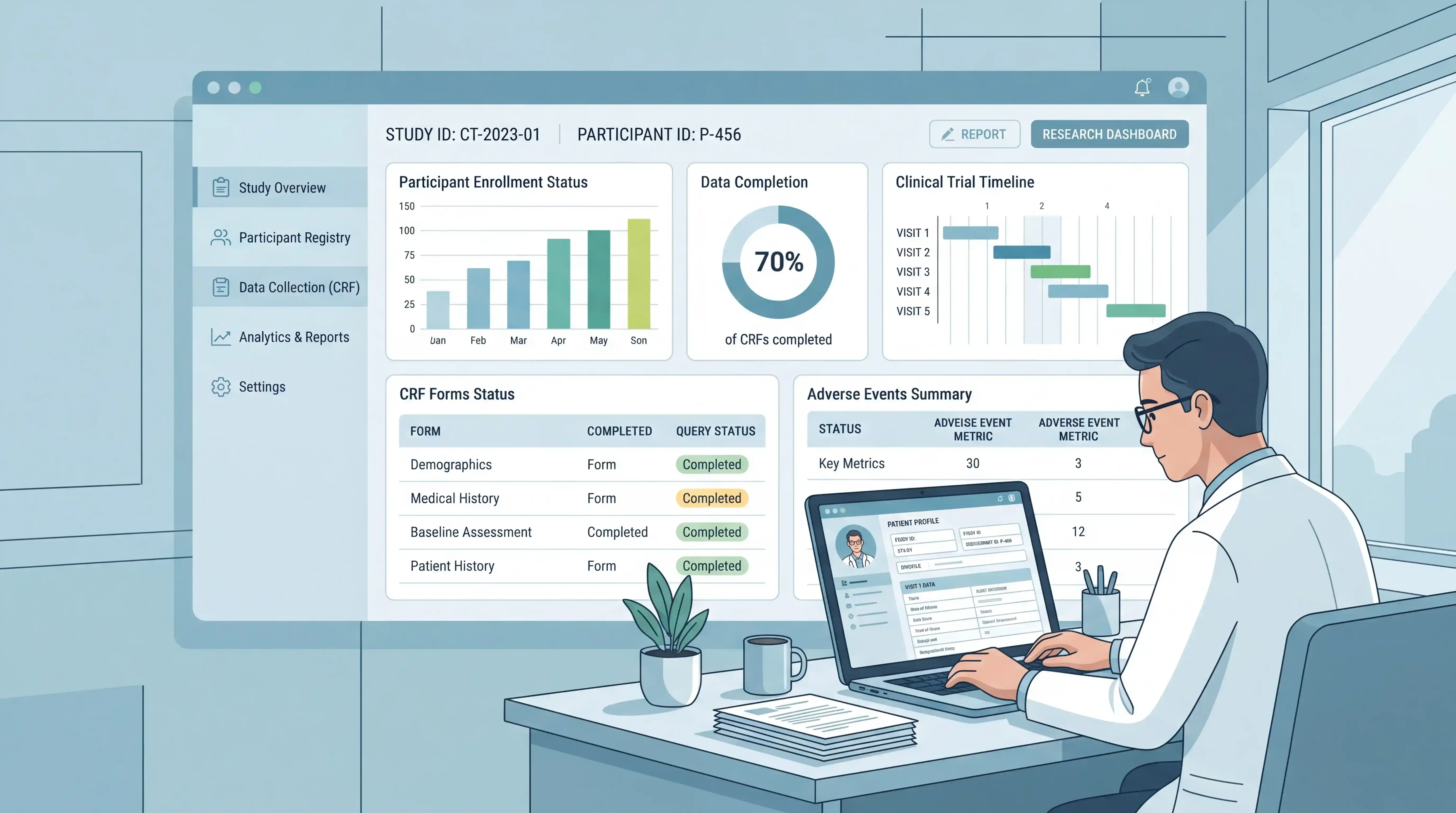
A case report form, or CRF, is the practical tool used to collect study data. Once the CRF is ready, data can be transferred into a database. For many projects, Excel is the simplest option. More advanced projects may use Access, SQL, or an EDC system.
The important point is not the software itself. It is whether the system supports accurate and efficient data handling. A useful plan should define:
- data source,
- field names,
- entry rules,
- missing data handling,
- review workflow,
- data lock procedure.
3.3 Include ethics and consent requirements
Ethics cannot be an afterthought. If patient samples are collected, informed consent is usually required, along with ethics committee approval. The same applies when data are used for research beyond routine care, depending on local rules and study design.
This is especially important in medical research. A compliant database is not only scientifically sound. It is also legally and ethically defensible. Good data management includes protection of patient rights.
4. How to Manage Data Well After Collection
4.1 Use structured checks and double entry
Data collection is only the first step. After entry, the database should go through quality control. Common methods include double entry, range checks, and logic checks. If a value falls outside the expected range, it must be reviewed against the source record.
Consistency is equally important. For example, a surgery date should not appear before the diagnosis date. These are basic but necessary checks. They reduce errors before analysis and save time later.
4.2 Keep the original records and lock the final dataset
A good data management plan requires traceability. The study team should be able to track every key field back to the source record. That is how errors are found and corrected responsibly.
Before analysis, the dataset should be locked. Locking means the final version is fixed and approved for statistical work. This prevents accidental changes after analysis starts. In clinical research, that final version must be stable, documented, and reproducible.
4.3 Make the system practical for real teams
In real departments, research is often done alongside clinical work. That means the plan must be realistic. It should fit the workflow of doctors, assistants, and data managers. If the system is too complex, data entry quality drops.
Simple tools can work well if they are used consistently. But for larger datasets, a more structured platform is safer. The best plan is the one your team can actually follow every day.
5. Why Medical Researchers Should Care Now
5.1 Better data leads to stronger conclusions
For medical students, doctors, and researchers, the value of a data management plan is practical. It makes data easier to trust, compare, and analyze. It also improves the chances that a study can be replicated or extended later.
This is especially important in observational research, where the database itself is often the foundation of the paper. A weak database limits the study. A strong one creates options. That is why experienced teams treat data design as part of research design, not as an afterthought.
5.2 Scifocus.ai can help streamline the process
If your team struggles with organizing clinical research data, scifocus.ai can help support a more efficient workflow. It can help researchers structure tasks, manage writing, and keep study materials organized more clearly. For teams balancing patient care and research, that kind of support matters.
A tool like Helix can also help reduce friction in the research process by making the workflow more organized from draft to output. When the process is clearer, the study is easier to execute, review, and complete. That is exactly where modern research support tools can make a difference.
Conclusion
A data management plan is essential for any serious clinical or research project. It defines what data to collect, how to collect it, how to check it, and when to lock it for analysis. For medical students, doctors, and researchers, that means better quality, better compliance, and better science. If you want your study to be credible, your data management plan must come first.
If you are building a clinical study workflow and want to reduce manual friction, consider using scifocus.ai to support your research process from planning to writing. A well-organized system makes it easier to produce reliable evidence and move your project forward.
Did you like this article? Explore a few more related posts.
Start Your Research Journey With Scifocus Today
Create your free Scifocus account today and take your research to the next level. Experience the difference firsthand—your journey to academic excellence starts here.