

Introduction
Blinding is one of the most important tools in a randomized controlled trial, yet it is often misunderstood or poorly reported. What is blinding in clinical trials? It is a method used to keep treatment allocation hidden from participants, investigators, outcome assessors, and sometimes statisticians until the study is complete. When blinding is weak, bias can inflate results and weaken trust in the findings. For medical students, clinicians, and researchers, understanding blinding is essential for reading, designing, and appraising an essay on clinical research.
1. The Meaning and Purpose of Blinding
1.1 What blinding means in practice
Blinding is a confidentiality measure during treatment and follow-up. The goal is simple. The people involved in the trial do not know which treatment the participant received. In the source material, this includes the participant, the doctor, the data collector, the evaluator, and the statistician before final unblinding.
This is especially important in randomized controlled trials. In other study designs, blinding is rarely used in the same way. A well-blinded trial reduces the chance that expectations influence care, reporting, or analysis.
Blinding is often used together with placebo control. The placebo helps preserve masking and reduces the placebo effect when estimating the true effect of the intervention.
1.2 Why blinding matters
The main reason for blinding is to reduce bias. If people know which treatment was given, they may unconsciously judge symptoms differently, give different care, or interpret outcomes in a biased way.
This matters most when outcomes are subjective. Pain scores, itching, fatigue, and quality-of-life measures are vulnerable to expectation effects. For objective outcomes, blinding still helps. It protects the integrity of the dataset and the final analysis.
Evidence from the source notes that trials without double blinding may overestimate treatment effects, in some cases by up to 17%. That is why experts recommend blinding whenever it is feasible.
2. Types of Blinding in Clinical Trials
2.1 Single-blinded and double-blinded designs
In clinical research, it is better to state exactly who is blinded rather than use vague terms. Instead of saying “single blinded” or “double blinded,” describe whether the participant, investigator, outcome assessor, or statistician was blinded.
A single-blinded trial usually means one key party is unaware of the allocation. A double-blinded trial means two parties are unaware. However, the terminology can be imprecise. Clear reporting is more important than labels.
For example:
- Participant-blinded.
- Investigator-blinded.
- Outcome assessor-blinded.
- Statistician-blinded.
This approach is cleaner and more consistent with good reporting practice.
2.2 When double-dummy blinding is needed
Some comparisons cannot be masked with only one placebo. This often happens when the study compares two active drugs or an active drug against standard treatment.
If both groups need to receive two treatments to preserve blinding, a double-dummy design is used. One group receives the experimental drug plus the placebo for the control drug. The other group receives the control drug plus the placebo for the experimental drug.
Double-dummy blinding is especially useful when the treatments differ in appearance, taste, or dosing schedule. It helps keep both participants and researchers unaware of allocation.
2.3 Placebo-controlled trials and masking
Placebo control and blinding often go together. A placebo makes it easier to conceal treatment allocation and separate the real pharmacologic effect from the placebo effect.
However, placebo use is not always appropriate. The source material notes that active-controlled trials are now often preferred when placebo control would be unfair or ethically difficult. In such cases, blinding may still be possible, but the design must be planned carefully.
3. Blinding, Allocation Concealment, and Trial Integrity
3.1 Blinding is not the same as allocation concealment
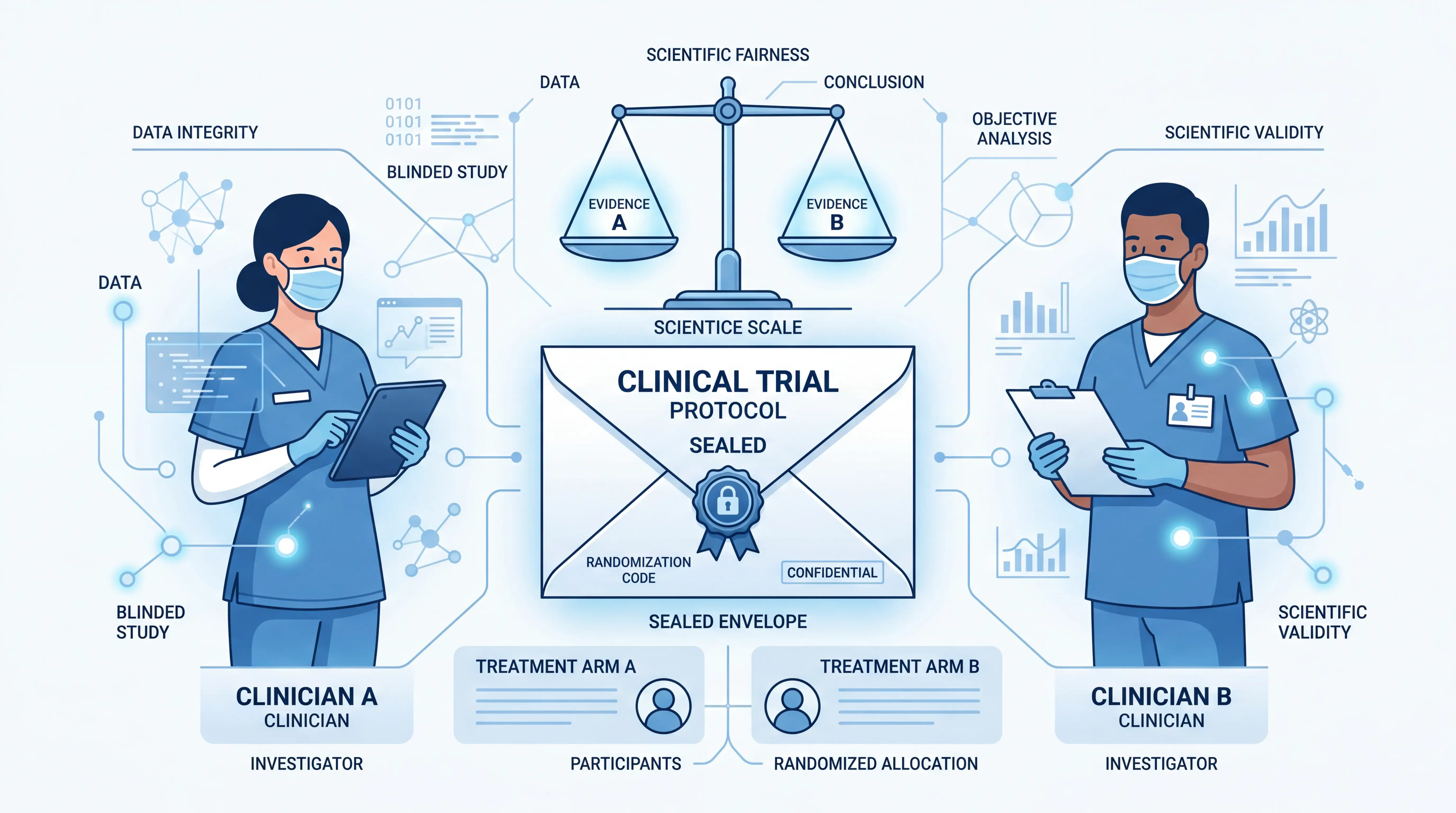
These two concepts are related but not identical. Allocation concealment protects the randomization process before assignment. Blinding protects the trial after assignment.
If allocation concealment fails, blinding may also be compromised. But one does not replace the other. Good randomization does not automatically mean good blinding.
Researchers should treat them as separate safeguards. Both are necessary to minimize bias in a rigorous RCT.
3.2 When blinding cannot be done
Some studies cannot be blinded. Surgery, certain behavioral interventions, and complex care pathways may make masking impossible. In these cases, the trial should not pretend otherwise.
Instead, researchers should use other bias-control measures:
- Blind the outcome assessor.
- Blind the statistician.
- Use objective endpoints when possible.
- Standardize follow-up and data collection.
- Predefine analysis methods.
If blinding is partly possible, do it. If full blinding is impossible, partial blinding is still valuable. The source material is clear: if double blinding is not possible, use single blinding; if even that is impossible, blind the data or analysis team whenever feasible.
4. How Blinding Is Implemented Across the Trial
4.1 Blinding must run through the full study
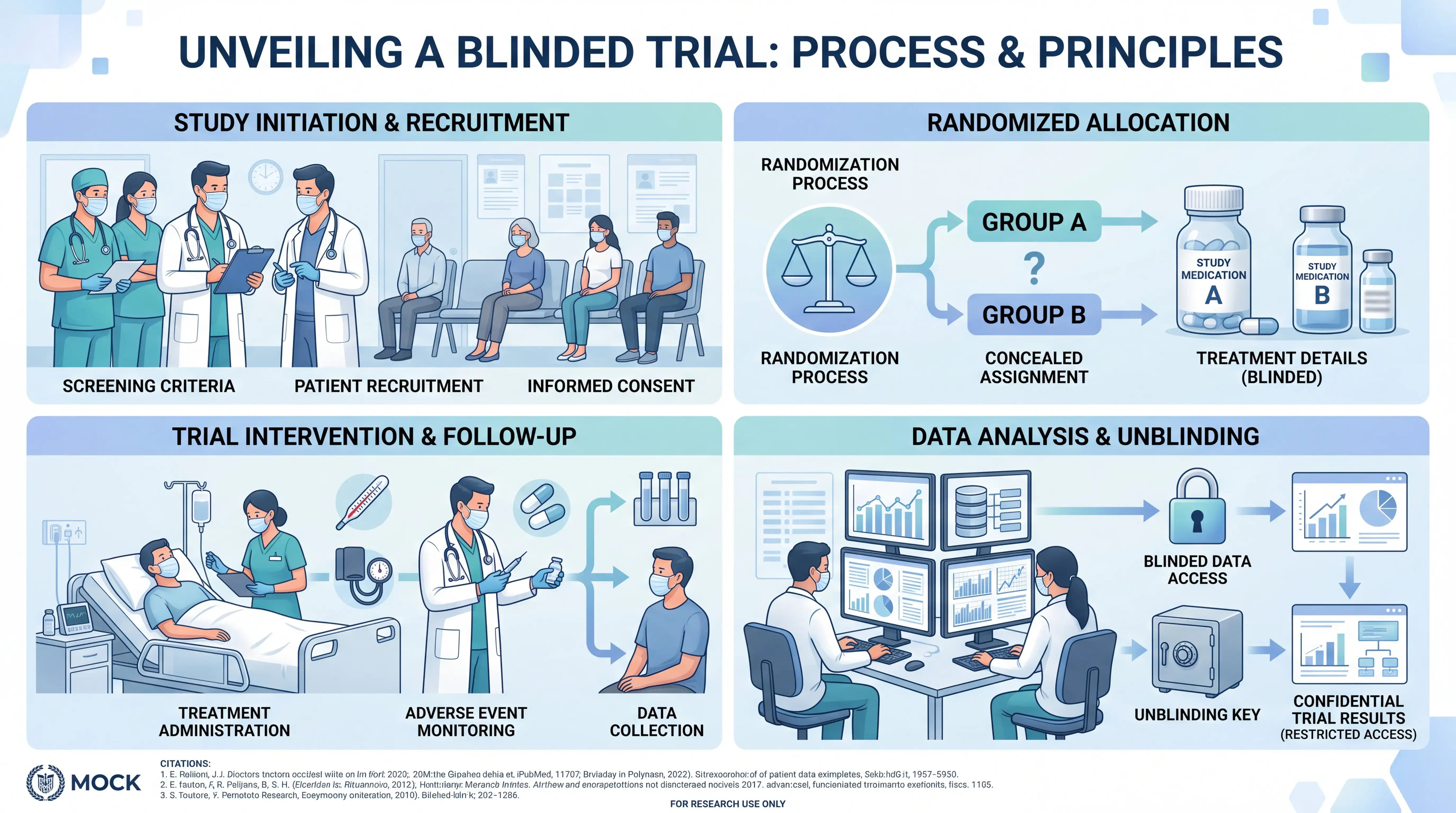
Blinding should not be treated as a one-time step. It should begin with random sequence generation and continue through allocation concealment, packaging, coding, participant enrollment, outcome collection, monitoring, data management, and statistical analysis.
The trial should remain blinded until the planned unblinding point. If the blind is broken early, the study may lose validity.
A leak in the blind can undermine the credibility of the entire trial. That is why blinding procedures must be documented and protected from the start.
4.2 Typical operational steps
In practice, a well-organized blinded RCT may include the following steps:
- Generate the random sequence.
- Create treatment codes.
- Prepare identically labeled study drugs or placebos.
- Package and number the materials.
- Store the blind code securely.
- Prepare emergency envelopes or emergency unblinding procedures.
- Enroll participants according to the allocation plan.
- Keep investigators and assessors blinded during follow-up.
- Lock the database before unblinding.
- Unblind only after analysis is ready or when emergency unblinding is justified.
These steps may sound technical, but they are the backbone of credible clinical evidence.
4.3 Emergency unblinding
Sometimes urgent clinical reasons require unblinding. For example, a serious adverse event may make treatment identity medically relevant.
This should never be casual. The source material emphasizes that emergency unblinding needs clear rules. It should be limited, documented, and triggered only when necessary. Otherwise, the trial’s internal validity may be damaged.
5. Common Mistakes in Blinding
5.1 Using vague language
A frequent problem in manuscripts is saying “double blinded” without explaining who was blinded. This makes the study harder to evaluate.
Better reporting is specific. State exactly who remained unaware and at what stage. This improves transparency and reader trust.
5.2 Ignoring subjective outcomes
Some researchers assume blinding is optional if the endpoint is simple. That is not always true. Subjective outcomes are often more sensitive to bias, so masking becomes more important, not less.
Pain ratings, symptom scores, and clinician judgment can all be affected by expectations. The more subjective the endpoint, the greater the need for blinding.
5.3 Failing to protect the blind
A blinded trial can still fail if the blind is broken by poor packaging, visible side effects, inconsistent dosing, or careless communication.
That is why the appearance, labeling, and handling of study products matter. The entire team must know how to preserve masking.
6. How to Report Blinding in a Clinical Research Essay
6.1 What strong reporting should include
If you are writing an essay, article, or protocol, do not stop at “the study was blinded.” Add detail. Good reporting should specify:
- Who was blinded.
- How blinding was maintained.
- Whether placebo or double-dummy methods were used.
- When unblinding occurred.
- What happened if emergency unblinding was needed.
This level of detail reflects stronger methodology and better scientific writing.
6.2 Why reporting quality affects trust
Readers and reviewers judge trial quality partly by how clearly blinding is described. Poor reporting can make a strong study look weak. Good reporting does the opposite.
For medical students and researchers, this is an important lesson. Methodological clarity is not decoration. It is part of the evidence.
If you are preparing a manuscript or an academic essay, tools such as scifocus.ai can help you organize research notes, refine structure, and improve clarity while keeping the content focused on the trial methods that matter.
Conclusion
Blinding is a core safeguard in randomized clinical trials. It protects against expectation bias, improves the reliability of subjective and objective outcomes, and strengthens the scientific value of the study. When feasible, blinding should be built into the trial from randomization to final analysis. When full blinding is impossible, partial blinding and other bias-control methods should still be used.
For clinicians, researchers, and students, the key is not only to understand what blinding is, but also to report it precisely and implement it correctly. If you want to write faster and produce a more structured medical essay, scifocus.ai can support your workflow from outline to polished draft.
Did you like this article? Explore a few more related posts.
Start Your Research Journey With Scifocus Today
Create your free Scifocus account today and take your research to the next level. Experience the difference firsthand—your journey to academic excellence starts here.