

What Is a Meta-Analysis in Research
Introduction
A meta-analysis in research helps solve a common problem for medical students, doctors, and researchers. Many studies answer the same question, but their results do not always match. That is why understanding a meta-analysis in research is essential when you need stronger evidence for clinical or academic decisions. In this article, you will learn what it is, when to use it, how it differs from a systematic review, and why it matters in evidence-based medicine.
1. What a Meta-Analysis Means
1.1 A statistical method, not just a summary
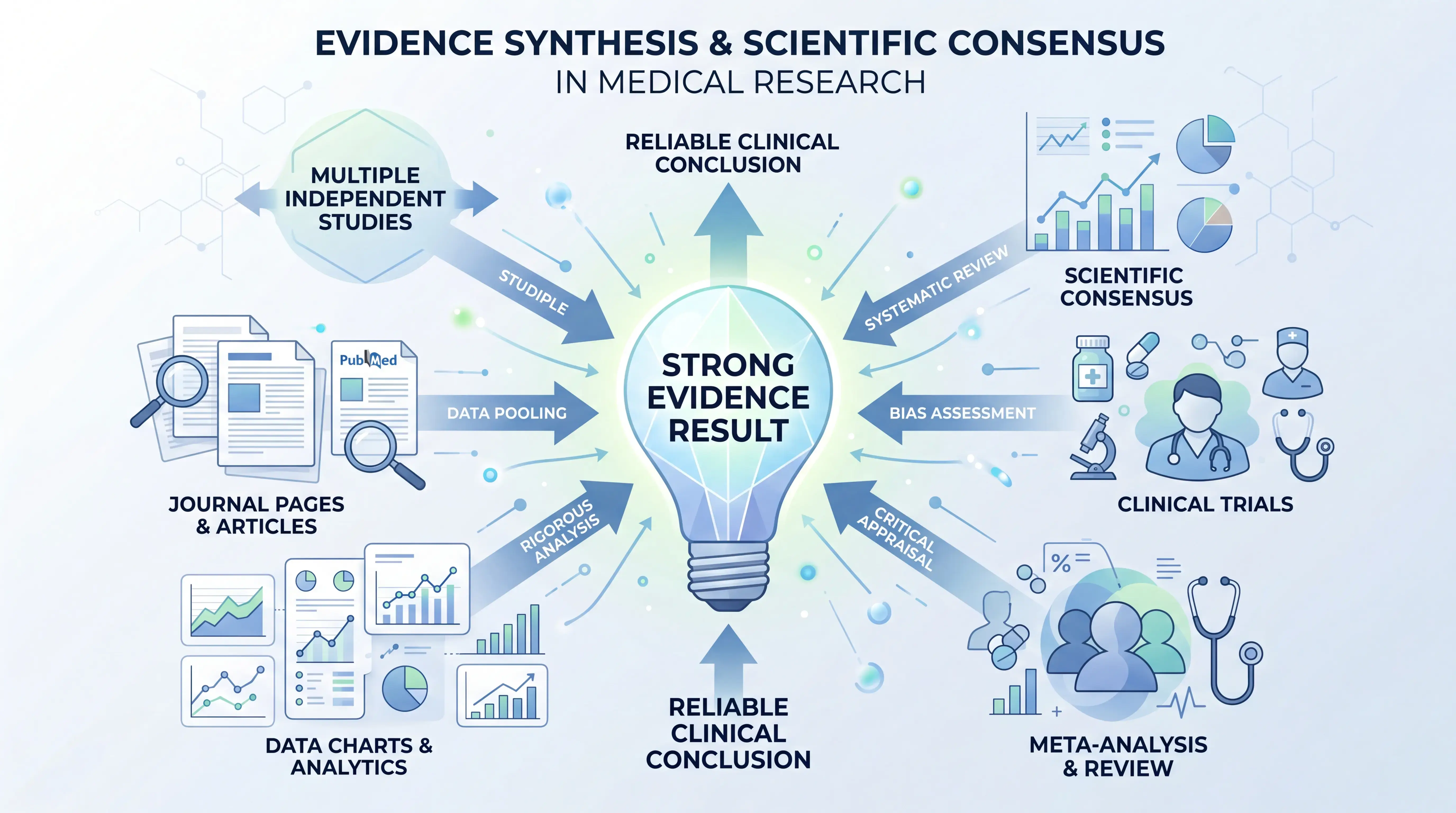
A meta-analysis is a statistical method that combines the results of multiple studies on the same topic. These studies must meet specific conditions and be sufficiently similar. The goal is not simply to list findings. The goal is to pool data and produce a more precise estimate of effect.
In clinical research, this matters because individual studies may be small, underpowered, or even contradictory. A meta-analysis in research increases sample size and improves statistical power. That makes it useful when single studies cannot provide a clear answer.
In evidence-based medicine, meta-analysis sits near the top of the evidence hierarchy. It is widely used because it can reduce uncertainty and support decision-making with stronger quantitative evidence.
1.2 Why researchers rely on it
Researchers use meta-analysis when the same clinical question has been studied several times. If one trial shows benefit and another shows no effect, the combined evidence can be more informative than either study alone.
The first medical meta-analysis was published in 1904. The method became more common after 2000. Today, it remains a core tool in medicine, but the main challenge is no longer technique alone. It is topic selection. A weak or trivial question will not produce useful evidence, even with advanced analysis.
2. Meta-Analysis vs. Systematic Review
2.1 They are related, but not identical
A systematic review and a meta-analysis are often mentioned together, but they are not the same thing. A systematic review is a structured method for finding, selecting, and appraising studies on a question. It does not always include statistical pooling.
A meta-analysis, by contrast, is the quantitative part. It is performed only when the included studies are similar enough to combine. In other words, a systematic review can exist without a meta-analysis, but a meta-analysis is a statistical technique that may be part of a broader review.
2.2 When pooling is appropriate
If studies are too heterogeneous, combining them may be inappropriate. In that case, the review becomes descriptive or qualitative. This is common when interventions, outcomes, populations, or study designs differ too much.
For clinicians and researchers, this distinction is important. A pooled estimate is only meaningful when the studies are sufficiently comparable. Otherwise, the result may be misleading.
2.3 Quantitative and qualitative reviews
When the studies are homogeneous, the review can be quantitative. When heterogeneity is high, the analysis is often qualitative. This is why careful screening and methodological judgment are essential before any data are merged.
3. Common Types of Meta-Analysis
3.1 Clinical research uses several forms
Meta-analysis is not limited to one data type. In practice, there are several common forms:
- Continuous data meta-analysis
- Dichotomous data meta-analysis
- Diagnostic test accuracy meta-analysis
- Proportion meta-analysis
- Survival data meta-analysis
- Dose-response meta-analysis
- Network meta-analysis
- Adverse event meta-analysis
- Cost-effectiveness meta-analysis
Among these, continuous and dichotomous data analyses are the most common and the most basic. They are often the starting point for beginners in evidence synthesis.
3.2 Choosing the right type matters
The effect measure depends on the study design and outcome. For continuous outcomes, researchers often use weighted mean difference or standardized mean difference. If the units are the same across studies, weighted mean difference is suitable. If the measurement scales differ, standardized mean difference is more appropriate.
For binary outcomes, common measures include odds ratio, relative risk, and hazard ratio. Odds ratio is often used in case-control studies. Relative risk is more common in cohort studies. Hazard ratio is used in survival analysis.
Using the wrong effect measure can distort interpretation. That is why method selection is not a minor detail. It is a core scientific decision.
4. How a Meta-Analysis Is Done
4.1 The usual workflow
A meta-analysis in research usually follows a fixed sequence:
- Define a focused question.
- Search databases such as PubMed and Embase.
- Screen studies using inclusion and exclusion criteria.
- Assess study quality.
- Extract data.
- Pool the results.
- Test for heterogeneity.
- Check sensitivity.
- Assess publication bias.
- Write and report the findings.
This process is structured, but topic choice remains the most important step. A good topic should have clinical relevance, uncertainty, and practical value. If the answer is already settled, a new meta-analysis adds little. If no new studies have appeared in recent years, an “update” may also be unnecessary.
4.2 What researchers extract from studies
Data extraction depends on the outcome type. For continuous data, researchers collect means and standard deviations. For binary outcomes, they collect event counts and sample sizes. For survival outcomes, they may extract hazard ratios.
Software such as RevMan and Stata is commonly used for analysis. But software does not replace methodological judgment. The researcher still needs to decide whether the studies are comparable and whether the pooled estimate is credible.
4.3 Quality control before pooling
Before combining results, researchers should evaluate risk of bias and study quality. This step is essential because low-quality studies can weaken the final estimate. Heterogeneity should also be examined. If the studies differ too much, the pooled result may not be reliable.
Sensitivity analysis helps identify whether one study changes the overall conclusion. Publication bias is another important issue, because positive studies are more likely to be published than negative ones.
5. Why Meta-Analysis Matters in Medicine
5.1 Better evidence for clinical decisions
For doctors and medical students, the main value of meta-analysis is practical. It can help answer questions about treatment effectiveness, diagnostic accuracy, prognosis, and safety. It can also clarify where evidence is uncertain.
A well-done meta-analysis can support guidelines, inform treatment choices, and identify gaps for future research. This is especially valuable in fields where single studies are small or inconsistent.
5.2 A tool for evidence-based medicine
Meta-analysis is central to evidence-based medicine because it integrates multiple findings into one quantitative estimate. That makes it easier to interpret the overall direction of evidence.
Still, it is not a magic answer. A meta-analysis is only as strong as the studies it includes. If the underlying studies are biased, the pooled result can still be flawed. This is why transparent methods and careful interpretation are non-negotiable.
5.3 What makes a topic worth studying
Strong topics usually meet one or more of these criteria:
- They have clear clinical importance.
- The literature is inconsistent.
- The question is still uncertain.
- The problem is urgent in practice.
- New data have appeared since the last review.
These criteria help researchers choose topics that can truly contribute to the field. In modern research, choosing the right question is often more important than running the analysis itself.
6. Practical Challenges and Research Strategy
6.1 Heterogeneity is the biggest obstacle
The most common barrier in meta-analysis is heterogeneity. When studies use different populations, interventions, outcome definitions, or follow-up periods, the results may not be comparable. In such cases, forcing a pooled estimate can weaken the conclusion.
A careful researcher should first ask whether the studies are similar enough to justify combination. If not, a narrative synthesis may be more appropriate than a statistical one.
6.2 Why topic selection is critical
Many researchers focus too much on software and too little on the research question. But topic selection decides whether the project has value. A narrow, clinically relevant, and unresolved question is far more useful than a broad topic with weak evidence.
That is why experienced researchers spend substantial time on search planning, study selection, and protocol design before analysis begins.
6.3 How scifocus.ai can help
For researchers who want to work faster without losing rigor, scifocus.ai can support the early stages of the process. It can help organize research ideas, structure literature work, and reduce repetitive tasks during essay and manuscript preparation. For a busy medical student, doctor, or researcher, that means less time spent on manual drafting and more time spent on critical analysis.
If your goal is to produce a clearer, more efficient, and better-structured essay on evidence synthesis, scifocus.ai can help streamline the workflow.
Conclusion
A meta-analysis in research is a statistical method that combines results from comparable studies to produce stronger evidence. It is different from a systematic review, though the two often work together. It is widely used in medicine because it improves precision, supports evidence-based decisions, and helps resolve conflicting findings.
For medical students, doctors, and researchers, the key takeaway is simple. A good meta-analysis starts with a good question, careful study selection, and honest interpretation of the data. If you are preparing an academic essay, scifocus.ai can help you organize the process and move from idea to structured draft with greater efficiency.

Did you like this article? Explore a few more related posts.
Start Your Research Journey With Scifocus Today
Create your free Scifocus account today and take your research to the next level. Experience the difference firsthand—your journey to academic excellence starts here.