

What Is a Literature Gap?
Introduction
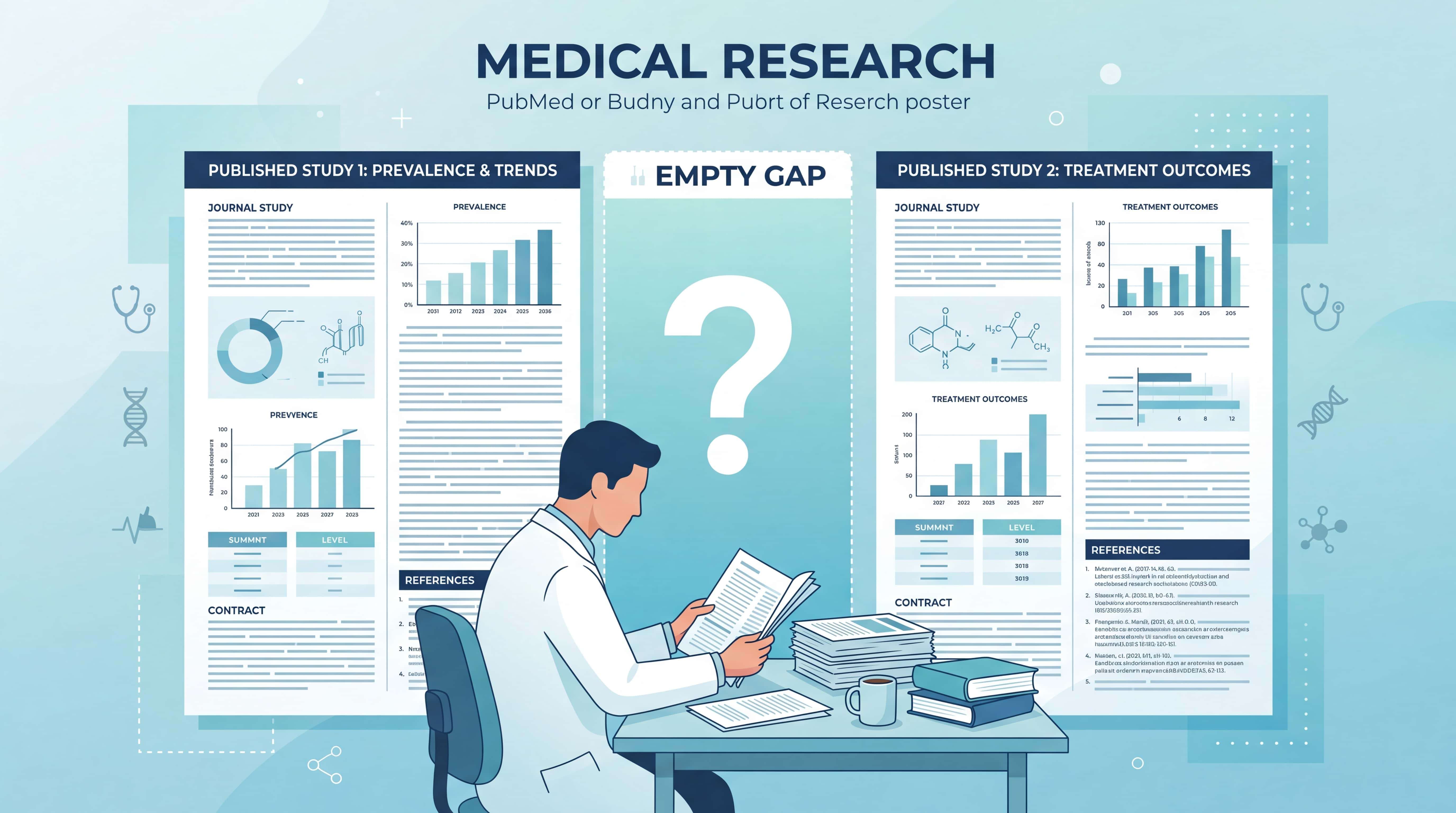
A literature gap is the missing piece in existing research. For medical students, doctors, and researchers, finding that gap is often the hardest part of an essay, review, or research proposal. If the gap is unclear, the whole argument becomes weak. If it is well defined, the study gains purpose, direction, and value. A strong literature gap turns background reading into a focused research question.
1. Understanding the Literature Gap
1.1 What the term means
A literature gap is an area that current studies have not fully explained, tested, or agreed on. It may be a missing population, an unanswered mechanism, a limited method, or conflicting findings. In academic writing, the gap is not just “something new.” It must be a real and defensible absence in the evidence.
For example, a review may show that many studies examine a disease in adults, but few focus on children. That is a population gap. Or several papers may report different outcomes for the same treatment. That is an evidence gap created by disagreement.
A literature gap should be based on what the literature actually shows, not on what the author wishes to claim.
1.2 Why it matters in medical writing
In medicine, the literature gap supports clinical relevance. It helps explain why a study deserves attention. Without it, an essay may read like a summary of articles rather than a scientific argument.
A clear gap also improves the logic of your paper. It connects background, problem, and objective. This is especially important in systematic reviews, narrative reviews, and introductions for original studies. The reader should see why the next step is necessary.
1.3 Common forms of gaps
Literature gaps often appear in several forms:
- Knowledge gap: the mechanism, cause, or relationship is still unclear.
- Methodological gap: studies use weak designs, small samples, or inconsistent measures.
- Population gap: specific groups are underrepresented.
- Evidence gap: results are limited, outdated, or contradictory.
- Practical gap: findings exist, but clinical application is still uncertain.
Each type matters differently. In a medical essay, naming the correct gap makes the analysis more precise and credible.
2. How to Identify a Literature Gap
2.1 Start with a focused search
A gap cannot be identified from one or two papers. It requires a structured reading process. Start with recent reviews, then move to primary studies. Look for repeated limitations, unanswered questions, and areas where authors ask for further research.
Pay close attention to the discussion section. Authors often state what they could not answer. In many medical papers, the limitation is the clearest clue to the gap.
2.2 Compare studies, not just topics
Do not search for a topic alone. Compare designs, outcomes, and populations. Ask:
- Who was studied?
- What method was used?
- Which outcome was measured?
- How long was follow-up?
- Did the results agree?
This comparison helps reveal whether the field lacks data, lacks consistency, or lacks clinical translation. A gap becomes visible when studies fail to answer the same question in a reliable way.
2.3 Use the funnel approach
Academic writing often moves from broad context to a narrow research problem. This is the classic funnel structure. Begin with the larger medical issue, then narrow to a specific question, and finally state the gap.
A useful sequence is:
- State the general problem.
- Summarize what is already known.
- Identify what remains uncertain.
- Explain why the uncertainty matters.
This structure works well in an essay because it keeps the writing logical and readable. It also prevents the introduction from becoming a full literature review.
2.4 Avoid false gaps
Not every unstudied angle is a meaningful gap. A weak gap is too broad, too vague, or already answered by existing literature. Avoid statements such as “few studies have explored this area” unless you can show why that matters and what exactly is missing.
A valid gap should be:
- Specific
- Evidence-based
- Relevant to the research question
- Important for theory or practice
3. How to Write the Literature Gap in an Essay
3.1 Use precise academic language
The literature gap should be written in a way that sounds measured, not exaggerated. Strong academic phrasing includes:
- “However, current evidence remains limited on…”
- “Findings are still inconsistent regarding…”
- “Little is known about…”
- “Previous studies have not adequately addressed…”
- “Existing research has focused mainly on…, while…”
These phrases are useful because they identify the gap without overstating it. In medical writing, restraint is a sign of professionalism.
3.2 Connect the gap to your study aim
A gap alone is not enough. You must show how your essay or study responds to it. The reader should understand the logic from limitation to objective.
For example, if the literature lacks data on outcomes in elderly patients, the next sentence should explain that your work examines that group. If methods are inconsistent, your essay may justify a standardized framework or critical comparison.
The strongest essay does not just describe a gap. It shows how the gap leads directly to a research purpose.
3.3 Keep the gap short and sharp
A literature gap does not need long explanation. One or two well-built paragraphs are often enough. Long passages can dilute the message. For most medical essays, clarity is better than volume.
A practical formula is:
- What is known
- What is not known
- Why it matters
- What your work addresses
This formula keeps the argument focused and easy to follow.
3.4 Example of a gap statement
Here is a simple example in a medical context:
“Although several studies have evaluated treatment outcomes in adult patients, evidence remains limited for older adults with multiple comorbidities. In addition, existing results are inconsistent across study designs. This gap makes it difficult to guide clinical decisions for high-risk populations.”
This statement works because it identifies the gap, shows the problem, and implies the need for further research.
4. Common Mistakes to Avoid
4.1 Treating novelty as a gap
New does not always mean important. An essay should not claim a literature gap just because a topic has fewer publications. The absence of papers may reflect low relevance, not a meaningful scientific problem.
4.2 Using vague language
Avoid phrases like “many studies,” “some research,” or “various issues” without specifics. Vague claims weaken trust. If possible, name the population, variable, outcome, or method involved.
4.3 Ignoring contrary findings
A real literature gap often includes disagreement. If studies show conflicting results, that inconsistency itself is part of the gap. Ignoring it makes the review incomplete.
4.4 Writing a summary instead of a critique
A literature review is not just a list of studies. It must analyze what the studies do not answer. This distinction is essential in essay writing. Summary tells the reader what exists. Critique tells the reader what is missing.
5. Practical Workflow for Medical Students and Researchers
5.1 A simple 5-step method
Use this workflow to identify and write a literature gap efficiently:
- Search recent review articles.
- Extract the main findings and limitations.
- Group studies by population, method, and outcome.
- Note recurring disagreements or exclusions.
- Write one gap statement and link it to your objective.
This approach saves time and reduces guesswork. It also helps when preparing an essay, thesis chapter, or journal manuscript.
5.2 How SciFocus.ai can help
If you often struggle to locate a clear literature gap, scifocus.ai can support the process. It helps organize reading, extract themes, and structure research ideas faster. For medical students and researchers working under time pressure, that means less manual sorting and more time spent on analysis.
Used well, a tool like scifocus.ai can improve the speed and clarity of your writing process. It does not replace expert judgment, but it can make the workflow more efficient and more systematic.
Conclusion

A literature gap is the missing piece that gives academic writing direction. In a medical essay, it shows what research has not yet explained, where evidence is weak, and why the question matters. The best gap statements are specific, evidence-based, and directly linked to the study aim. If you can define the gap clearly, you can write a stronger essay, build a better argument, and design more credible research.
If you want to save time and sharpen your academic workflow, consider scifocus.ai as a practical support tool for organizing literature, identifying gaps, and shaping a focused research direction.
Did you like this article? Explore a few more related posts.
Start Your Research Journey With Scifocus Today
Create your free Scifocus account today and take your research to the next level. Experience the difference firsthand—your journey to academic excellence starts here.