

What Is a Hypothesis in Research?
Introduction
In medical writing, a weak or missing hypothesis can make an entire paper feel unfocused. Many medical students, physicians, and researchers know the data, but still struggle to state the essay of the study clearly. That is a serious problem, because a hypothesis is the core idea that gives a research paper direction, logic, and purpose.
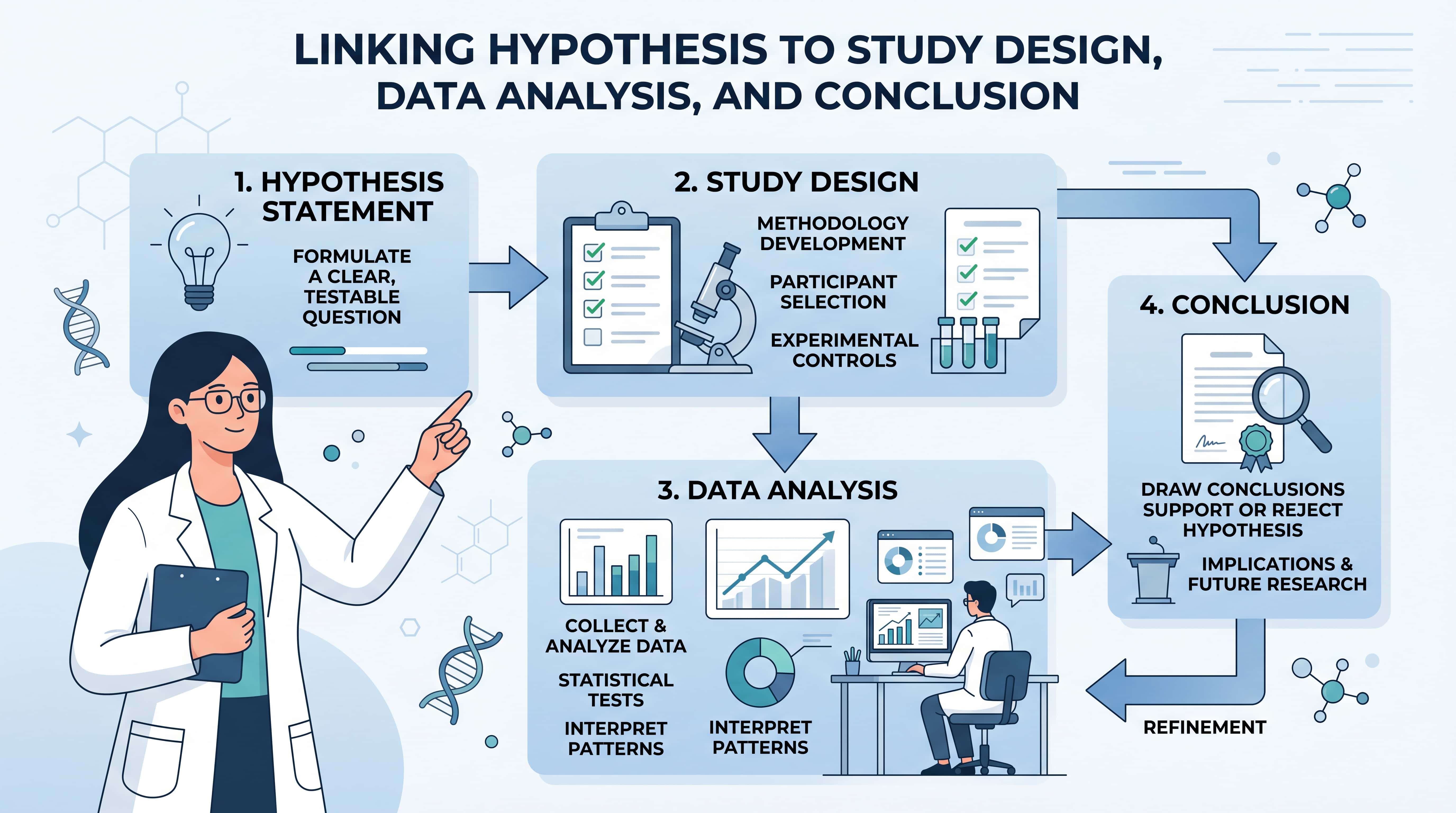
A strong hypothesis helps the reader understand what the study is testing, why it matters, and how the results should be interpreted. In this article, we explain what a hypothesis in research is, why it matters, how to write one, and how to avoid common mistakes.
1. What a Hypothesis Means in Research
1.1 The definition
A hypothesis is a clear, testable statement about a possible relationship, effect, or outcome. In scientific writing, it is not a random guess. It is an educated prediction based on prior knowledge, theory, or observation.
In simple terms, a hypothesis tells the reader what you expect to find. It connects the unknown problem with the experiment or data you use to answer it.
1.2 Why it matters
A research paper without a clear hypothesis often loses its central focus. The manuscript may feel broad, incomplete, or disconnected. This is especially important in clinical and biomedical research, where studies should be hypothesis-driven.
A well-written hypothesis helps you:
- define the exact research question
- choose relevant methods
- keep the results section focused
- avoid adding unrelated data
- interpret findings more clearly
In short, the hypothesis is not decoration. It is the structure that supports the entire paper.
2. Why Hypothesis-Driven Research Is Essential
2.1 It keeps the study focused
A strong hypothesis acts like a guide. It tells you what belongs in the paper and what does not. If a result does not help test the hypothesis, it may not need to be included in the final manuscript.
This is one reason many experienced editors look for a clear hypothesis early in the abstract and introduction. When the hypothesis is visible from the start, the paper becomes easier to read and easier to trust.
2.2 It improves scientific logic
Research is not only about collecting data. It is about answering a defined question. A hypothesis gives the study a logical path:
- identify a knowledge gap
- form a testable prediction
- collect relevant data
- evaluate whether the data support the prediction
- explain the meaning in discussion and conclusion
This sequence is especially important in medical research, where clarity affects both academic quality and clinical relevance.
2.3 It supports better writing
A good hypothesis also improves the writing process. When you keep it in mind, your essay becomes more focused and concise. You are more likely to choose the right literature, write a tighter discussion, and present a cleaner conclusion.
In practice, the hypothesis should appear in the abstract, the introduction, and the discussion or conclusion. These sections should reflect the same central idea.
3. Types of Hypotheses You Can Use
3.1 A hunch
A hunch is an initial idea based on experience or observation. It is not enough by itself, but it can become a hypothesis if it can be tested.
3.2 An educated guess
This is a more developed form of thinking. It is based on evidence, not intuition alone. For example, if earlier studies suggest a biomarker is linked to prognosis, you may hypothesize that the biomarker is associated with survival outcomes.
3.3 A testable prediction
This is the strongest form. A good hypothesis must be testable. You should be able to collect data and determine whether the statement is supported or not.
A useful self-check is simple: If you can place “we tested whether” before the statement, it is probably a valid hypothesis.
4. How to Write a Strong Hypothesis
4.1 Use clear, direct language
A hypothesis should be short and precise. Avoid vague wording. Avoid overloading it with multiple ideas. One central hypothesis is usually better than many scattered ones.
A strong statement often includes:
- the variable or factor being studied
- the expected relationship or effect
- the population or context
For example:
- We hypothesized that collagen XVIII expression correlates with serum endostatin levels in patients with non-small cell lung cancer.
This is clear because it tells the reader exactly what is being tested.
4.2 Use active voice
Modern scientific writing prefers active voice. Write:
- We hypothesize that...
- We tested whether...
- Our hypothesis was that...
Avoid weak passive wording such as:
- It was hypothesized that...
Active voice sounds more direct, more confident, and more transparent.
4.3 Match the tense correctly
A common pattern is:
- use past tense for the act of hypothesizing
- use present tense for the actual scientific statement
For example:
- We hypothesized that X is associated with Y.
This style is common in research writing because the hypothesis is presented as a testable statement, while the act of formulating it happened in the past.
4.4 Keep it testable
A hypothesis must be something your data can answer. A statement about whether a method can be developed is often better written as a research purpose, not a hypothesis.
For example, a better hypothesis should focus on a biological or clinical outcome, such as association, effect, or prediction.
5. Common Mistakes to Avoid
5.1 No hypothesis at all
This is one of the most frequent problems in manuscripts. The paper may describe data, but the reader never sees the main scientific question.
5.2 An unclear hypothesis
Some papers mention a general topic but never give a precise testable statement. That weakens the entire essay.
5.3 Changing the hypothesis during writing
Your hypothesis should stay consistent from start to finish. If it changes in the middle of the manuscript, the paper becomes confusing. The introduction, results, discussion, and conclusion must all align.
5.4 Too many unrelated sub-hypotheses
You can have more than one sub-hypothesis, but they should be closely related. Too many disconnected ideas make the paper harder to follow.
5.5 Non-testable statements
If the statement cannot be tested with data, it is not a strong hypothesis. It may be a goal, a method description, or a project idea, but not a scientific hypothesis.
6. Where the Hypothesis Should Appear in a Paper
6.1 In the introduction
The introduction should move from known information to the knowledge gap, then to the hypothesis. This creates a natural scientific flow.
A practical structure is:
- background
- gap in knowledge
- hypothesis
This is where you explain why the study was needed and what it aims to test.
6.2 In the abstract
The abstract should briefly state the hypothesis or the main question. Readers should understand the study’s logic within the first read.
6.3 In the discussion and conclusion
The discussion should return to the hypothesis and explain whether the results supported it, rejected it, or only partially supported it.
This is important because a good paper closes the loop. The reader should finish the article knowing that the main question has been answered.
7. A Practical Framework for Researchers
7.1 Use this checklist
Before finalizing your paper, ask:
- Is the hypothesis clearly stated?
- Is it testable?
- Is it aligned with the data?
- Is it repeated in the abstract or introduction?
- Does the discussion answer it directly?
- Does the conclusion reflect the result of testing it?
If the answer is yes to these questions, your paper is much stronger.
7.2 A simple writing test
A helpful method is to place “we tested whether” before the sentence. If the sentence still makes sense and can be answered by data, it is likely a good hypothesis.
Example:
- We tested whether circulating tumor cell levels are associated with survival in metastatic breast cancer.
This is clear, specific, and measurable.
8. How SciFocus.ai Can Help
Writing a strong hypothesis takes time, especially when you are balancing clinical work, data analysis, and manuscript deadlines. SciFocus.ai can help you refine your essay, sharpen your hypothesis statement, and keep your manuscript aligned from introduction to conclusion.
For medical students, doctors, and researchers, this means faster drafting, better structure, and fewer revisions. Instead of rewriting the same idea across multiple sections, you can use a focused workflow that keeps your research question clear and your paper consistent.
Conclusion
A hypothesis is more than a sentence. It is the scientific core of your paper. It defines the question, guides the analysis, and shapes how the results should be presented. For medical students, physicians, and researchers, learning how to write a clear hypothesis is essential for producing a strong research essay.
A good hypothesis is specific, testable, consistent, and easy to explain. It should appear early, stay stable throughout the manuscript, and be answered directly in the discussion and conclusion.
If you want to write faster and with more precision, explore SciFocus.ai. It can support your research writing process and help you turn a scattered draft into a focused, publication-ready essay.
Did you like this article? Explore a few more related posts.
Start Your Research Journey With Scifocus Today
Create your free Scifocus account today and take your research to the next level. Experience the difference firsthand—your journey to academic excellence starts here.