

What Is a Citation?
Introduction
In academic writing, a citation is more than a formality. It is the proof behind an essay claim. For medical students, doctors, and researchers, unclear or missing citations can weaken credibility, slow peer review, and create avoidable errors. This article explains what a citation is, why it matters, and how to use it correctly in a professional essay. It also shows how tools like scifocus.ai can simplify citation work and improve workflow.

1. What Is a Citation in an Essay?
A citation is a brief note that identifies the source of information used in an essay or other academic work. It tells readers where a fact, idea, statistic, quote, or theory came from. In simple terms, a citation is the link between your writing and the evidence that supports it.
In medical and scientific writing, a citation does two jobs. First, it shows that your essay is based on reliable sources. Second, it allows readers to verify the information and explore the original research. That makes citation a core part of academic honesty and scientific transparency.
1.1 Why citations matter
Citations are essential because they support the structure of evidence-based writing. They help readers judge whether your claims are grounded in peer-reviewed research, textbooks, or other credible sources.
They also protect you from plagiarism. If you present another author’s words or ideas without attribution, you risk serious academic and professional consequences. In medicine, that matters even more because poor sourcing can affect clinical reasoning, education, and patient trust.
1.2 What a citation usually includes
A citation typically contains enough information to identify the source. Depending on the style, this may include:
- Author name
- Year of publication
- Title of the work
- Journal, book, or website name
- Volume, issue, and page numbers
- DOI or URL
The exact format depends on the citation style required by your journal, school, or department.
2. Main Types of Sources Used in an Essay
Not all sources carry the same weight. In a strong essay, source selection matters as much as citation format. Medical students, physicians, and researchers should prioritize high-quality references that support accurate and current conclusions.
Common source types include:
- Academic journal articles. These are usually peer-reviewed and highly credible.
- Conference papers. These often present new findings in fast-moving fields.
- Theses and dissertations. These can provide detailed background and methodology.
- Books and book chapters. These are useful for foundational theory and broad context.
- Web resources. These can be useful if the site is authoritative and current.
- Newspaper and magazine articles. These may help with events or public discussion, but they are less often used as primary evidence in scientific writing.
For a medical essay, journal articles and authoritative databases are usually the strongest choices. A high-quality citation depends on a high-quality source.
2.1 How to judge source quality
Before citing a source, check whether it is:
- Peer-reviewed or published by a trusted institution.
- Recent enough for the topic.
- Relevant to your research question.
- Written by qualified authors.
- Supported by data, methods, or references.
This evaluation is especially important in clinical and biomedical writing, where outdated or weak evidence can distort conclusions.
3. Common Citation Styles You Should Know
Different fields use different citation styles. A medical essay may require one style for a class assignment and another for a journal submission. You should always follow the rules given by your institution or publisher.
Here are four commonly used styles:
- APA. Often used in social sciences and some health-related fields.
- MLA. Common in humanities and literary studies.
- Chicago. Used in many disciplines, with notes-bibliography or author-date formats.
- IEEE. Common in engineering and technical fields, using numbered references.
Each style formats in-text citations and reference lists differently. For example, APA usually emphasizes author and year, while IEEE uses numbered brackets.
3.1 Why style consistency matters
A reference list is not just a list of sources. It is part of the academic record. If your formatting is inconsistent, readers may question your attention to detail.
That is why every essay should follow one style from start to finish. Do not mix formats unless the journal explicitly allows it. Consistency improves readability and strengthens trust.
3.2 A practical example
If you cite the same study in two places, the style must remain the same every time. The in-text citation, reference entry, punctuation, capitalization, and ordering all need to match the required format.
For medical writers, this precision matters. Editors and reviewers often treat reference accuracy as a sign of manuscript quality.
4. How Citations Work Inside an Essay
In an essay, citations usually appear in two places. The first is in the body of the text. The second is in the reference list or bibliography at the end.
In-text citations show which idea came from which source. Reference entries give full publication details. Together, they create a traceable evidence chain. This is what turns a general statement into a verifiable academic claim.
4.1 Direct quotes, paraphrases, and summaries
You should cite sources in three common situations:
- When you quote exact words.
- When you paraphrase someone else’s idea.
- When you summarize findings, data, or arguments.
Even if you rewrite the sentence in your own words, the underlying idea still belongs to the original source. That means a citation is still required.
4.2 What happens when citations are missing
Missing citations can cause three major problems:
- Plagiarism concerns.
- Lower trust in your essay.
- Weak evidence for your argument.
In clinical and research settings, this can also affect publication quality and peer-review outcomes. A well-cited essay shows the reader that your reasoning is built on evidence, not assumption.
5. Common Citation Errors and How to Avoid Them
Many citation problems are not caused by lack of effort. They happen because researchers are managing multiple sources, deadlines, and formatting rules at the same time. Still, these errors are preventable.
Common mistakes include:
- Citing secondary information without checking the original source.
- Using outdated references for a current medical topic.
- Formatting one source differently from the rest.
- Missing page numbers, DOI links, or author details.
- Copying a reference list from another paper without verification.
To avoid these problems, keep a source log while you write. Record author names, titles, years, journal details, and retrieval links as soon as you find a source. This saves time later and reduces formatting errors.
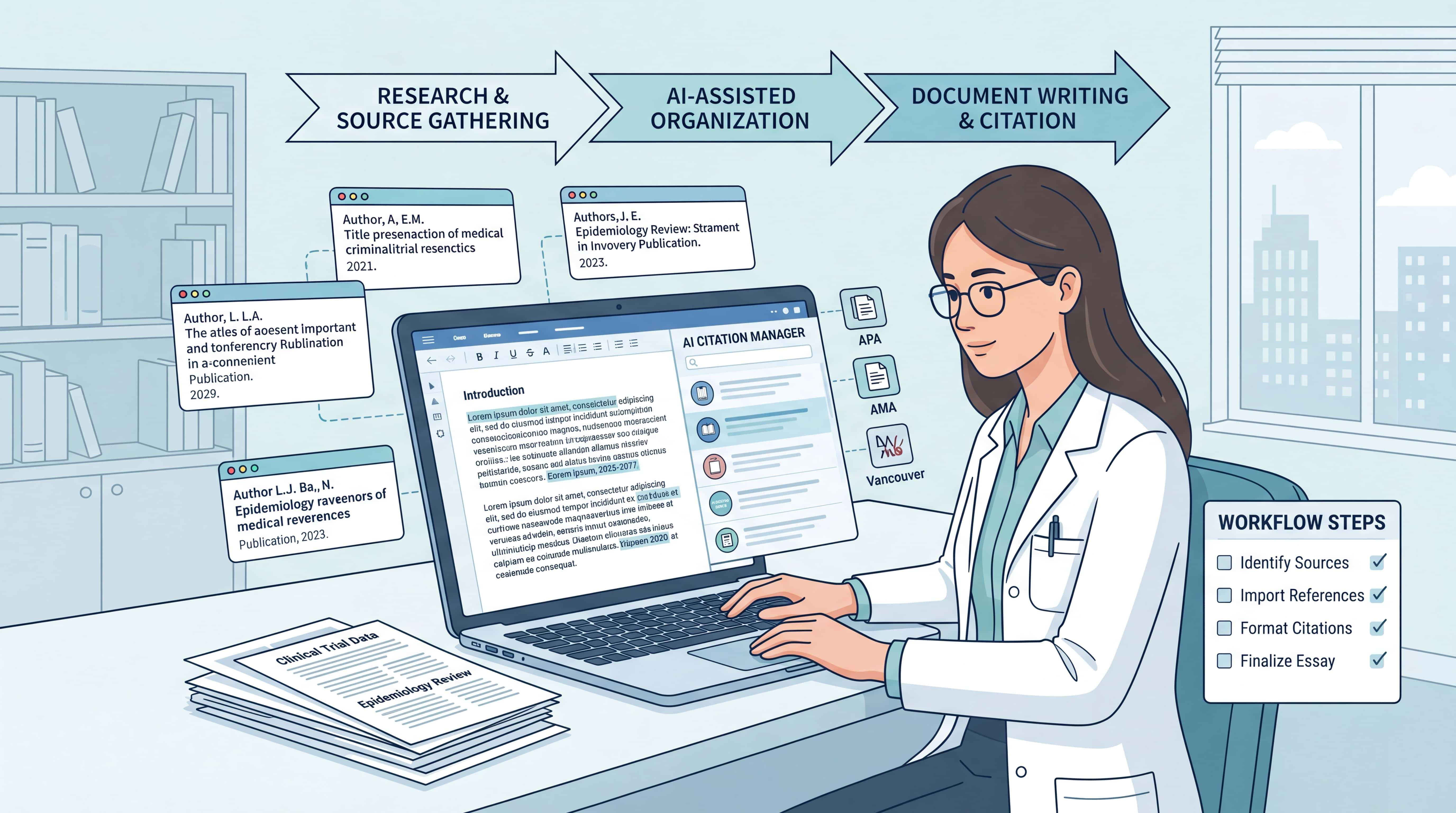
5.1 A simple citation workflow
A reliable workflow for any essay is:
- Collect sources from trusted databases.
- Evaluate source quality.
- Decide where each source supports your argument.
- Insert citations as you draft.
- Check every reference entry against the original source.
- Run a final formatting review.
This process is efficient, transparent, and easier to audit.
6. How scifocus.ai Can Help with Citation Work
For medical students, doctors, and researchers, citation management is repetitive work. It takes time to identify source type, choose the correct style, and format every entry accurately. That is where scifocus.ai can help.
A tool like scifocus.ai can streamline citation handling, reduce manual formatting tasks, and support more consistent reference preparation. It is especially useful when you are managing many sources at once or preparing a time-sensitive essay.
6.1 Where AI adds value
AI is most helpful when the task is repetitive and rule-based. For citation work, that includes:
- Identifying citation formats.
- Converting source details into a required reference style.
- Standardizing lists of references.
- Reducing formatting inconsistencies.
This does not replace your responsibility to verify accuracy. But it can significantly reduce the time spent on mechanical work, allowing you to focus on analysis, interpretation, and writing quality.
6.2 Why this matters for professionals
In medicine and research, time is limited. A physician writing a clinical review may need to cite dozens of sources. A researcher preparing a manuscript may need to adapt references to a journal’s requirements. A medical student may need to finish an evidence-based essay under deadline.
scifocus.ai can help make that process faster and more organized, while keeping the final essay more polished and submission-ready.
Conclusion
A citation is the foundation of credible academic writing. In an essay, it shows where your evidence came from, protects you from plagiarism, and helps readers evaluate your argument. For medical students, doctors, and researchers, citation accuracy is not optional. It is part of professional writing.
The best way to improve your essay is to use strong sources, follow one citation style consistently, and check every reference carefully. If you want to reduce manual work and improve accuracy, consider using scifocus.ai to support your citation workflow and streamline reference management.
Did you like this article? Explore a few more related posts.
Start Your Research Journey With Scifocus Today
Create your free Scifocus account today and take your research to the next level. Experience the difference firsthand—your journey to academic excellence starts here.