

What Is a Case Series and When Should You Publish One
Introduction
A case series is a practical way to report multiple similar clinical cases when the pattern matters more than a single patient. For medical students, doctors, and researchers, it can be the right format when you want to document a new presentation, a rare complication, or a useful treatment observation. In this essay, we will explain what a case series is, when it is worth publishing, and how to decide whether your clinical observation has real academic value.
1. What a Case Series Is
1.1 A focused report on multiple related cases
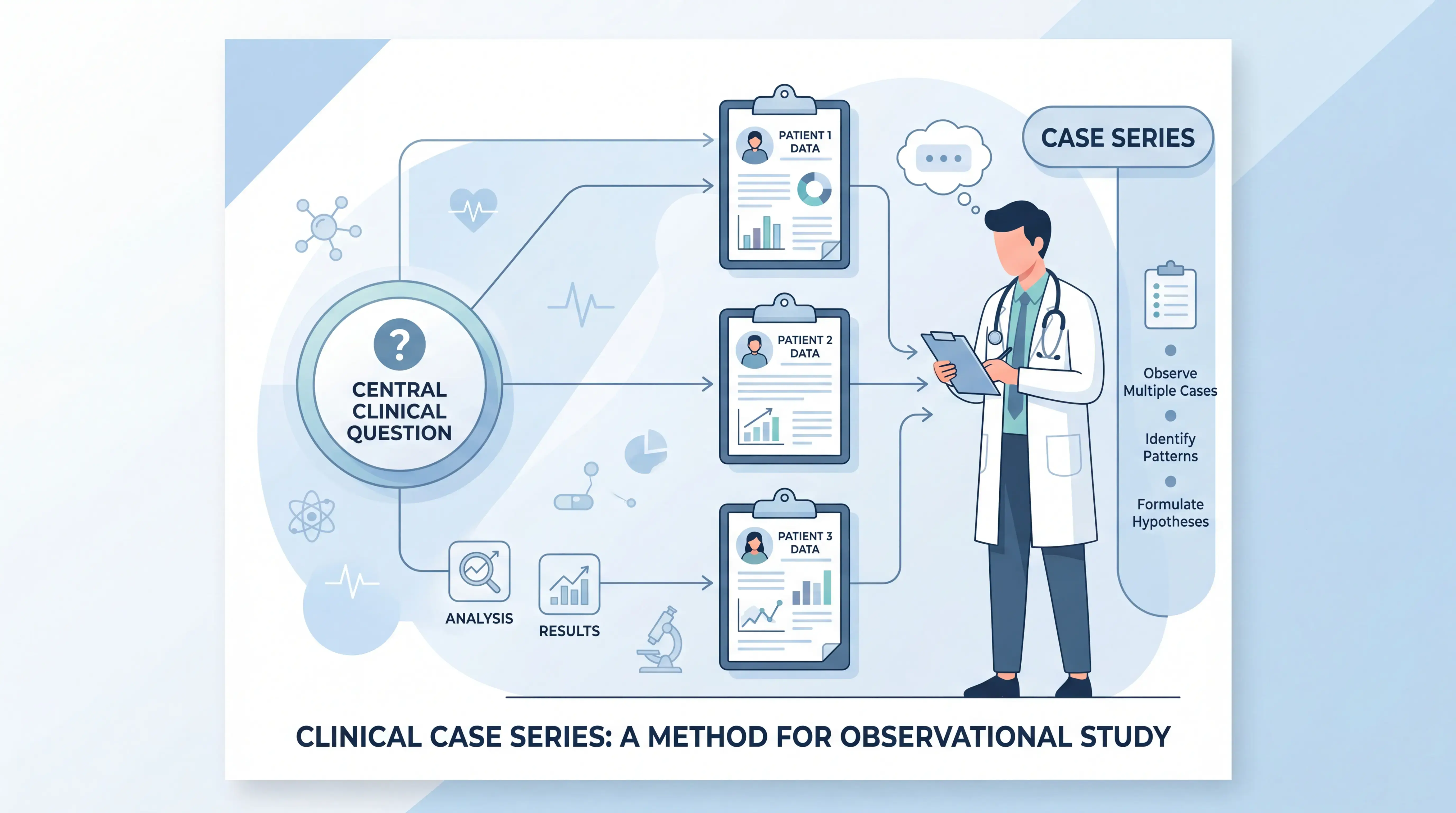
A case series usually describes a small group of patients with a shared condition, exposure, treatment, or outcome. Unlike a case report, which centers on one patient, a case series looks for a pattern across several cases. It is still descriptive, not comparative. It does not test a hypothesis the way a randomized controlled trial does.
A case series is most useful when the cases reveal something clinically meaningful that is not yet well covered in the literature.
In practice, case series often appear in open-access journals. That is because they are meant to share clinical experience quickly and widely. They are especially common in specialties such as internal medicine, surgery, endocrinology, gastroenterology, and infectious disease.
1.2 Why it matters in clinical publishing
Case series have helped medicine notice important patterns early. Historic examples include the identification of Broca’s area from a single unusual patient, the early recognition of Parkinsonian tremor, and the first clinical signals of AIDS. These were not large studies. They were careful observations that changed medical thinking.
That is the main value of a case series. It does not need to prove everything. It needs to show a pattern that deserves attention. If the observation is unusual, clinically useful, or likely to influence future research, a case series can be highly relevant.
2. When You Should Publish a Case Series
2.1 Publish when the cases add something new
You should consider a case series when the cases show one of the following:
- A rare disease presentation.
- A new complication of a known disease.
- An unexpected response to treatment.
- A cluster of cases with the same unusual feature.
- A diagnostic challenge that offers a useful lesson.
If the clinical pattern is new or meaningfully different from what is already known, a case series may be publishable.
A strong case series often answers a simple question: why should another clinician care? If the answer is that the cases change diagnostic thinking, treatment reasoning, or disease recognition, then publication may be justified.
2.2 Publish when the clinical context is important
Some case series are valuable because they highlight how medicine works in real settings. For example, a pregnant patient with suspected preeclampsia may later be found to have an asymptomatic cerebral infarct. The value is not only the diagnosis. It is also the diagnostic reasoning, the multidisciplinary discussion, and the management path. That kind of detailed clinical context can be worth publishing.
Case series are also useful when a treatment is being used in a novel way, but the evidence is still early. A report may describe a monoclonal antibody used in acquired hemophilia A, for example. In such cases, the publication should be careful and factual. It should not overstate conclusions that only a larger study can support.
3. When a Case Series Is Not the Best Choice
3.1 When stronger evidence is available
A case series is not always the best format. If the question can be answered more reliably with a controlled study, registry analysis, or randomized trial, those designs are usually stronger. This matters especially for treatment claims.
If the main goal is to prove efficacy, safety, or comparative benefit, a case series is usually not enough.
That is why some case series journals have lower visibility or impact. The method is valuable, but its evidence level is limited. In modern medicine, where many diseases are already well described, journals may prefer studies with stronger design unless the observation is truly exceptional.
3.2 When the report is too routine
Not every unusual feeling in clinic deserves publication. A case series should not be used for cases that are simply common, repetitive, or poorly documented. If the cases do not add a clear clinical message, the paper may not be useful to readers or editors.
Before writing, ask:
- Is there a real pattern?
- Does the pattern change practice, diagnosis, or awareness?
- Is the number of cases enough to show consistency?
- Is the lesson still relevant after publication?
If the answer is mostly no, then the manuscript may be better kept as internal teaching material.
4. How to Build a Strong Case Series
4.1 Define the clinical question first
A good case series starts with one clear question. Do not begin with a pile of charts. Begin with the reason the cases matter. That question should guide case selection, data collection, and the final discussion.
Useful questions include:
- What unusual presentation did these patients share?
- What diagnostic pitfall did we encounter?
- What treatment response was unexpectedly consistent?
- What clinical feature may help other clinicians act earlier?
Clarity at the start makes the final manuscript stronger and more publishable.
4.2 Select cases carefully
Case selection should be transparent. Readers need to understand why these cases were included and whether they represent a meaningful clinical cluster. Avoid random collection. Focus on cases that are similar enough to support a pattern, but detailed enough to offer insight.
A strong case series usually includes:
- Patient background.
- Presentation and timeline.
- Key investigations.
- Treatment approach.
- Outcome.
- Clinical interpretation.
4.3 Present the lesson, not just the details
The best case series do more than list facts. They explain why the pattern matters. This is where the writing should be precise and disciplined. The discussion should compare the cases with known literature, identify what is new, and acknowledge uncertainty.
For many authors, this is the hardest part of the essay. The goal is not to sound dramatic. The goal is to show that the observation is credible, limited, and useful.
5. Where to Publish a Case Series
5.1 Match the journal to the value of the cases
Most case series are published in open-access journals because the purpose is educational dissemination. Some journals focus specifically on case-based articles. Others, including specialty journals, may publish them when the clinical message is strong enough.
The right journal depends on the importance of the observation. If the cases are highly relevant to a narrow specialty, a subspecialty journal may be the best fit. If the message is broader, a more general clinical journal may be appropriate.
5.2 Understand editorial expectations
Editors usually look for three things:
- Novelty.
- Clinical relevance.
- Clear writing.
They also expect ethical handling of patient information and a realistic discussion of limitations. A case series should not pretend to be more rigorous than it is. It should present what was seen, what it may mean, and what still needs study.
For authors who want help organizing the manuscript, structuring the message, and improving publication readiness, scifocus.ai can support the drafting process and make the work easier to refine into a journal-ready paper.
Conclusion
A case series is a focused clinical essay built around multiple related patients. It is most useful when the pattern is rare, educational, or likely to influence future research. It is less suitable when stronger study designs can answer the question better. If your cases reveal a clear lesson, a careful case series can help other clinicians learn from your experience and may be worth publishing.
If you are preparing a manuscript and want a more efficient way to shape the narrative, organize the evidence, and polish the submission, scifocus.ai can help you move from notes to a publishable draft with less friction.
Did you like this article? Explore a few more related posts.
Start Your Research Journey With Scifocus Today
Create your free Scifocus account today and take your research to the next level. Experience the difference firsthand—your journey to academic excellence starts here.