
What Grant Reviewers Actually Look For in a Research Proposal
Introduction
Writing a strong essay for a research grant is not about sounding impressive. It is about making reviewers trust that your idea is worth funding, feasible, and clearly structured. Many applicants lose points because their proposal reads like a list of experiments instead of a convincing scientific story. Grant reviewers look for logic, depth, and evidence that your study can actually be done.
1. The First Thing Reviewers Judge Is the Scientific Story
1.1 A clear hypothesis matters more than a long method list
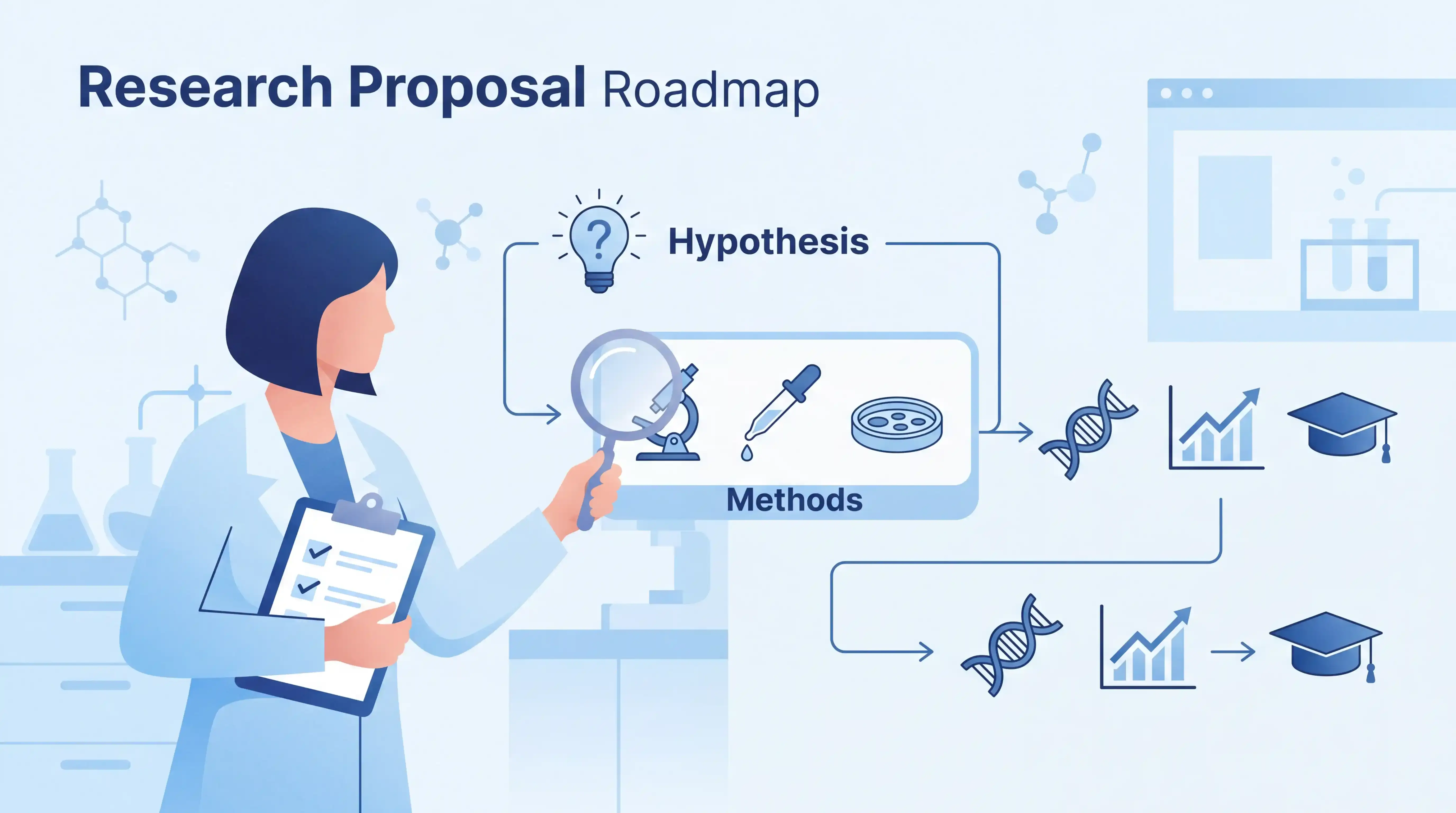
Reviewers usually start with one question. Is this proposal built on a believable scientific idea. A strong proposal does not begin with techniques. It begins with a problem, a gap, and a testable hypothesis.
If the central hypothesis is weak, no amount of technical detail will fully rescue the application. That is why the opening logic must connect the clinical question to the biological mechanism.
1.2 Storyline beats scattered facts
A good proposal reads like a sequence of linked steps. One finding leads to the next. One experiment supports the next claim. This is what makes the project feel credible.
For medical students, physicians, and researchers, this means avoiding fragmented writing. Do not simply stack literature, objectives, and methods. Instead, show how the evidence leads naturally to your hypothesis. Reviewers notice when the narrative is coherent.
1.3 Why reviewers care about coherence
In practice, reviewers often have limited time. They may not read every line carefully. They look for a fast judgment.
They want to see:
- a real knowledge gap,
- a rational hypothesis,
- a study design that follows the hypothesis,
- and outcomes that can answer the question.
A proposal that tells a clear scientific story is easier to trust, and easier to fund.
2. Feasibility Is Often Decisive
2.1 Reviewers check whether the study can be completed
A proposal can be exciting and still fail if the work looks unrealistic. Reviewers pay attention to whether the experiments match the applicant’s stage, resources, and timeline.
The knowledge base behind many successful proposals is simple. If the key argument is already established, the experimental section should support it with clear, practical steps. Reviewers do not expect every detail to be novel. They expect the plan to be executable.
2.2 Too much detail can hurt if it looks ungrounded
Reviewers usually are not looking for a perfect procedural manual. If the method section becomes overly technical without strengthening the logic, it may distract from the core argument.
What matters is whether the chosen experiments are appropriate. For example:
- Does the study use the right controls?
- Do the groups answer the hypothesis?
- Is there a rescue design when mechanism is claimed?
- Are the steps realistic within the budget?
Feasibility is not about doing everything. It is about doing the right things in the right order.
2.3 Budget and scope must match
A smaller grant does not require a deeper hypothesis. It requires a tighter, better-justified scope. A common mistake is overloading the proposal with too many aims and too many assays.
Reviewers prefer a focused plan that can be delivered cleanly. If the budget supports only core experiments, then the proposal should prioritize those. A slim but rigorous design often performs better than an ambitious one that feels stretched.
3. Reviewers Want Broad Yet Controlled Experimental Logic
3.1 Strong proposals use more than one line of evidence
A convincing proposal does not rely on a single readout. Reviewers look for breadth. They want to see the hypothesis examined from several angles, such as expression, function, and mechanism.
In biomedical research, that often means combining:
- molecular assays,
- cell-based functional tests,
- and, when possible, animal or tissue-level evidence.
This layered design matters because one result alone is rarely enough. Breadth strengthens confidence, as long as each layer serves the same scientific question.
3.2 Rescue experiments are especially persuasive
A reviewer will often look for proof that the mechanism is not just correlational. That is where rescue experiments become important. If you change a target and the phenotype shifts back, the argument becomes stronger.
This is one of the clearest signals that the applicant understands causal reasoning. A rescue design shows that the proposal is not merely descriptive. It is mechanistic.
A solid rescue framework usually asks:
- What is the upstream factor?
- What is the downstream effector?
- Can the effect be reversed by restoring one side of the pathway?
If the proposal claims mechanism, reviewers expect a rescue strategy.
3.3 Parallel experiments improve credibility
Reviewers also respond well to parallel logic. If one experiment tests expression, another tests function, and another tests interaction, the proposal feels balanced.
This does not mean adding random experiments. It means using different readouts to answer the same question from different directions. That approach is especially useful in complex medical research, where phenotype alone is not enough.
4. Reviewers Look for Realistic Experimental Detail
4.1 Enough detail to prove the plan, not so much that it becomes noisy
There is a useful balance in proposal writing. Too little detail makes the study seem vague. Too much detail can make it look unfocused.
Reviewers usually want the essentials:
- the key model,
- the main comparison groups,
- the critical assay,
- and the expected interpretation.
They do not need a full lab protocol. They need confidence that the applicant knows what will be done and why it matters.
4.2 Technical steps should support the claim
If a proposal says it will test a pathway, then the methods must support that claim. If it says it will prove causality, then the design should include proper perturbation and reversal steps. If it says it will have clinical relevance, then human samples or clinically meaningful data should be included where available.
Reviewers notice when the methods and the claim do not match. That mismatch is one of the fastest ways to lose confidence.
4.3 Keep the sequence logical
A high-quality research proposal usually follows a clean order:
- establish the phenomenon,
- test the mechanism,
- verify the effect in a more relevant system,
- and connect the finding to clinical value.
This sequence helps reviewers move through the proposal without confusion. It also reduces the chance that the project feels like a collection of disconnected tasks.
5. What Makes a Proposal Feel Fundable
5.1 Reviewers want confidence, not hype
Strong proposals do not overpromise. They state the problem clearly, show the evidence honestly, and explain why the next step is justified.
Trust is built through precision. Use measurable language. Avoid vague phrases. State what will be compared, what will be measured, and what would count as a meaningful result.
5.2 Preliminary work is one of the strongest signals
Reviewers often ask whether the applicant has already built enough of the foundation. Preliminary data matter because they reduce uncertainty. They show that the idea is not only interesting, but already moving.
This is especially important in competitive funding environments. A proposal with solid pilot data usually feels safer because the path from idea to result is shorter.
5.3 Clinical relevance should be explicit
For medical applicants, the final question is simple. Why does this matter. Reviewers want the proposal to connect biology to patient benefit, even if the study is preclinical.
That connection can be framed through:
- diagnosis,
- prognosis,
- therapeutic targeting,
- or mechanism-based intervention.
A proposal is stronger when it ends with a clear medical payoff.
6. How SciFocus.ai Can Help You Write a Better Research Proposal
6.1 Faster structure, cleaner logic
Many applicants struggle not with science, but with structure. They know their data. They know their hypothesis. What they lack is a clean way to turn that material into a reviewer-friendly essay.
That is where scifocus.ai can help. It supports clearer organization, faster drafting, and more disciplined proposal writing. For busy clinicians and researchers, that means less time spent reshaping paragraphs and more time refining the science.
6.2 Better alignment between aim and method
A strong proposal depends on alignment. The aim, methods, and expected results must point in the same direction. Tools like scifocus.ai can help users turn scattered notes into a more coherent grant narrative, which is exactly what reviewers want to see.
If the story is clear, the proposal becomes easier to review, easier to trust, and easier to support.
Conclusion
Grant reviewers do not look for fancy language. They look for a strong scientific story, a feasible plan, and evidence that the project can answer an important question. They pay attention to hypothesis strength, experimental logic, rescue design, realism, and clinical relevance. If you can deliver those elements in a clean structure, your proposal becomes far more competitive. For researchers who want help shaping that structure, scifocus.ai can streamline the writing process and make your next grant essay more persuasive.

Did you like this article? Explore a few more related posts.
Start Your Research Journey With Scifocus Today
Create your free Scifocus account today and take your research to the next level. Experience the difference firsthand—your journey to academic excellence starts here.