

Understanding the Peer Review Process
Introduction
For medical students, physicians, and researchers, an essay on publishing often runs into the same pain point: the manuscript seems strong, yet the journal response is slow, unclear, or negative. That frustration usually comes from not understanding the peer review process. Knowing what happens after submission helps you make better decisions, reduce avoidable rejection, and respond to reviewers with more precision.
1. What Happens After Submission
1.1 The first editorial screen
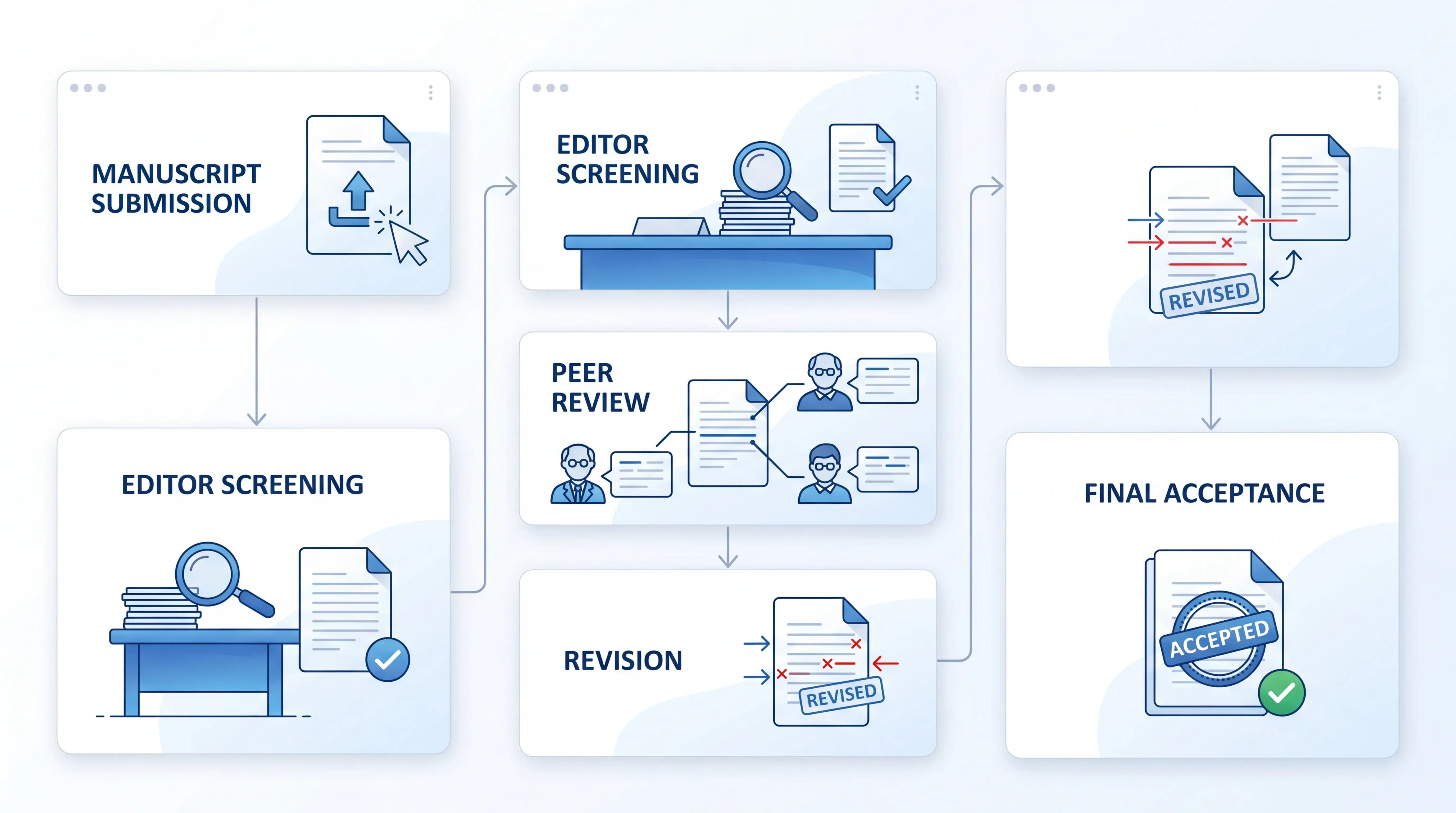
Once you submit a manuscript, the journal office checks whether the file set is complete and whether the paper follows the instructions for authors. This early stage can include format checks, plagiarism screening, and basic scope review. In practice, many papers are stopped here before external review begins.
A journal editor will also judge whether the manuscript fits the journal’s level and readership. Top journals reject a large share of submissions at this stage, sometimes 80% to 90%, without sending them to reviewers. That is why a strong paper can still be rejected quickly if the scope, quality, or presentation is not aligned with the journal.
1.2 Common early status updates
Submission systems often show a series of status labels. These are not always identical across publishers, but the logic is similar:
- Manuscript Submitted
- Awaiting admin processing
- Editor Invited
- With Editor
- Reviewer Invited
These labels help authors track movement through the workflow, but they do not guarantee progress. A paper can remain in one status for days or weeks, especially while the editor is finding suitable reviewers.
1.3 Why format matters more than many authors think
Editors and administrators expect a complete, clean submission. If figures, ethics documents, or author confirmations are missing, the paper may be returned before peer review. Repeated format errors create a poor impression. A manuscript that cannot meet simple submission requirements may be judged as unlikely to meet revision demands later.
2. How Editors Decide Whether to Send the Paper for Review
2.1 Editorial fit and scientific level
The editor’s job is not only administrative. It is also strategic. The editor asks two basic questions. First, does the manuscript fit the journal’s scope? Second, is the scientific level competitive for that journal? If the answer to either question is no, the paper may be rejected immediately.
This is one reason the peer review process is not just about reviewers. It begins with editorial filtering. In many journals, the editor acts as the first quality gate. If the paper is below the journal’s threshold, it may never reach external reviewers at all.
2.2 When an editor sends the paper onward
If the manuscript appears suitable, the editor invites reviewers. Some journals use two reviewers, while others may seek three or more. In some cases, a paper can be sent to six or even ten experts if the topic is complex or the journal expects broader evaluation.
A few practical points matter here:
- Reviewers are usually unpaid.
- They work alongside full-time research and clinical duties.
- Delays are common, especially when reviewers decline or fail to respond.
That is why the “under review” stage often lasts one to two months, and sometimes longer.
2.3 When a paper is rejected before review
A paper may move from editor assignment to a decision stage without external review. This usually means the manuscript does not match the journal’s scope, quality bar, or formatting expectations. Authors often receive a rejection within a few days.
In practical terms, this is not a failure of the review system. It is a sign that the editorial filter is working. Journals use it to protect reviewer time and maintain standards.
3. What Peer Review Actually Looks Like
3.1 Reviewer selection and invitations
When the editor decides the paper deserves external evaluation, reviewer invitations are sent. The status may show “Reviewer Invited” until someone accepts. If a reviewer declines, the editor must search again. That can return the paper to “With Editor” or keep it in invitation status longer than expected.
This stage matters because reviewer selection affects both speed and outcome. A well-matched reviewer can identify methodological gaps, statistical weaknesses, or overclaims. A poorly matched reviewer may focus on minor issues and miss the core scientific problem.
3.2 The typical review window
In many fields, peer review takes about one to two months, but this is only an estimate. The real timeline depends on reviewer availability, journal workload, and the complexity of the paper. A clinically focused original article may move faster than a highly technical translational study.
A useful way to think about this is simple. Peer review is slow because it depends on expert volunteer labor, not because the system is broken. For authors, patience is part of the process.
3.3 Required reviews complete
When all requested reviews are returned, the system may show “Required Reviews Complete.” This does not mean a decision is final. It means the editor now has the reports and must synthesize them.
Sometimes the editor will ask for an additional review if the first round is mixed or insufficient. In that case, the status can shift back to “Under Review.” This is normal and does not necessarily indicate a problem.
4. How Decisions Are Made
4.1 The editor weighs the reports
Once the reviews are in, the editor, and sometimes the deputy editor or editor-in-chief, evaluates the comments. The final decision is not a simple vote count. Instead, the editor weighs scientific quality, reviewer agreement, journal priorities, and feasibility of revision.
Typical outcomes include:
- Reject
- Major revision
- Minor revision
- Accept
Among these, direct acceptance is rare. Most accepted papers pass through at least one round of revision, and many go through several rounds before final acceptance.
4.2 Reject, major revision, or minor revision
A reject decision usually means the manuscript has major scientific, methodological, or fit problems. For major journals, rejection rates can be very high, and a reject does not always mean the study is worthless. It may simply be better suited to another journal.
Major revision means the paper has promise, but substantial work is required. Authors may need new analyses, better explanations, stronger controls, or tighter discussion. Minor revision usually means the paper is close to acceptable, but the editor expects specific corrections and clarifications.
4.3 Why revision quality matters
When revision is requested, the author’s response is crucial. Reviewers want to see three things:
- Respectful tone.
- Point-by-point answers.
- Clear evidence that changes were made.
If a requested experiment cannot be done, the author should explain why clearly and objectively. Defensive language rarely helps. A strong revision letter is often as important as the manuscript itself.
5. Common Status Labels and What They Mean
5.1 Manuscript under review
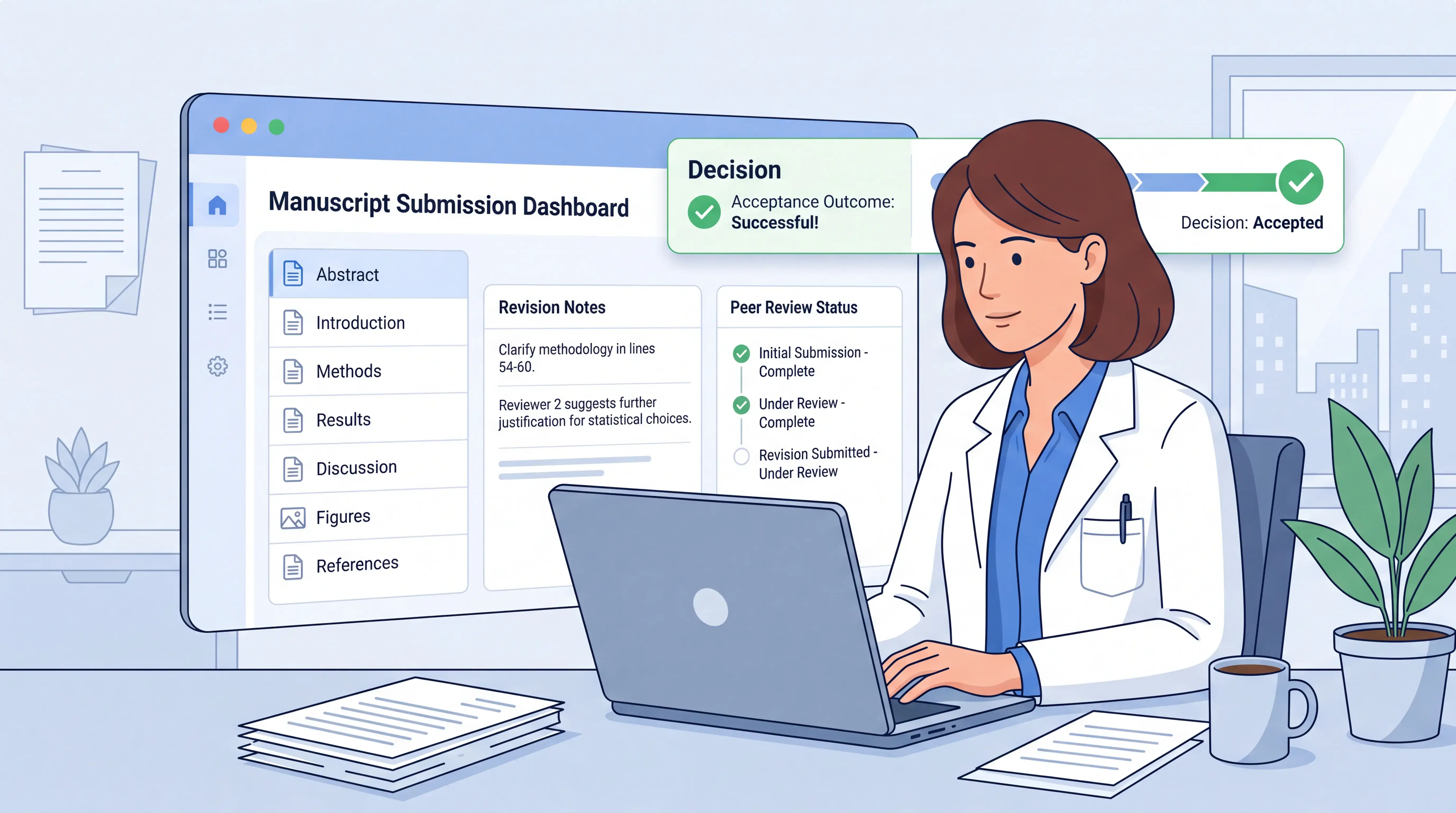
“Under Review” means the paper is with external reviewers. This is usually the stage authors watch most closely, but it is also the stage they can influence least. Delays here are common, especially if one reviewer is late or declines.
5.2 Decision in process
“Decision in Process” means the editor is evaluating the reviewers’ comments and preparing the outcome. If the reviewers agree, this stage may end quickly. If they disagree, the editor may consult more colleagues or seek another review. That can add time.
5.3 Revised manuscript submitted
After revision, the system often shows “Revised Manuscript Submitted.” The paper then re-enters the editorial workflow. The editor may check the revision directly or send it back to the original reviewers for a second round.
5.4 Accept
“Accept” means the editor is satisfied with the revision and the manuscript is approved for publication. Proofreading and production follow. At this stage, authors should still check for errors in tables, figures, affiliations, and references.
6. How to Improve Your Chances in the Peer Review Process
6.1 Choose the right journal first
A strong submission starts before the paper is uploaded. The journal must fit the topic, scope, and evidence level of the study. Read the instructions for authors carefully. Check word count, figure limits, reference style, ethics requirements, and article type.
This simple step prevents many preventable rejections. A polished essay about peer review is useful only if the underlying submission strategy is correct.
6.2 Prepare the submission package carefully
Before submission, make sure the package is complete:
- Main manuscript
- Figures and tables
- Cover letter
- Ethics documents
- Author approvals, if required
- Suggested reviewers, if requested
A clear cover letter should explain the problem, the novelty, and why the paper matters to the journal’s audience. Keep it concise and factual.
6.3 Write for reviewers, not just for yourself
Reviewers respond best to clear logic, short sentences, and clean structure. Avoid unnecessary complexity. Use direct language. Present the methods, results, and interpretation in a way that allows quick evaluation.
That is also where tools like scifocus.ai can help. It can support manuscript refinement, language clarity, and structured writing so authors spend less time fixing avoidable problems and more time strengthening the science. For busy clinicians and researchers, that means a smoother path from submission to revision.
Conclusion
The peer review process is not random. It follows a structured path: submission, editorial screening, reviewer invitation, external review, editorial decision, revision, and final acceptance or rejection. For medical students, doctors, and researchers, understanding this workflow reduces anxiety and improves submission strategy.
A well-prepared essay on publishing is only the beginning. The real advantage comes from knowing how journals think, what editors screen for, and how reviewers judge quality. If you want to improve your next submission, streamline your revision workflow, and present a stronger manuscript, consider using scifocus.ai to support the process from draft to decision.
Did you like this article? Explore a few more related posts.
Start Your Research Journey With Scifocus Today
Create your free Scifocus account today and take your research to the next level. Experience the difference firsthand—your journey to academic excellence starts here.