

Understanding Nominalization in Academic Texts
Introduction
Nominalization is common in an academic essay, but it often makes medical and research writing harder to read. Many medical students, doctors, and researchers use it without noticing. The result is text that sounds formal, yet feels heavy, indirect, and vague. In scientific writing, that can weaken clarity and slow down peer review. Understanding how nominalization works helps you write with more precision, stronger logic, and less wordiness.
1. What Nominalization Means in Academic Writing
1.1 The basic idea
Nominalization is the process of turning a verb or adjective into a noun. For example, “analyze” becomes “analysis,” and “decide” becomes “decision.” In an academic essay, this shift often creates a more formal tone. It can also compress complex ideas into compact noun phrases.
That is useful in science. Medical writing often needs to describe processes, outcomes, and abstract concepts in a concise way. But nominalization can also hide the actor and make sentences less direct. For example, “the team analyzed the samples” is clearer than “the analysis of the samples was performed.”
The key point is not to avoid nominalization completely, but to use it only when it improves meaning and structure.
1.2 Why it is so common in scientific prose
Academic English values objectivity. Writers often prefer nouns over personal, active expressions because nouns can sound more impersonal. This is why phrases like “risk assessment,” “patient compliance,” and “treatment response” appear so often in journals and conference writing.
In biomedical contexts, nominalization is especially frequent because researchers need to describe methods, findings, and mechanisms. It helps create dense and compact text. A sentence can carry more information without becoming overly long.
Still, density is not always clarity. When nominalization stacks up, readability drops fast. Readers must work harder to identify the action, the agent, and the result.
1.3 Common forms you will see
In research writing, nominalization often appears in predictable forms:
- Verb to noun: analyze, analyze → analysis
- Verb to noun: diagnose → diagnosis
- Verb to noun: observe → observation
- Adjective to noun: stable → stability
- Adjective to noun: accurate → accuracy
These forms are not wrong. They are standard academic vocabulary. The issue is how they are used inside a sentence. A well-written essay uses them to clarify structure, not to bury it.
2. Why Nominalization Can Hurt Clarity
2.1 It can hide the agent
One of the main problems is that nominalization often removes the doer of the action. Compare these two versions:
- “Researchers analyzed the blood samples.”
- “An analysis of the blood samples was conducted.”
The second sentence is not incorrect. But it is less direct. It delays the main action and can make the sentence feel passive and distant. In a clinical or scientific context, that may reduce force and precision.
For readers scanning a manuscript, direct verbs are faster to process. This matters in abstracts, introductions, and discussion sections where each sentence must work hard.
2.2 It can create noun-heavy sentences
Nominalization often leads to clusters of nouns. These clusters are common in academic essay writing, but too many in one sentence can overload the reader. For example:
- “The implementation of the intervention led to a reduction in inflammation.”
This sentence is readable. But if the entire paragraph uses this structure repeatedly, the style becomes stiff. Readers may lose the thread because the sentence relies on abstract nouns rather than action.
A strong rule for scientific writing is simple. If a sentence feels heavy, check whether a verb can carry the meaning more clearly.
2.3 It can weaken precision in medical writing
In medicine, precision matters. If a sentence is vague, readers may not know who acted, what changed, or what caused the outcome. Nominalization can blur these relationships.
For example:
- “The assessment of symptoms showed improvement.”
Improvement in what, by whom, and compared with what? The sentence is grammatical, but not optimal. A more precise version may be:
- “Clinicians assessed the symptoms and found that they improved.”
That version is easier to verify and interpret. It helps the reader follow the logic without guessing.
3. When Nominalization Is Useful
3.1 It helps create a formal academic tone
Nominalization is not a mistake. In many cases, it is exactly what academic writing needs. It can make a sentence more concise and more aligned with scholarly convention.
For example, “the implementation of the protocol” sounds more formal than “when we implemented the protocol.” In methods sections, that style can be appropriate because the focus is on the procedure, not the person.
This is one reason academic essay writing often prefers nouns for concepts like “evaluation,” “association,” “significance,” and “prevalence.” These nouns are efficient and standard in the literature.
3.2 It supports abstract reasoning
Science often deals with abstract relationships. Nominalization helps writers describe those relationships in compact form. Phrases like “risk reduction,” “tissue damage,” and “gene expression” allow you to discuss ideas at a high level without repeating verbs constantly.
This is especially helpful in discussion sections, where the writer must connect findings to broader mechanisms. When used well, nominalization improves cohesion. It lets the paragraph move from one concept to the next in an orderly way.
3.3 It is useful for summarizing results
Results sections often need to present findings in a compact format. Nominalization can help turn repeated processes into stable concepts. That can make tables, headings, and transitions easier to manage.
For example:
- “The reduction in fever was observed after treatment.”
- “There was a significant increase in survival.”
These constructions are common in research writing. They are not inherently weak. The problem starts only when nominalization replaces clear action in every sentence.
4. How to Use Nominalization Well
4.1 Use the conversion test
A practical editing step is to ask whether a noun phrase could become a verb phrase without losing meaning. If the verb version is clearer, use it.
Compare:
- “The examination of the tissue was completed.”
- “The tissue was examined.”
The second sentence is shorter and clearer. It keeps the same meaning with less effort for the reader. This is a useful habit for anyone writing a medical essay or journal draft.
4.2 Keep the actor visible when it matters
If the person or system performing the action is important, do not hide it inside a noun phrase. Scientific writing should be accurate about responsibility and process.
Use active verbs when:
- you describe methods
- you report clinical actions
- you explain decision-making
- you want stronger emphasis
Use nominalization when:
- the action itself is the focus
- the actor is not important
- you need a compact academic tone
That balance is what separates clear writing from inflated writing.
4.3 Edit for sentence shape
A good academic paragraph should not feel like a chain of abstract nouns. Read each sentence aloud. If you see repeated structures such as “the identification of,” “the analysis of,” and “the evaluation of,” ask whether some can become verbs.
A simple editing workflow helps:
- Highlight every noun ending in “-tion,” “-ment,” “-ence,” or “-ity.”
- Check whether the sentence still works with a verb.
- Replace weak passive constructions where possible.
- Keep only the nominalizations that improve precision.
This process is especially useful for manuscripts written by non-native English speakers.
5. Nominalization and Article Use in Academic English
5.1 Why nouns often need careful article control
Nominalization turns actions into nouns, and nouns trigger article decisions. That means clarity depends not only on word choice, but also on grammar. In scientific writing, a nominalized phrase may need “a,” “the,” or no article at all, depending on whether the reference is specific, general, or abstract.
For example, “an analysis” suggests one instance of analysis, while “the analysis” points to a specific one. If you overuse nominalization, article errors become more likely because the sentence depends on noun structure rather than direct action.
This is one reason many researchers struggle with polishing their academic essay drafts. The sentence may look formal, but small grammar choices affect meaning.
5.2 Precision matters more than complexity
A sentence does not become stronger just because it contains more nouns. In fact, heavy nominalization can reduce readability and raise the chance of grammar mistakes. This is especially true in clinical writing, where precision and transparency are essential.
A useful standard is this: prefer the clearest sentence that preserves scientific meaning. If the verb form is accurate, direct, and professional, use it. If the nominalized form better matches the discourse pattern of your field, keep it.
6. Practical Rewrite Examples for Medical Writers
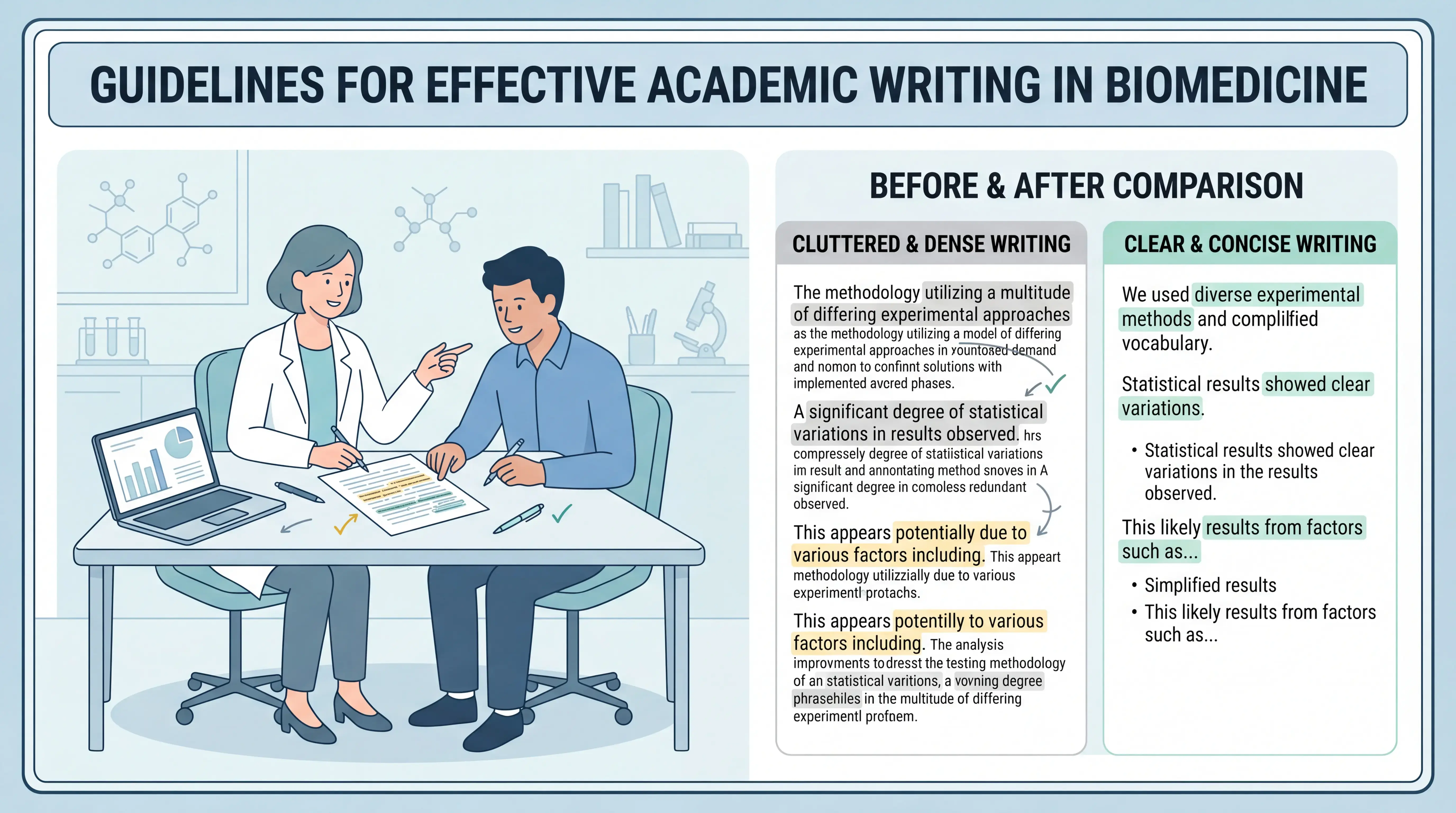
6.1 Before and after
Here are a few common rewrites:
-
Before: “The investigation of the patient’s symptoms was conducted.”
-
After: “The clinicians investigated the patient’s symptoms.”
-
Before: “There was a reduction in inflammation after treatment.”
-
After: “Treatment reduced inflammation.”
-
Before: “The implementation of the protocol improved adherence.”
-
After: “Implementing the protocol improved adherence.”
These examples show the same idea in different shapes. The second version is usually easier to read. The first may still be acceptable in formal contexts, but only when it serves a purpose.
6.2 A simple rule for your next draft
If you are preparing an academic essay, follow this rule:
- Use nominalization for abstraction, summary, and formal structure.
- Use verbs for action, responsibility, and clarity.
- Do not let noun phrases replace meaning.
That balance improves readability without making the text sound informal.
7. Conclusion
Nominalization is a normal and often useful feature of academic English. In medical and research writing, it helps compress ideas and maintain a formal tone. But too much nominalization can hide agents, weaken precision, and make an essay difficult to read.
The best academic writing is not the most complex. It is the clearest. If you want to improve your manuscript faster, use a structured editing tool that can identify dense phrasing, simplify nominalizations, and improve sentence flow. Scifocus.ai can help you refine academic wording, reduce unnecessary noun stacks, and turn heavy prose into cleaner scientific English.

Did you like this article? Explore a few more related posts.
Start Your Research Journey With Scifocus Today
Create your free Scifocus account today and take your research to the next level. Experience the difference firsthand—your journey to academic excellence starts here.