

Transition Words for Research Papers
Introduction
Writing a strong essay for a research paper is not only about facts. It is also about flow. Many medical students, doctors, and researchers have solid data, but their writing feels disconnected. Without the right transition words, results look like separate notes instead of a coherent argument. Transition words for research papers help you link findings, compare evidence, and guide readers through your logic.
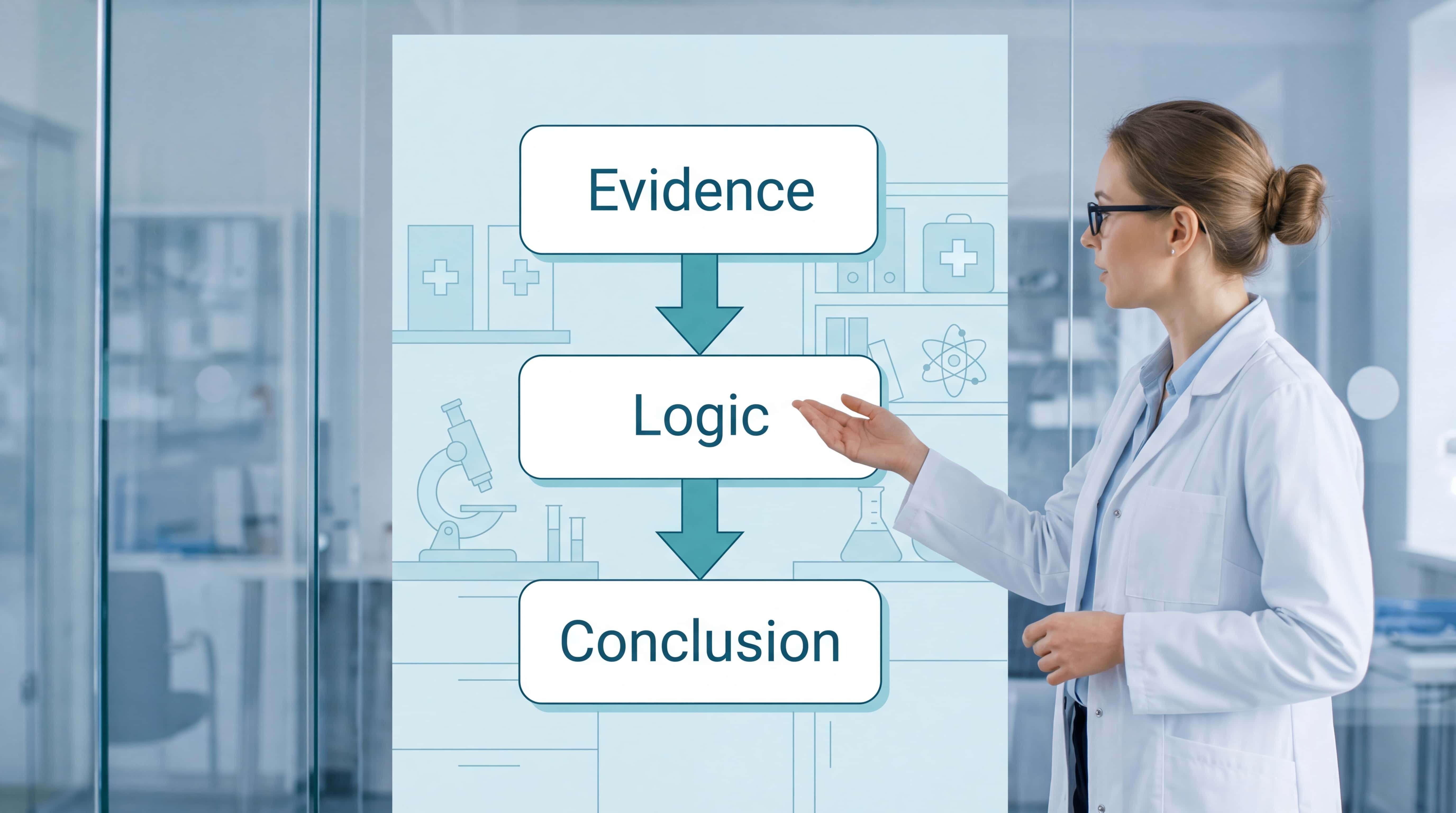
1. Why Transition Words Matter in Research Writing
1.1 They turn data into a clear argument
In scientific writing, readers expect more than raw results. They want to know why one finding follows another. Transition words make that relationship visible. They show cause, contrast, addition, and summary.
This matters especially in a research paper, where each paragraph should build toward one conclusion. If the logic is weak, even strong data can lose impact.
A well-structured essay in medicine often follows this pattern:
- State the problem.
- Present prior evidence.
- Show your results.
- Explain what they mean.
Transition words help each step connect smoothly.
1.2 They improve readability and trust
Medical readers are busy. They scan quickly. If your sentences are fragmented, they may miss the key point. Clear transitions reduce cognitive effort and make your writing easier to follow.
Some useful signposting phrases include:
- however
- therefore
- in addition
- in contrast
- moreover
- nevertheless
These words do not just decorate a sentence. They show the reader how to interpret it.
2. Core Transition Word Types for Research Papers
2.1 Addition and continuation
Use addition words when you want to add another result, method, or explanation. These are useful in result sections and discussion sections.
Common examples:
- in addition
- moreover
- furthermore
- likewise
- meanwhile
Example:
- The biomarker was elevated in serum samples. In addition, it was associated with disease severity.
This kind of transition keeps the essay moving forward without repeating the same idea.
2.2 Contrast and limitation
Use contrast words when your data differ from prior findings, or when you need to show a limitation, exception, or competing interpretation.
Common examples:
- however
- in contrast
- on the other hand
- nevertheless
- yet
- conversely
Example:
- The treatment improved survival in the animal model. However, the mechanism remains unclear.
In research papers, contrast words are essential because science rarely moves in a straight line. They help you present uncertainty honestly.
2.3 Cause and effect
These words are especially important when explaining experimental logic or interpreting findings.
Common examples:
- therefore
- thus
- as a result
- consequently
- accordingly
Example:
- The knockout reduced protein expression. Therefore, the protein may play a regulatory role in the pathway.
Use these carefully. Only use strong causal language when the data support it. If the relationship is suggestive but not proven, use softer verbs such as indicate, suggest, or may.
2.4 Summary and emphasis
When you need to close a paragraph or highlight the main point, summary words are useful.
Common examples:
- in conclusion
- to summarize
- overall
- notably
- importantly
- in short
Example:
- Overall, these findings support a link between inflammation and progression.
A concise essay becomes much stronger when each section ends with a clear takeaway.
3. How to Use Transition Words in Results and Discussion
3.1 Link your own findings to published evidence
One common problem in research writing is that authors list results without connecting them to the literature. A better approach is to use markers that signal comparison or paraphrase.
Useful reporting phrases include:
- others have shown
- Smith reported
- our previous study showed
- their findings demonstrate
Example:
- Smith reported a similar increase in cytokine expression.
- Our previous study showed that the pathway was activated under hypoxic conditions.
These phrases are useful when you want to compare your results with earlier work.
3.2 Use transitions to show paragraph logic
A strong essay does not jump from one idea to another. Each paragraph should lead naturally into the next.
A practical structure is:
- First, describe the main result.
- Next, explain the comparison or exception.
- Then, interpret the mechanism.
- Finally, state the clinical or scientific implication.
Example:
- The intervention reduced cell migration. Interestingly, the effect was stronger in the high-risk subgroup. In contrast, no significant change was observed in controls. These results suggest a context-dependent mechanism.
This style is especially effective in medical writing because it mirrors how researchers think.
3.3 Use soft transitions when the evidence is indirect
Not every result supports a direct conclusion. In those cases, use cautious transitions and cautious verbs.
Better choices include:
- suggest
- indicate
- support
- imply
- may reflect
Example:
- The increase in marker expression may indicate early pathway activation.
- The pattern suggests a possible regulatory role, but further validation is needed.
This is a key E-E-A-T principle in scientific writing. Precision builds credibility.
4. Practical Sentence Templates for Medical Researchers
4.1 Templates for reporting findings
You can use these structures to make your essay more readable and professional:
- Interestingly, the results showed that...
- Significantly, we found that...
- In addition to the main outcome, ...
- Unexpectedly, no notable difference was observed...
- Notably, the expression of ... was associated with ...
Example:
- Interestingly, the treated group showed lower inflammatory activity than the control group.
These phrases are useful when a result deserves attention without sounding exaggerated.
4.2 Templates for contrast and discussion
When your findings differ from previous studies, write it clearly and professionally.
Examples:
- However, our result differed from the earlier report.
- In contrast to previous work, we observed ...
- Although the model was similar, the outcome was different.
- Nevertheless, the overall trend remained consistent.
Example:
- In contrast to earlier studies using immortalized cells, we used primary samples to reduce bias.
This kind of sentence shows methodological awareness, which is important for doctors and researchers.
4.3 Templates for summarizing the key message
At the end of a section, use a clean summary line.
Examples:
- These data indicate that ...
- Taken together, the findings support ...
- Overall, the evidence suggests ...
- In summary, the pathway may contribute to ...
A good summary sentence can make an entire essay feel more authoritative.
5. Common Mistakes to Avoid
5.1 Overusing transition words
Too many transitions can make writing feel mechanical. Use them where they truly clarify logic. Do not place one in every sentence.
Bad example:
- The group was larger. Therefore, the result was better. Moreover, the marker was higher. However, the method was stable.
Better approach:
- The group was larger, and the result was better. Moreover, the marker was higher. However, the method remained stable.
5.2 Mixing strong and weak logic
Do not write therefore if the evidence only suggests a possible link. In scientific writing, overstating causality can reduce trust.
Use:
- may suggest
- could indicate
- is associated with
Instead of:
- proves
- confirms
- demonstrates when the data are still limited
5.3 Repeating the same transition
If every paragraph begins with however, the text becomes predictable. Rotate your wording:
- however
- in contrast
- nevertheless
- yet
- still
Variety improves rhythm and reader attention.
6. A Simple Workflow for Writing Better Research Essays
6.1 Draft the logic first
Before polishing language, map the argument:
- What is known?
- What is unknown?
- What did you test?
- What did you find?
- What does it mean?
Once the logic is clear, transitions become easier to place.
6.2 Revise for connection
During revision, check every paragraph:
- Does the first sentence connect to the previous one?
- Does the last sentence prepare for the next section?
- Are comparison and conclusion markers used correctly?
6.3 Use tools to speed up the process
For medical students and researchers who write often, AI-assisted writing tools can save time. Platforms like scifocus.ai can help organize ideas, improve flow, and refine academic language while keeping the draft professional and concise.
If your essay feels fragmented, a structured writing workflow can help you move from scattered notes to publication-ready prose.
Conclusion
Transition words are a small part of writing, but they have a large impact. They improve clarity, strengthen argument flow, and make your research paper easier to read. For medical students, doctors, and researchers, this is not just a language issue. It is a scientific communication skill. Use transition words to connect evidence, compare findings, and summarize conclusions with precision. If you want faster, cleaner academic writing, explore scifocus.ai and build a more efficient research workflow.

Did you like this article? Explore a few more related posts.
Start Your Research Journey With Scifocus Today
Create your free Scifocus account today and take your research to the next level. Experience the difference firsthand—your journey to academic excellence starts here.