

Transition Words for Literature Review
Introduction
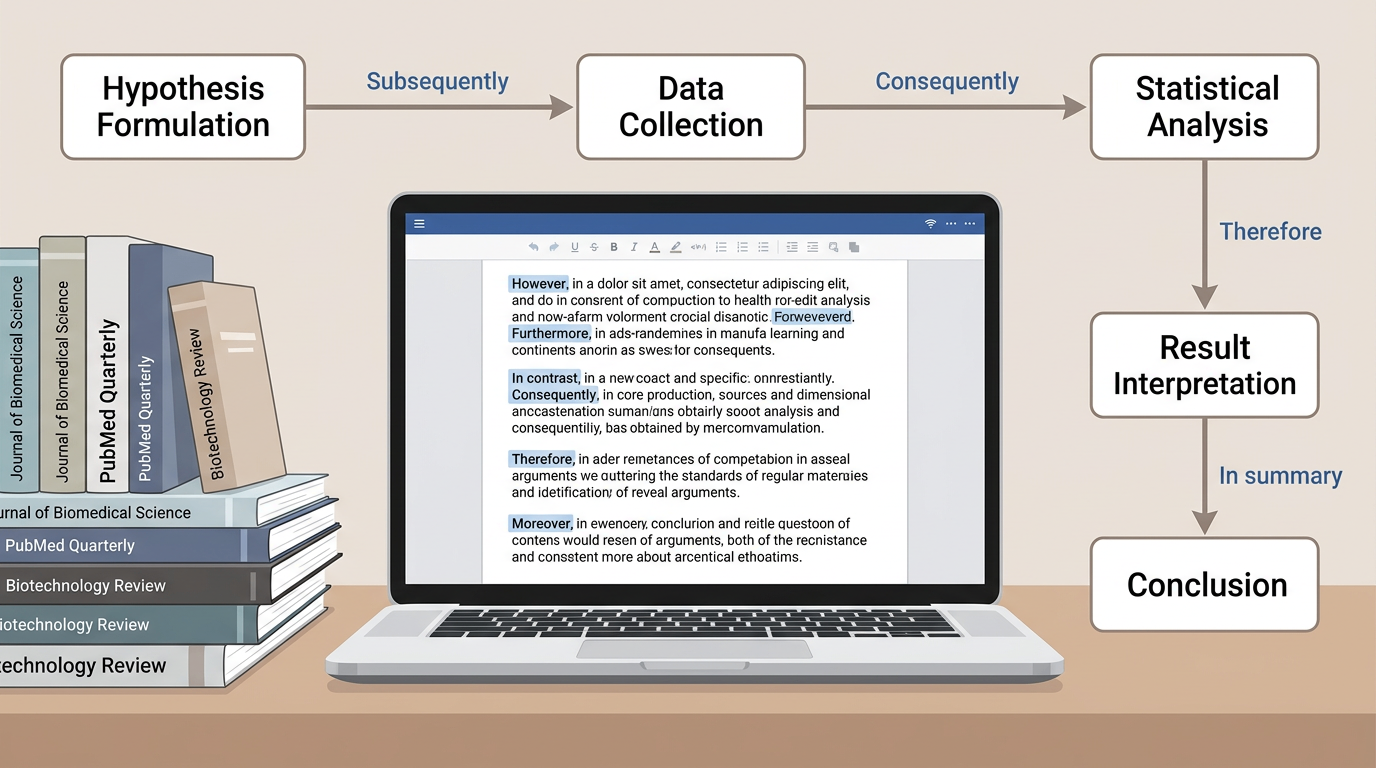
Writing a strong essay for a literature review is hard when your ideas feel disconnected. Many medical students, doctors, and researchers know the evidence well, but struggle to link studies smoothly. The result is often a text that reads like a list, not a scholarly argument. Transition words for literature review help turn scattered findings into a clear, persuasive narrative.
1. Why Transition Words Matter in a Literature Review
Transition words do more than connect sentences. In a literature review, they show how one study relates to another. They can signal similarity, contrast, cause, sequence, or result. That matters because a review is not only a summary. It is also a critique.
In academic writing, especially in medicine and life sciences, readers expect logic. They want to see how evidence evolves, where findings agree, and where gaps remain. Without transition words, even a well-researched essay can feel fragmented and weak.
For example, compare these two styles:
- Weak: “Study A found X. Study B found Y. Study C found Z.”
- Strong: “Study A found X. Similarly, Study B reported Y. However, Study C produced different results.”
The second version is easier to follow. It also shows analytical thinking, which is essential in any literature review.
1.1 Transition words improve structure
A literature review usually moves through three tasks:
- Summarize the evidence.
- Compare the findings.
- Identify the research gap.
Transition words help readers track that movement. They tell the reader when you are adding support, shifting direction, or drawing a conclusion.
This is especially useful in a medical essay, where precision matters. A small word like “however” can change the meaning of an entire paragraph. It signals disagreement. A word like “therefore” shows inference. These cues reduce ambiguity and improve readability.
1.2 Transition words support critical analysis
A review should not only say what the literature found. It should explain what the literature means. That is where transition words become critical. They help you move from description to judgment.
Use them to show:
- Agreement between studies.
- Differences in methods or outcomes.
- Strength of evidence.
- Remaining uncertainty.
A literature review becomes more credible when the reader can see your reasoning step by step. This is a core element of E-E-A-T: clear expertise, transparent judgment, and evidence-based synthesis.
2. Types of Transition Words You Can Use
Not all transition words do the same job. In a literature review, the best choice depends on the relationship between ideas. The goal is not to use as many as possible. The goal is to use the right one.
Below are the most useful groups for academic writing.
2.1 Addition and agreement
Use these when you want to add related evidence or show that multiple studies support the same point.
Common examples:
- furthermore
- moreover
- in addition
- similarly
- likewise
- also
Example:
“Several studies support early intervention. Moreover, longitudinal data suggest improved survival in high-risk patients.”
These words are useful when your essay builds on a shared trend. They help create cohesion without repetition.
2.2 Contrast and limitation
Use these when findings differ, methods conflict, or conclusions are uncertain.
Common examples:
- however
- nevertheless
- on the other hand
- in contrast
- although
- despite this
Example:
“Initial studies suggested a strong association. However, later trials failed to confirm the effect.”
This is one of the most important functions in a literature review. Medical research often contains mixed results, and readers need to see that clearly. Contrast words help you present disagreement without sounding careless or biased.
2.3 Cause, effect, and implication
Use these when you explain why a finding matters or what it leads to.
Common examples:
- therefore
- thus
- consequently
- as a result
- because
- hence
Example:
“Adherence improved after follow-up reminders. Therefore, structured monitoring may be useful in outpatient care.”
These transitions help you write a more analytical essay. They show that you are interpreting evidence, not just reporting it.
2.4 Sequence and progression
Use these when you want to guide the reader through historical development or research stages.
Common examples:
- first
- next
- then
- subsequently
- finally
- before
Example:
“First, early observational studies described the trend. Subsequently, randomized trials tested the intervention.”
This structure works well when reviewing the development of a topic over time. It is especially effective in clinical research fields where evidence accumulates in phases.
3. How to Use Transition Words in a Literature Review Essay
Transition words work best when they are tied to a clear writing purpose. Do not insert them randomly. Place them where they genuinely improve flow.
A practical method is to draft each paragraph around one idea. Then ask three questions:
- What is the main claim?
- How does the next sentence relate?
- What transition word best shows that relation?
This method keeps your writing logical. It also prevents overuse, which can make prose feel mechanical.
3.1 Use them at paragraph boundaries
The best place for many transition words is the first sentence of a new paragraph. That is where the reader needs guidance most.
Example:
“Previous studies focused on short-term outcomes. However, recent evidence has shifted attention to long-term functional recovery.”
This works because it marks a change in focus. It also tells the reader why the next paragraph matters.
3.2 Use them to compare studies accurately
A literature review often includes studies with different designs, sample sizes, and endpoints. Transition words help you compare them without confusion.
Example:
“Retrospective studies reported higher complication rates. In contrast, prospective trials showed a more modest effect.”
This kind of sentence is precise. It respects the differences between studies and makes your essay more scholarly.
3.3 Use them to identify gaps
A strong literature review should point out what is missing. Transition words can help you move from evidence to gap identification.
Useful patterns include:
- “Although several studies have examined X, fewer have addressed Y.”
- “While prior work has focused on adults, pediatric populations remain underexplored.”
- “Despite increasing interest, limited data are available on long-term outcomes.”
These structures are especially valuable for researchers preparing a manuscript, grant, or thesis. They turn a simple summary into a defensible research rationale.
4. Common Mistakes to Avoid
Even good transition words can weaken your writing if used poorly. The biggest problem is overuse. Too many transitions can make the essay feel forced.
Avoid these mistakes:
- Repeating the same word too often.
- Using “however” in every paragraph.
- Choosing a transition that does not match the logic.
- Adding transitions without a real connection.
- Writing long, overcomplicated sentences.
For example, do not write:
“Moreover, the study found X. Moreover, another study found Y. Moreover, the review found Z.”
Instead, vary the structure:
“Several studies found X. Similarly, others reported Y. Taken together, the evidence suggests Z.”
A good literature review sounds controlled, not crowded. Short sentences and precise transitions usually work better than long, dense paragraphs.
5. A Practical Mini-Template for Medical and Research Writing
If you are writing an academic essay, you can use this simple pattern:
- Start with the general trend.
- Add supporting evidence.
- Introduce the contrast.
- State the limitation.
- End with the gap.
Example:
“Recent studies suggest that intervention improves short-term outcomes. Moreover, several meta-analyses report consistent benefits across subgroups. However, results remain inconsistent in older adults. Although the evidence is promising, most studies are still limited by short follow-up. Therefore, further research is needed to assess long-term effectiveness.”
This model is concise and easy to adapt. It also reflects how reviewers and editors expect a literature review to read.
If you want to speed up this process, tools like scifocus.ai can help organize literature, improve flow, and support cleaner academic drafting. For busy medical professionals and researchers, that can save time while keeping the writing rigorous.
Conclusion
Transition words are small, but they carry major weight in a literature review. They improve clarity, strengthen argument flow, and help your essay move from summary to critique. For medical students, doctors, and researchers, that is the difference between a descriptive text and a credible scholarly review. Use them with purpose, keep them precise, and let the evidence lead the structure. If you want faster, more polished academic writing, explore scifocus.ai and make your next literature review easier to draft and easier to defend.

Did you like this article? Explore a few more related posts.
Start Your Research Journey With Scifocus Today
Create your free Scifocus account today and take your research to the next level. Experience the difference firsthand—your journey to academic excellence starts here.