

Transition Words for Giving Examples
Introduction
When writing an essay, especially in medicine or research, weak example transitions can make even strong ideas feel disconnected. Readers may understand the point, but not the logic. That is a serious problem in academic writing. In scientific essays, transitions do more than join sentences. They guide interpretation, comparison, and emphasis.
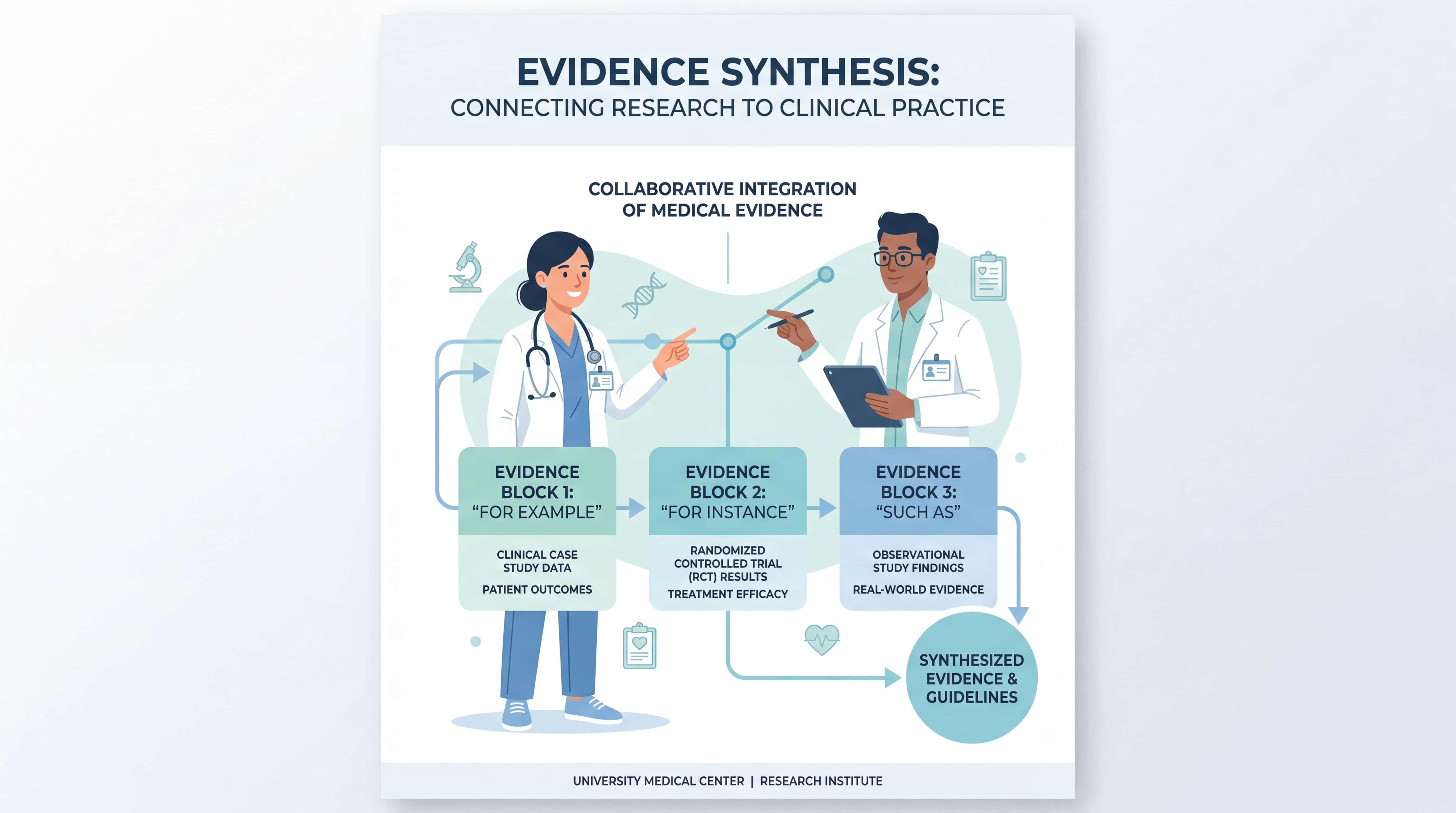
1. Why Example Transitions Matter in Academic Writing
1.1 They make your argument easier to follow
In a medical essay, readers expect precision. A good example transition tells them that the next sentence is not random. It is evidence, clarification, or illustration.
This matters in clinical notes, research discussions, and literature reviews. When you use example transitions well, your writing becomes more logical. It also becomes more trustworthy.
Strong transitions reduce cognitive load. They help the reader process one idea at a time. That is especially useful when the topic is complex, such as disease mechanisms, biomarkers, or treatment comparisons.
1.2 They improve clarity without overexplaining
Many writers repeat the same pattern. They add examples, but they do not signal them clearly. As a result, the paragraph feels flat.
For example, instead of writing only “Several markers were altered,” you can write:
- Several markers were altered. For example, E-cadherin decreased.
- Several markers were altered. For instance, inflammatory cytokines increased.
This small change improves readability. It also makes the essay sound more professional.
2. The Most Useful Transition Words for Giving Examples
2.1 Core example transitions
The most common transitions for examples are simple, direct, and widely accepted in academic writing:
- For example
- For instance
- Such as
- Including
- Namely
These are the safest choices for a formal essay. They are clear. They are neutral. They work in almost all disciplines.
Use for example and for instance when you introduce one or more specific cases. Use such as when the example is part of a larger group. Use namely when you want to specify something already mentioned.
2.2 How their tone differs
Not all example transitions do the same job.
- For example is the most flexible.
- For instance is slightly more formal in many contexts.
- Such as works best inside a noun phrase.
- Namely is more precise and narrow.
Choose the transition based on sentence structure, not habit. This is one of the most important rules in academic writing.
3. How to Use Example Transitions Correctly
3.1 Match the grammar to the transition
A frequent mistake in an essay is using the wrong structure after a transition word. Good style is not only about vocabulary. It is also about grammar.
Examples:
- Correct: Many inflammatory pathways are involved, for example, NF-κB signaling.
- Correct: Many inflammatory pathways are involved, such as NF-κB signaling.
- Correct: The study focused on one pathway, namely NF-κB signaling.
A useful rule is this. Use “such as” before a list or noun phrase. Use “for example” before a complete example sentence or clause.
3.2 Avoid weak repetition
If every paragraph starts with “for example,” the writing becomes predictable. That weakens the impact.
Instead, vary the structure:
- For example, the treatment reduced tumor size.
- This effect was seen in several models, including xenografts.
- The same pattern appeared in two cell lines, namely A549 and H1975.
Variation improves flow. It also keeps the reader engaged.
4. Best Practices for Medical and Research Essays
4.1 Use examples to support claims, not replace them
In scientific writing, an example should clarify a claim. It should not stand in for evidence.
A weak sentence says:
- The pathway is important, for example, it affects cells.
A stronger sentence says:
- The pathway is important. For example, it regulates proliferation, apoptosis, and migration in tumor cells.
The second version adds meaningful detail. It tells the reader why the claim matters.
4.2 Place the example after the main idea
This is a core principle of academic style. First, state the general point. Then add the example.
That structure is easier to read:
- Main claim.
- Specific illustration.
- Short interpretation.
In a medical essay, this pattern improves both clarity and authority.
4.3 Use examples to compare studies
Example transitions are also useful when summarizing literature. You can introduce a representative study or result.
For example:
- Several studies support this mechanism. For example, a 2023 report showed reduced migration after gene silencing.
- Similar findings were reported in other cancers, such as breast and colorectal tumors.
This technique is common in literature reviews because it keeps the discussion focused while still showing breadth.
5. Transition Words That Work Well Beyond Examples
5.1 Combine example transitions with logical links
In a strong essay, example words often work better when paired with other transitions:
- Therefore
- However
- In addition
- Moreover
- In contrast
This creates a more complete argument. You do not just give examples. You explain what they mean.
For instance:
- The results were consistent across groups. For example, both cohorts showed improved survival. Therefore, the effect appears robust.
That is much stronger than a single isolated example.
5.2 Prefer precision over intensity
In academic writing, especially for medical readers, clarity is more important than rhetorical force. A mild transition is often better than a dramatic one.
The same principle applies to contrast words. In scientific context, however is often safer than but when the writer wants a neutral, professional tone. This is useful when your essay needs to report findings carefully.
The best academic transitions are accurate, not flashy.
6. Practical Examples for Medical Writers
6.1 Sentence models you can reuse
Here are several clean models for a formal essay:
- For example, elevated IL-6 was observed after treatment.
- For instance, three patients developed mild adverse events.
- Markers of EMT, such as E-cadherin and vimentin, were measured.
- The authors identified one major regulator, namely BIRC3.
- Several tissues were analyzed, including liver, lung, and kidney.
These patterns are simple. They are also highly reusable in medical and research writing.
6.2 Mini-paragraph example
Here is a short model:
The intervention improved cell viability in multiple experiments. For example, viability increased in both dose-response and time-course assays. The same trend was also seen in independent validation sets. Therefore, the finding appears consistent across conditions.
This kind of paragraph is concise and professional. It is suitable for a research essay or discussion section.
7. How SciFocus.ai Can Help
7.1 Faster drafting, cleaner transitions
Many medical writers know the content, but struggle with expression. They may have the data, but not the best academic phrasing.
That is where scifocus.ai can help. It supports structured scientific writing, improves sentence flow, and helps you place transitions more naturally. It is especially useful when you need to turn fragmented notes into a coherent essay.
Better transitions lead to better readability. Better readability supports stronger academic impact.
7.2 A practical writing workflow
A simple workflow can save time:
- Write the main claim.
- Add one precise example.
- Choose the correct transition word.
- Check grammar and tone.
- Revise for clarity and brevity.
Using a tool like scifocus.ai can make this process faster and more consistent. For medical students, doctors, and researchers, that means less time polishing sentences and more time refining ideas.
Conclusion
Transition words for giving examples are small, but their impact is large. In a medical or research essay, they improve clarity, structure, and credibility. Use for example, for instance, such as, and namely with care. Match the grammar. Avoid repetition. Keep the tone precise.
If your goal is to write stronger academic content with less effort, explore scifocus.ai. It can help you build clearer arguments, smoother transitions, and more professional essays.

Did you like this article? Explore a few more related posts.
Start Your Research Journey With Scifocus Today
Create your free Scifocus account today and take your research to the next level. Experience the difference firsthand—your journey to academic excellence starts here.