

Transition Words for Emphasizing Points
Introduction
Writing a strong essay in medicine or research is not only about facts. It is also about clarity. Many drafts lose impact because key points are buried in weak transitions. This makes the logic hard to follow and the message less convincing. For medical students, doctors, and researchers, precise linking words can improve flow, highlight findings, and strengthen argument quality. In this guide, we focus on transition words for emphasizing points and how to use them in a professional, academic essay.
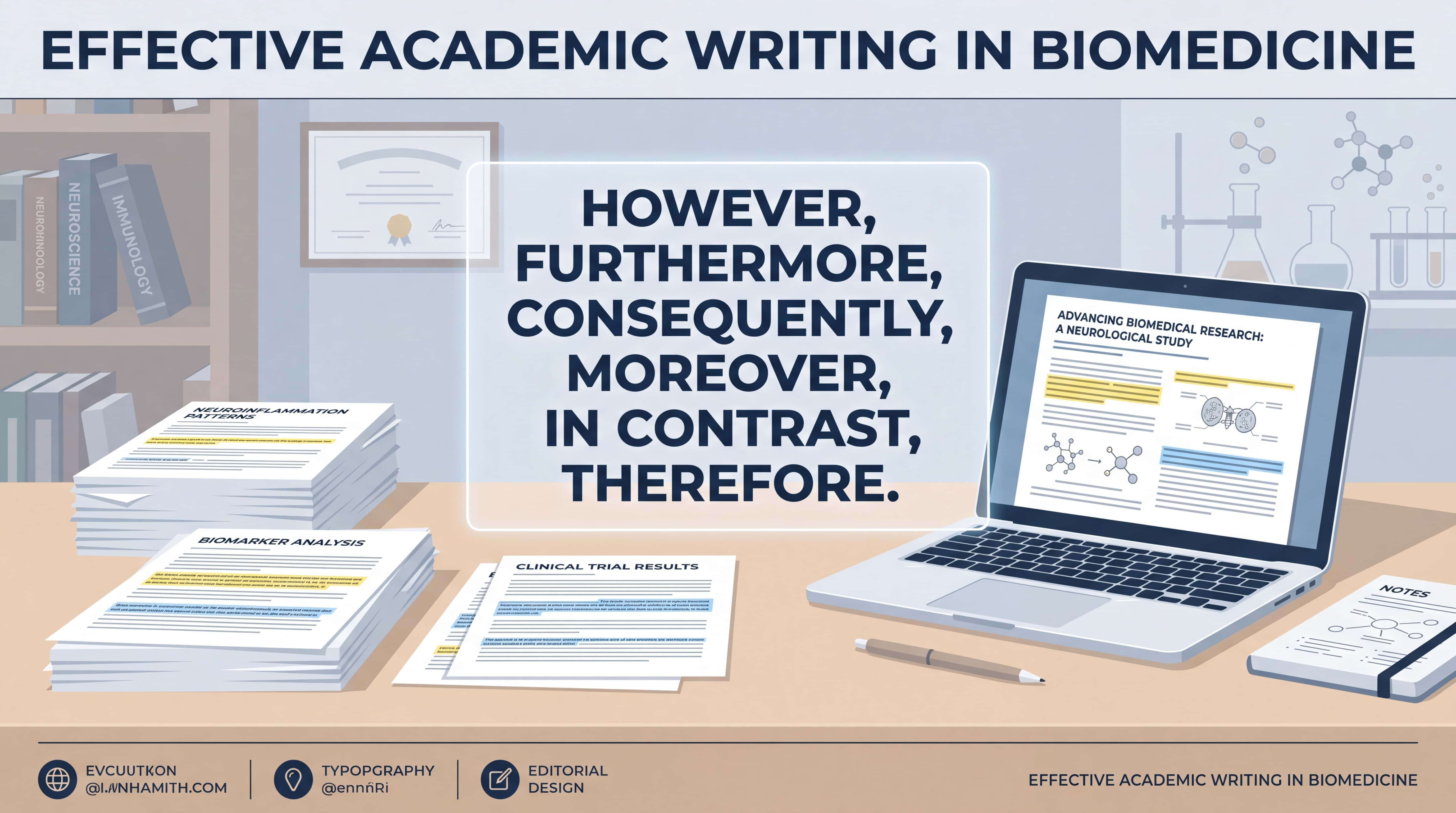
1. Why Emphasis Matters in Academic Writing
1.1 Strong transitions improve reader focus
In scientific writing, emphasis helps the reader identify what matters most. A sentence may be correct, but without emphasis, it may sound flat. That is a problem in an essay, especially when you want to highlight a result, a contrast, or a key interpretation.
Well-chosen transition words tell the reader where to look. They signal importance, progression, and logical weight. Words such as “notably,” “importantly,” “in fact,” and “significantly” help separate core findings from supporting details.
1.2 Emphasis supports structure and argument
A well-structured essay usually moves from observation to interpretation. Emphatic transitions help you build that path. They can introduce an unexpected result, underline an important mechanism, or connect two ideas without losing momentum.
For example, in research writing, authors often move from phenotype to mechanism, then to validation. Emphasis words make that sequence easier to read. They also reduce repetition. Instead of repeating “this is important,” you can use a precise transition that carries the same force.
1.3 Academic readers expect precision
Medical readers are trained to look for evidence, not decoration. That means your transitions should be functional. Use them to guide logic, not to exaggerate. In an academic essay, emphasis should feel measured, not promotional.
A good rule is simple. If the transition does not improve clarity, remove it. If it adds weight to a central point, keep it.
2. The Most Useful Transition Words for Emphasizing Points
2.1 Words that highlight importance
These are the most direct emphasis markers in academic writing:
- Importantly
- Notably
- Significantly
- Crucially
- Of note
- Indeed
- In particular
Use them when you want to show that the following statement deserves special attention. For example: “Notably, the expression of the target marker increased after treatment.” This makes the point stand out without sounding informal.
In a research essay, these words are especially useful in Results and Discussion sections. They help readers quickly see what changed and why it matters.
2.2 Words that strengthen a claim
Some transitions do more than highlight. They intensify the statement itself. Common examples include:
- In fact
- As a matter of fact
- More importantly
- Even more important
- Above all
These words work well when the second clause is stronger than the first. For example, you may write: “The treatment reduced inflammation. More importantly, it improved tissue recovery.” The second sentence carries higher interpretive value.
A careful point here. Do not use these words too often. Overuse weakens their impact. In a polished essay, emphasis works best when it is selective.
2.3 Words that show unexpected importance
Sometimes a finding is important because it is surprising. In that case, these transitions are useful:
- Interestingly
- Surprisingly
- Strikingly
- Unexpectedly
These are common in scientific writing because they signal novelty. For instance: “Interestingly, the control group also showed a mild response.” This tells the reader that the result is worth a closer look.
Use them only when the data truly support surprise. In a professional essay, overstating novelty can reduce trust.
3. How to Use Emphasis Transitions Correctly
3.1 Put the key point after the transition
The emphasized idea should come immediately after the transition word. That is where the reader expects the main message. If you hide the point too far away, the effect is lost.
Compare these two versions:
- Notably, the protein level dropped after silencing.
- The protein level dropped after silencing, which is notably relevant.
The first is clearer and stronger. In an essay, direct placement is usually better.
3.2 Match the transition to the sentence function
Not every emphasis word fits every context. Choose based on the purpose of the sentence.
Use “notably” when pointing to a key fact.
Use “importantly” when showing significance.
Use “in fact” when reinforcing or correcting an assumption.
Use “interestingly” when the result is unexpected but valid.
This matters in medical and scientific writing. A precise essay depends on accurate tone. The transition should reflect the actual strength of the evidence.
3.3 Avoid stacking too many emphasis words
A common mistake is to combine several emphasis markers in one sentence. For example, “Importantly, notably, and significantly” in the same line sounds forced. It also creates noise.
A cleaner approach is better:
- State the result.
- Add one emphasis word.
- Explain why it matters.
This keeps the writing readable. It also helps your essay sound confident rather than inflated.
4. Practical Patterns for Medical and Research Essays
4.1 Use emphasis in Results sections
Results writing should stay objective. Still, emphasis words are useful when you want to guide attention to the main observation. This is common in laboratory papers, clinical summaries, and dissertation chapters.
Examples:
- Importantly, the knockout reduced migration and invasion.
- Notably, the mRNA level changed before the protein change.
- Strikingly, the marker was elevated in the treated group.
These patterns are concise. They are also easy for readers to scan. In a biomedical essay, that is a major advantage.
4.2 Use emphasis in Discussion sections
The Discussion section is where you interpret what the results mean. This is the right place for stronger emphasis words because you are connecting findings to implications.
Examples:
- Crucially, the data support a direct regulatory link.
- In fact, the pattern is consistent with the proposed model.
- More importantly, the effect was reproduced across assays.
These sentences do not just report data. They tell the reader why the data matter. That is the core function of an effective academic essay.
4.3 Use emphasis in clinical or educational essays
Medical students often write essays on disease mechanisms, treatment comparisons, or case discussions. Doctors may need concise reports or review-style summaries. Researchers may prepare grant text or paper drafts. In each case, emphasis transitions help sharpen the message.
A practical workflow is:
- Write the full point without transitions.
- Identify the most important sentence.
- Add one emphasis word only.
- Read it aloud for natural flow.
This simple method improves the final essay without making it feel artificial.
5. Common Mistakes to Avoid
5.1 Using emphasis without real significance
Do not label every sentence as important. If everything is “notably” or “importantly,” then nothing stands out. Emphasis words should be reserved for key points.
5.2 Mixing emphasis with unsupported claims
A transition word cannot make weak evidence strong. If the data are limited, keep the wording modest. For example, “suggests” may be better than “confirms.” In a rigorous essay, credibility matters more than force.
5.3 Forcing casual style into formal writing
Some emphasis phrases are too conversational for scientific work. Choose language that fits the audience. Medical and research readers prefer clean, direct, and neutral phrasing.
6. A Simple Checklist for Better Emphasis
Before finalizing your essay, ask these questions:
- Is this the main point of the paragraph?
- Does the transition match the evidence?
- Am I using it too often?
- Would the sentence still be clear without it?
- Does the emphasis improve precision?
If the answer is yes, keep the word. If not, simplify the sentence.
For writers who need consistent quality, tools can help. scifocus.ai can support drafting, refining transitions, and improving academic tone. It is especially useful when you need to turn raw research notes into a structured, publication-ready essay with clearer emphasis and better flow.
Conclusion
Transition words are small, but their effect is large. In medical and research writing, they help you highlight what matters, guide the reader, and strengthen your argument without losing professionalism. The best essay uses emphasis sparingly, precisely, and with purpose. If you want faster drafting and cleaner academic transitions, consider using scifocus.ai to refine your writing workflow and produce more polished scientific text.
Did you like this article? Explore a few more related posts.
Start Your Research Journey With Scifocus Today
Create your free Scifocus account today and take your research to the next level. Experience the difference firsthand—your journey to academic excellence starts here.