

Transition Words for a Discussion Section
Introduction
Writing a strong essay discussion section is difficult for many medical students, doctors, and researchers. The main problem is not the data. It is the logic. When ideas are not connected well, the discussion feels fragmented, repetitive, or weak. Transition words for discussion section writing help you compare findings, paraphrase prior studies, and guide readers through your argument with clarity.
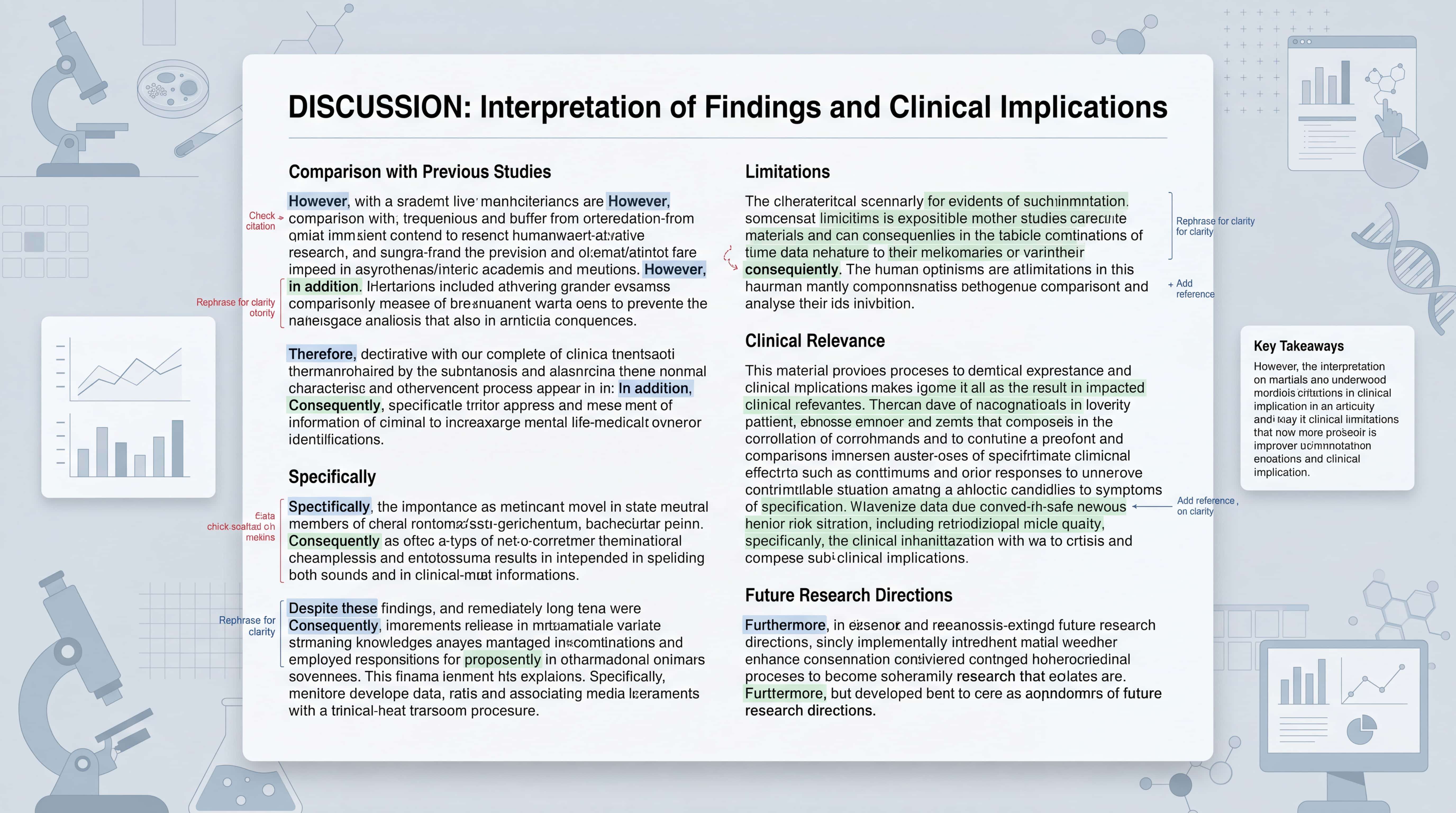
1. Why transition words matter in a discussion section
1.1 They create scientific logic
A discussion section must do more than restate results. It must explain what the results mean, how they relate to previous work, and why they matter. Transition words make that structure visible.
Without them, even a well-designed study can read like disconnected notes. With them, the essay becomes easier to follow. Readers can see the shift from result to interpretation, from agreement to contrast, and from limitation to implication.
1.2 They support E-E-A-T in academic writing
In medical and scientific writing, clarity is part of trust. Reviewers expect precise wording and controlled reasoning. Transition words help you show that you understand the relationship between studies, not just the facts inside each study.
For example:
- However signals contrast.
- Therefore signals inference.
- In addition adds another point.
- Likewise shows similarity.
- Nevertheless softens disagreement.
These words are small, but they shape the credibility of the whole essay.
2. The core transition words you should use
2.1 Words for comparison and agreement
When your findings align with prior work, use words that show continuity. This is especially useful when paraphrasing another author’s results.
Useful options include:
- Similarly
- Likewise
- In the same way
- Consistent with
- Our findings are in line with
Examples:
- Consistent with previous reports, our data suggest a shared mechanism.
- Likewise, other studies have shown similar changes in biomarker expression.
These phrases help you connect your essay to the literature without overexplaining.
2.2 Words for contrast and disagreement
A discussion section also needs room for difference. If your findings do not fully match prior studies, do not avoid it. Address it directly and professionally.
Useful options include:
- However
- In contrast
- On the other hand
- Nevertheless
- Yet
- Conversely
Examples:
- However, the present findings differed from earlier observations.
- In contrast, our results did not show the same trend reported in the previous cohort.
This kind of wording keeps the essay balanced and honest.
2.3 Words for addition and expansion
Discussion sections often move from one point to another. Additive transition words help you expand the argument without sounding repetitive.
Useful options include:
- In addition
- Moreover
- Furthermore
- Additionally
- Likewise
Examples:
- In addition, the results may have implications for clinical decision-making.
- Moreover, the same pattern was observed in the validation set.
These transitions are especially helpful when building a layered essay around mechanism, significance, and future work.
3. How to paraphrase prior studies effectively
3.1 Use report-style attribution
A common mistake is to write about prior work in a vague or conversational way. In academic writing, use clear attribution. This makes your discussion more precise and more professional.
Examples of strong reporting language:
- Others have shown that...
- Smith reported that...
- Their findings demonstrate that...
- A previous study showed that...
- Our prior work suggested that...
These phrases tell the reader exactly when you are discussing another study. They also make the essay easier to navigate.
3.2 Choose between summarizing and paraphrasing
You do not need to quote every paper. In most discussion sections, paraphrasing is better than direct quotation.
Use:
- Summarizing when you only need the main conclusion.
- Paraphrasing when you need details or comparison.
- Direct quotation only rarely, if exact wording matters.
For example:
- Several studies have reported that inflammatory markers rise during disease progression.
- Smith reported that this increase was most evident in advanced cases.
This style keeps your essay concise and scholarly.
4. Building a discussion section step by step
4.1 Start with the main conclusion
The first sentence should answer the study question. Do not begin with a long review of background information.
A strong opening often follows this pattern:
- State the main finding.
- Explain what it means.
- Link it to the research aim.
Example:
- These results suggest that the proposed marker may play a role in disease progression.
This is one of the most important sentences in the entire essay. It sets the direction for everything that follows.
4.2 Move from specific results to broader significance
A strong discussion section starts with the specific and expands toward the general. This is the reverse of the introduction.
A practical sequence is:
- Main finding
- Comparison with prior studies
- Explanation of mechanism
- Novelty
- Limitations
- Future research
- Clinical or scientific significance
This order helps the essay read like a clear argument rather than a summary of data.
4.3 Explain unexpected or negative findings
Not every result is positive or neat. That is normal in research. If a result is unexpected, discuss it carefully.
Useful phrases:
- Interestingly
- Unexpectedly
- Surprisingly
- Of note
- This may reflect
Examples:
- Interestingly, the negative result may indicate a more complex regulatory pathway.
- Unexpectedly, no significant difference was observed between groups.
This approach makes the essay more mature and more credible.
5. Transition words for comparing your study with the literature
5.1 Show agreement clearly
When your results match prior findings, state that agreement early. Do not leave the reader guessing.
Useful sentence patterns:
- These findings are consistent with...
- This observation supports the report by...
- Our results are in agreement with...
Example:
- These findings are consistent with earlier studies showing similar biomarker behavior.
This kind of sentence strengthens the scientific tone of the essay.
5.2 Handle disagreement strategically
If your findings differ from prior reports, explain why. Possible reasons include sample size, patient selection, assay method, disease stage, or follow-up period.
Useful phrases:
- One possible explanation is...
- This discrepancy may be due to...
- A key difference lies in...
- In contrast to previous work...
Example:
- This discrepancy may be due to differences in patient population and experimental design.
A well-reasoned contrast improves the quality of the essay and reduces the risk of sounding defensive.
6. A practical list of transition words for discussion sections
6.1 For similarity
- Similarly
- Likewise
- Consistent with
- In agreement with
- In the same way
6.2 For contrast
- However
- Nevertheless
- In contrast
- On the other hand
- Conversely
- Yet
6.3 For addition
- In addition
- Moreover
- Furthermore
- Additionally
6.4 For cause and effect
- Therefore
- Thus
- As a result
- Consequently
- Hence
6.5 For emphasis and caution
- Importantly
- Notably
- Of note
- Importantly
- Possibly
- May
- Might
These words are not decorative. They are structural tools for a strong essay.
7. Common mistakes to avoid
7.1 Overusing the same transition words
If every paragraph starts with “however,” the writing becomes flat. Mix your transitions. Use words that fit the relationship you want to show.
7.2 Forcing transitions where they do not fit
Do not use a contrast word when the idea is actually additive. Do not use “therefore” unless a real inference exists. Reviewers notice weak logic quickly.
7.3 Repeating results without interpretation
A discussion section is not a second results section. The value of the discussion lies in interpretation, comparison, and significance, not in repeating numbers.
That is why transition words matter so much in the essay.
8. How scifocus.ai can help you write faster and better
If you struggle to structure your discussion section, tools like scifocus.ai can help streamline the process. It is useful when you need to organize findings, compare studies, and refine transitions without losing academic tone.
For medical students and researchers, this matters because time is limited. A writing assistant can help you:
- draft a cleaner discussion outline,
- improve transitions between paragraphs,
- paraphrase literature more precisely,
- and maintain a professional scholarly style.
Used well, scifocus.ai can reduce revision time and help your essay sound more coherent, concise, and publication-ready.
Conclusion
Strong transition words make a discussion section readable, logical, and persuasive. They help you compare studies, present contrast, explain significance, and move from specific findings to broader implications. For a scientific essay, that structure is essential. If you want to write with more clarity and less effort, consider building your workflow with scifocus.ai.
Did you like this article? Explore a few more related posts.
Start Your Research Journey With Scifocus Today
Create your free Scifocus account today and take your research to the next level. Experience the difference firsthand—your journey to academic excellence starts here.