

Transition Words for Contradicting Ideas
Introduction
Writing a strong essay is not only about facts. It is also about showing contrast clearly. For medical students, doctors, and researchers, this matters in papers, discussions, and reviews. Without the right transition words for contradicting ideas, your argument can sound flat or unclear. The main problem is not lack of evidence. It is lack of connection between ideas.
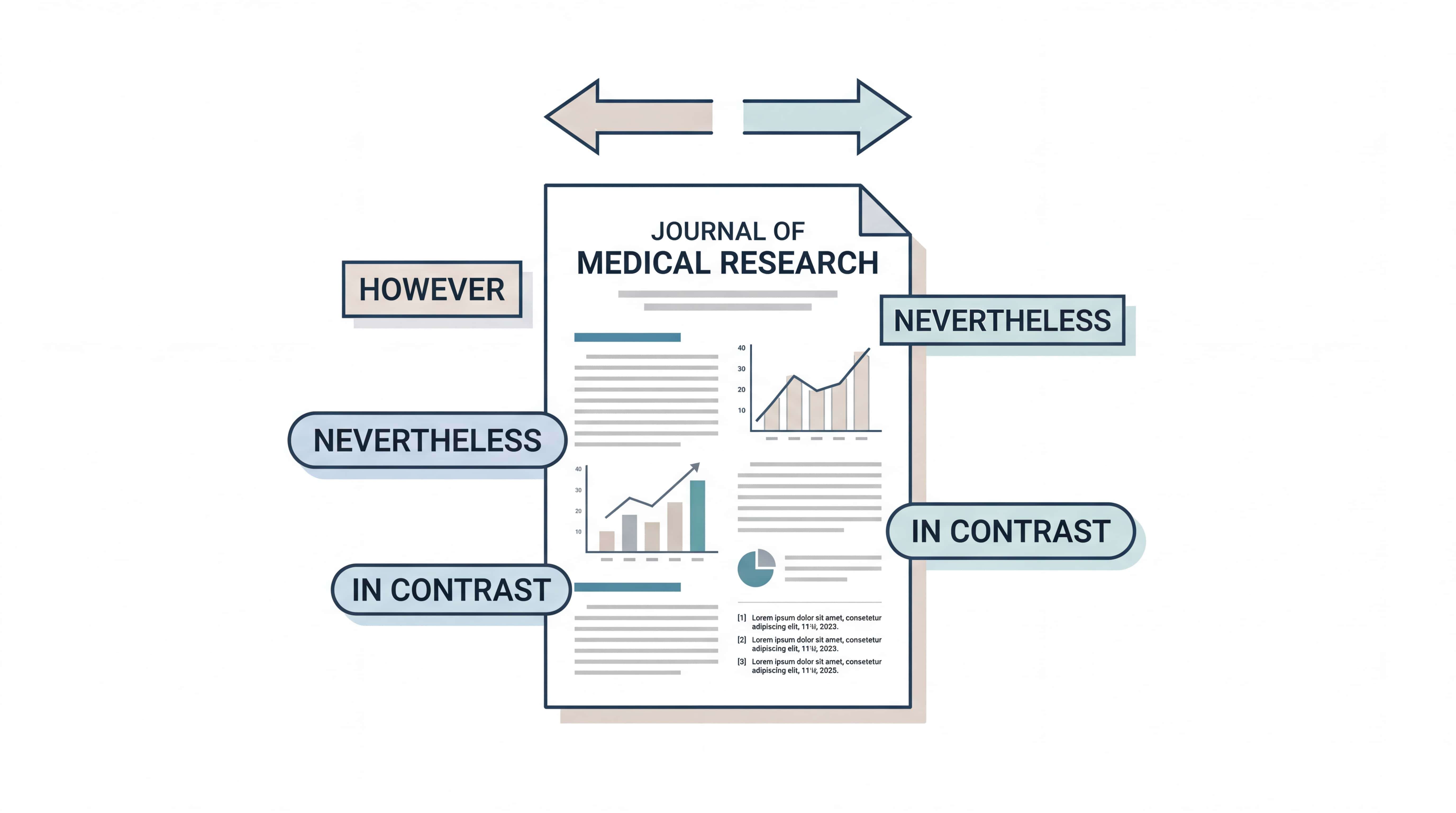
1. Why Contradicting Ideas Need Clear Transitions
1.1 Contrast Improves Scientific Logic
In scientific writing, contradiction is not confusion. It is structure. A good essay often compares two findings, two mechanisms, or two interpretations. Transition words help readers see where one idea ends and another begins.
This is especially important in medical and research writing. For example, one study may show a marker is elevated in cancer tissue, while another shows no meaningful difference. If you write this without contrast words, the reader has to guess the relationship.
Clear transitions reduce cognitive load. They help readers follow the logic in the first reading. That is valuable in fast-moving clinical and research settings.
1.2 Common Situations Where Contrast Appears
You will often need transition words for contradicting ideas when writing:
- literature reviews
- discussion sections
- case comparisons
- experimental results
- rebuttals to prior studies
In these sections, words such as however, in contrast, nevertheless, and on the other hand make the argument easier to follow. They also make your writing sound more professional.
A weak sentence says: “X increased. Y decreased.”
A stronger sentence says: “X increased; however, Y decreased under the same condition.”
The second version is more precise and more credible.
1.3 Why This Matters for Medical Writers
Medical readers value accuracy. They expect the data to be framed carefully. A good essay should not overstate agreement or disagreement. It should show the relationship between findings with exact wording.
For example, a research discussion may say:
- “The protein was associated with higher expression in tumor tissue.”
- “However, no significant difference was observed in adjacent normal tissue.”
This kind of contrast is clear, objective, and publication-ready. It also supports E-E-A-T because it reflects disciplined interpretation, not exaggerated claims.
2. Core Transition Words for Contradicting Ideas
2.1 High-Impact Contrast Words
Some transitions are used more often because they are direct and reliable. The most useful ones include:
- however
- nevertheless
- nonetheless
- in contrast
- on the contrary
- on the other hand
- conversely
- despite this
Use these when the second idea clearly limits, challenges, or reverses the first one. They work well in research papers, especially when reporting results that do not match the hypothesis.
Example:
“The treatment improved cell viability in vitro; however, the effect was not maintained in vivo.”
This sentence is balanced and informative. It presents a contrast without sounding dramatic.
2.2 Softer Contrast Words
Not every contradiction is strong. Sometimes the second idea is only partially different. In those cases, softer transitions are better:
- while
- yet
- although
- even though
- though
- whereas
These are useful when both ideas can exist at the same time. For example, one biomarker may be clinically useful while still lacking mechanistic clarity.
Example:
“Although the mutation was rare, it showed a strong association with poor prognosis.”
The key is matching the transition to the relationship. Overusing strong contrast words can make the text feel forced.
2.3 Transition Words That Show Unexpected Results
Scientific writing often needs words that signal surprise or tension with prior knowledge:
- unexpectedly
- surprisingly
- strikingly
- interestingly
- of note
- notably
These are useful when the data do not align with prior reports. They help the writer stay objective while guiding the reader.
Example:
“Interestingly, the knockdown did not reduce proliferation, but it significantly impaired invasion.”
This is a good model for a scientific essay because it highlights both the unexpected result and the exact biological effect.
3. How to Use Contrasting Transitions in an Essay
3.1 Place the Transition at the Right Point
The transition should appear exactly where the shift happens. Do not hide it too late. In a medical essay, the reader should know immediately that a contrast is coming.
A practical rule:
- State the first idea.
- Add the transition.
- Present the second idea.
- Explain why the contrast matters.
Example:
“Previous studies suggested that the marker was highly expressed in advanced disease; however, our data showed no clear difference across stages.”
This structure is concise and easy to read.
3.2 Pair the Transition With a Clear Comparison
A transition word alone cannot fix weak logic. The surrounding sentence must be specific. Compare the following:
Weak: “However, the result was different.”
Stronger: “However, the result was different in primary cells than in established cell lines.”
Specific comparison makes the contrast meaningful. This is especially useful in manuscripts, where vague statements reduce trust.
3.3 Use Contrast in Discussion, Not Just Results
Many writers use transition words only in the results section. That is a missed opportunity. In a strong essay, contrast should also appear in the discussion.
You can write:
- “Our findings support the current model.”
- “However, they also suggest an additional regulatory layer.”
- “In contrast to earlier reports, we observed a stronger effect in low-glucose conditions.”
This pattern helps readers understand both agreement and disagreement. It also shows that you can interpret data critically.
4. Practical Examples for Scientific Writing
4.1 Example in a Literature Review
A literature review often compares different studies. This is where transition words for contradicting ideas are essential.
Example paragraph:
“Several reports have linked the protein to tumor progression. However, other studies found no significant association in early-stage disease. In contrast, recent evidence suggests that its effect may depend on cellular context.”
This paragraph works because it shows the evolution of evidence. It does not force a single conclusion.
4.2 Example in a Research Discussion
In a discussion section, contrast words help you explain why your findings matter.
Example:
“The assay showed reduced migration after gene silencing. Nevertheless, the protein level of the EMT markers changed only modestly. This suggests that the phenotype may involve additional pathways.”
This is the type of reasoning medical readers expect. It is careful, balanced, and easy to verify.
4.3 Example in a Rebuttal or Response
When responding to reviewers or comparing your work with previous studies, contrast words help you stay professional.
Example:
“Our result differs from the previous report. In contrast to their use of immortalized cells, we used primary patient-derived samples.”
This kind of wording is objective. It explains differences without sounding defensive.
5. Common Mistakes to Avoid
5.1 Overusing “However”
“However” is useful, but repeating it in every paragraph weakens the writing. A good essay should vary its transitions.
Instead of repeating the same word, use:
- nevertheless
- in contrast
- yet
- whereas
- conversely
This keeps the prose cleaner and more readable.
5.2 Using a Contrast Word Without a Real Contrast
Do not use “on the other hand” if the second sentence is not actually opposing the first one. That creates confusion.
Wrong:
“The sample size was small. On the other hand, we used standard methods.”
Right:
“The sample size was small. However, the methods were standardized and reproducible.”
The transition must match the logic. Otherwise, the sentence loses credibility.
5.3 Mixing Contrast and Addition
Do not confuse contrast with addition. Words like “moreover” and “furthermore” add support. They do not contradict.
If the relationship is opposing, use contrast words.
If the relationship is cumulative, use additive words.
This distinction is basic, but it matters in every strong essay.
6. A Simple Framework for Better Writing
6.1 Use the “Claim, Contrast, Meaning” Pattern
For medical and research writing, this pattern is effective:
- Claim: state the first finding or idea.
- Contrast: introduce the opposing view or result.
- Meaning: explain what the difference implies.
Example:
“The biomarker was strongly expressed in aggressive tumors. However, its prognostic value was limited in early disease. This indicates that its clinical utility may be stage-dependent.”
This structure is concise and publication-friendly.
6.2 Build a Reusable Transition Bank
If you write scientific content often, keep a small bank of contrast words. This improves speed and consistency.
Recommended set:
- however
- nevertheless
- nonetheless
- in contrast
- on the other hand
- whereas
- while
- conversely
- although
- despite this
A fixed vocabulary bank helps you write faster without sounding repetitive.
6.3 Combine Transitions With Accurate Reporting
Good writing is not only about style. It is also about truthfulness. If the evidence is mixed, say so. If the effect is limited, say so. If the mechanism is unclear, say so.
That level of precision is what makes a medical essay trustworthy. It also improves readability for peers, reviewers, and editors.
7. Why Better Transitions Improve SEO and Trust
7.1 Search Engines Favor Clear Structure
Search engines reward content that is easy to scan and logically organized. Clear headings, short paragraphs, and precise transitions help both readers and crawlers.
An article about transition words for contradicting ideas should itself model good transitions. That means the writing must feel structured, not random.
7.2 Readers Stay Longer When Logic Is Clear
When readers can predict the flow of ideas, they stay engaged. That matters for blogs, academic resources, and product pages. It also supports conversion.
For researchers and clinicians, trust comes from clarity. A well-written essay signals competence. It suggests the author understands not only the topic, but also how to present it.
7.3 Scifocus.ai Can Support That Workflow
If your team writes manuscripts, discussion sections, or rebuttals regularly, Scifocus.ai can help streamline the process. It is designed to support research writing with clearer structure, faster drafting, and more consistent academic language.
For time-sensitive scientific work, that means fewer rewrites and cleaner output. It is especially useful when you need to compare studies, frame contradictions, or present results with precision.
Conclusion
Strong scientific writing depends on clear contrast. The right transition words for contradicting ideas make your essay easier to read, more accurate, and more persuasive. Use them to show disagreement, unexpected findings, or partial overlap between ideas. Choose the word that matches the logic. Keep the sentence specific. Avoid repetition.
If you want to write faster and maintain a more professional academic style, try Scifocus.ai for your next manuscript, literature review, or research summary. It can help you turn complex ideas into clearer, publication-ready writing.

Did you like this article? Explore a few more related posts.
Start Your Research Journey With Scifocus Today
Create your free Scifocus account today and take your research to the next level. Experience the difference firsthand—your journey to academic excellence starts here.