

Transition Words for an Analytical Essay
Introduction
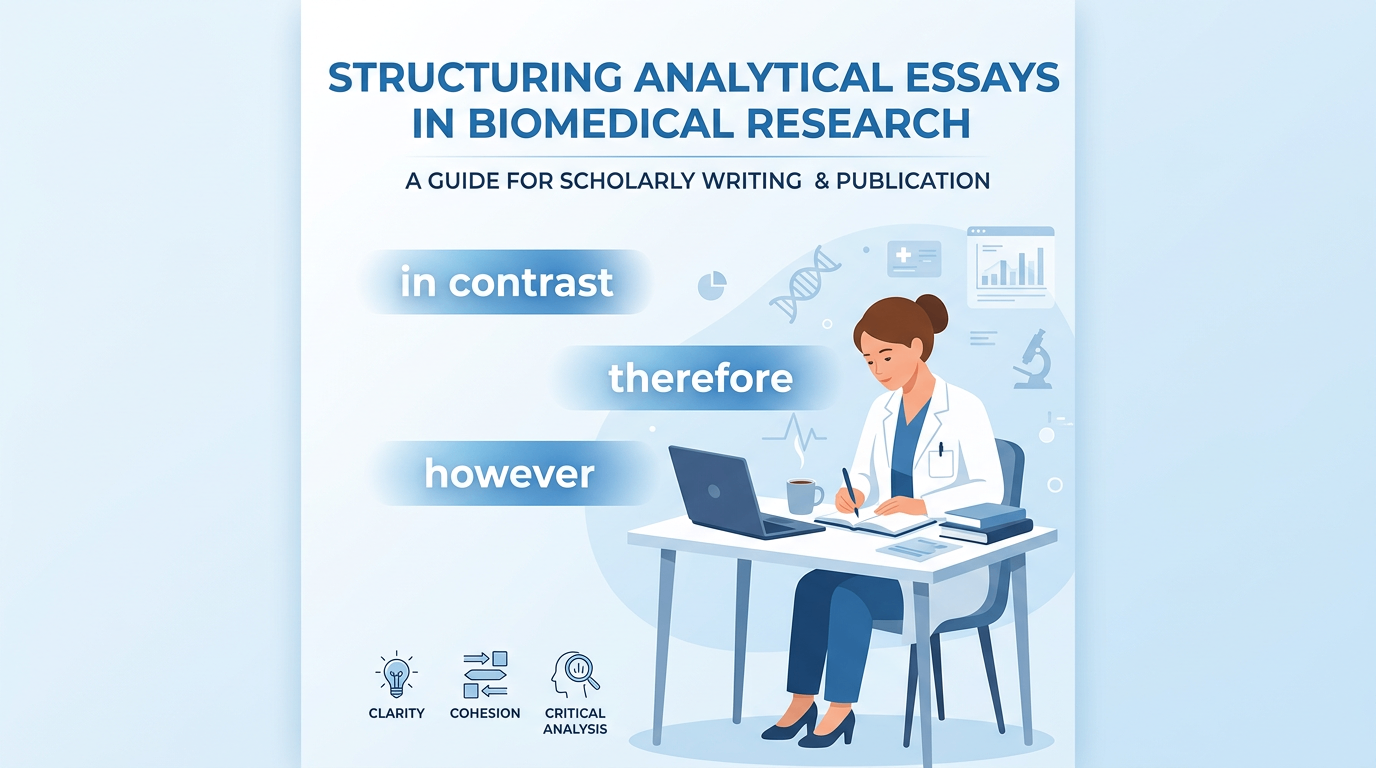
Writing an analytical essay in medicine, clinical practice, or research is not only about having strong evidence. It is also about showing clear logic. Many drafts lose force because ideas feel fragmented, comparisons are vague, or conclusions appear too early. If your essay must explain mechanisms, compare findings, or move from data to interpretation, transition words are essential. In a well-structured essay, they guide the reader through each argument without confusion.
1. Why transition words matter in an analytical essay
1.1 They create logical flow
An analytical essay depends on reasoning. Each sentence should lead to the next. Transition words make that movement visible. They show whether you are adding evidence, comparing results, signaling contrast, or drawing a conclusion.
Without transitions, even strong evidence can feel disconnected. For medical students, doctors, and researchers, this is a serious problem. Readers expect precision. They want to know whether a statement is a summary, a comparison, or an inference.
In scientific writing, transitions are not decoration. They are a structural tool. They help the writer move from observation to explanation. They also help the reader follow the logic of the essay from start to finish.
1.2 They improve clarity and credibility
A clear analytical essay sounds controlled and disciplined. Transition words reduce ambiguity. They signal that the writer understands the relationship between ideas. This matters in academic medicine, where imprecise wording can weaken an argument.
For example, a result can be stated in different ways:
- However, the mechanism remains unclear.
- Therefore, the next step was to test the pathway directly.
- In addition, the previous study reported a similar pattern.
Each phrase does a different job. That is why choosing the right transition word matters more than using many of them.
2. The main types of transition words for an analytical essay
2.1 Addition and progression
Use addition words when you want to build on a previous point. They are useful when one finding leads to another, or when you want to extend the discussion.
Common examples include:
- in addition
- furthermore
- moreover
- likewise
- also
- similarly
These words help create a stepwise argument. In a research-based essay, they are useful when linking one result to another. They tell the reader that the new point strengthens, rather than replaces, the previous one.
Example:
The study showed reduced inflammation. In addition, it found improved tissue repair.
2.2 Contrast and disagreement
Contrast words are essential in analytical writing. They are often used when findings differ from prior reports, when two mechanisms compete, or when one interpretation must be limited.
Common examples include:
- however
- in contrast
- nevertheless
- nonetheless
- although
- whereas
- on the other hand
These transition words are especially useful in a medical essay when discussing conflicting studies. They allow you to present disagreement without sounding abrupt.
Example:
Previous reports suggested a strong association. However, our data showed only a weak correlation.
Use contrast words only when the two ideas truly differ. Overusing them can make an essay sound forced.
2.3 Cause and effect
Cause-and-effect transitions are central to analytical essays because they help explain why something happened. They are especially important in scientific discussion sections, where evidence is often interpreted cautiously.
Common examples include:
- therefore
- thus
- as a result
- consequently
- hence
- because
- due to
These words should match the strength of your evidence. In research writing, therefore is appropriate when the relationship is strongly supported. Suggest or indicate is often better than a rigid causal claim when the evidence is indirect.
Example:
The intervention reduced bacterial load. Therefore, hospital stay was shortened.
2.4 Summary and conclusion
Summary transitions are useful at the end of a paragraph, section, or full essay. They help the writer consolidate the main message.
Common examples include:
- in conclusion
- to summarize
- in summary
- taken together
- overall
- collectively
In analytical writing, this is often the most efficient way to close a section. A strong summary sentence tells the reader what the evidence means.
Example:
Taken together, the findings support a clinically relevant benefit.
3. How to use transition words effectively in an analytical essay
3.1 Match the word to the logic
The best transition word is not the most advanced one. It is the one that reflects the real relationship between the ideas. This is a common problem in academic writing. Writers sometimes choose a “strong” word even when the logic is weak.
For example, if a result only suggests a possible relationship, therefore may be too strong. In that case, suggests, indicates, or may reflect is safer and more accurate.
A good rule is simple:
- Use addition words for extension.
- Use contrast words for disagreement.
- Use cause-and-effect words for supported inference.
- Use summary words for closure.
Accuracy is more persuasive than complexity.
3.2 Avoid repetition
Reusing the same transition word too often makes an analytical essay feel mechanical. If every paragraph starts with however or therefore, the writing loses rhythm.
A better approach is to rotate equivalent forms:
- however
- in contrast
- nevertheless
- still
- yet
Or:
- therefore
- thus
- as a result
- consequently
This keeps the essay readable while preserving the logic. It also shows stronger command of academic English.
3.3 Use signposting phrases for research-based writing
In scientific and medical essays, transition words often work best with signposting phrases. These phrases show the reader what kind of information is coming next.
Useful examples include:
- others have shown that
- previous studies reported that
- our findings demonstrate that
- this result suggests that
- the data indicate that
These forms are especially helpful when you need to connect your analysis with prior work. They also support E-E-A-T because they show careful citation awareness and disciplined interpretation.
4. High-value transition words for medical and scientific essays
4.1 For comparing studies
When writing about evidence from different papers, use comparison-focused transitions.
Examples:
- similarly
- likewise
- in the same way
- by contrast
- in contrast to
- compared with
These are useful when discussing diagnostic methods, biomarkers, treatment effects, or pathway activity. They help you show where studies agree and where they do not.
4.2 For discussing mechanisms
Mechanism-focused essays often need transitions that show sequence and relationship.
Examples:
- first
- next
- subsequently
- meanwhile
- meanwhile
- then
- accordingly
These words are valuable when explaining how one biological event leads to another. They are also useful when moving from phenotype to mechanism, or from mechanism to clinical implication.
Example:
The cells showed reduced migration. Subsequently, EMT markers were downregulated.
4.3 For drawing evidence-based conclusions
Conclusion language should be careful, not exaggerated.
Examples:
- therefore
- thus
- overall
- collectively
- in conclusion
- taken together
A strong analytical essay does not force certainty where evidence is limited. It presents the most reasonable conclusion supported by the data.
5. Common mistakes to avoid
5.1 Using transitions without a real logical link
A transition word cannot fix weak reasoning. If two sentences are unrelated, adding however or therefore will not make the argument valid. The logic must exist first.
5.2 Overusing informal or vague wording
In professional academic writing, avoid filler expressions that add no precision. Keep the language direct. Use clean sentence structure. Short sentences are often stronger than long, overloaded ones.
5.3 Treating every paragraph the same
A good analytical essay changes function from paragraph to paragraph. One paragraph may present evidence. Another may compare findings. A third may interpret significance. Transition words should reflect that movement.
6. A simple method for stronger analytical writing
6.1 Build each paragraph in three steps
A practical structure for an analytical essay is:
- State the point.
- Add evidence or comparison.
- End with a conclusion or implication.
This structure fits academic medical writing well. It keeps the argument visible and reduces drift.
Example:
The biomarker increased after treatment. However, the effect was not uniform across all subgroups. Taken together, the result suggests a context-dependent response.
6.2 Use AI tools to refine transitions
If you write essays regularly, especially for research or clinical publication, a structured writing assistant can save time. scifocus.ai can help you organize arguments, improve transitions, and refine academic tone without making the essay sound artificial. For medical students and researchers, that means faster drafting and cleaner logic.
It is especially useful when you need to:
- compare studies
- sharpen discussion sections
- reduce repetitive transition use
- maintain a formal academic style
A tool like this does not replace expert judgment. It supports it. That is exactly what a serious analytical essay needs.
Conclusion
Transition words are not small details. In an analytical essay, they control the logic, clarity, and authority of the entire argument. Use them to add information, show contrast, explain causality, and close with precision. Keep the wording accurate. Keep the structure clean. The best essay is not the one with the most transitions. It is the one with the clearest reasoning.
If you want to write faster and with stronger academic flow, try scifocus.ai. It can help you build a more coherent essay, improve transitions, and present your analysis with professional precision.
Did you like this article? Explore a few more related posts.
Start Your Research Journey With Scifocus Today
Create your free Scifocus account today and take your research to the next level. Experience the difference firsthand—your journey to academic excellence starts here.