

Transition Words for a Compare and Contrast Essay
Introduction
In a medical essay, clear comparison is not optional. It is essential. Whether you are reviewing clinical guidelines, contrasting study designs, or discussing treatment outcomes, weak transitions can blur your logic and reduce credibility. The right transition words for a compare and contrast essay help readers follow similarities, differences, and conclusions with precision. For medical students, doctors, and researchers, strong transitions improve clarity, structure, and scientific tone.
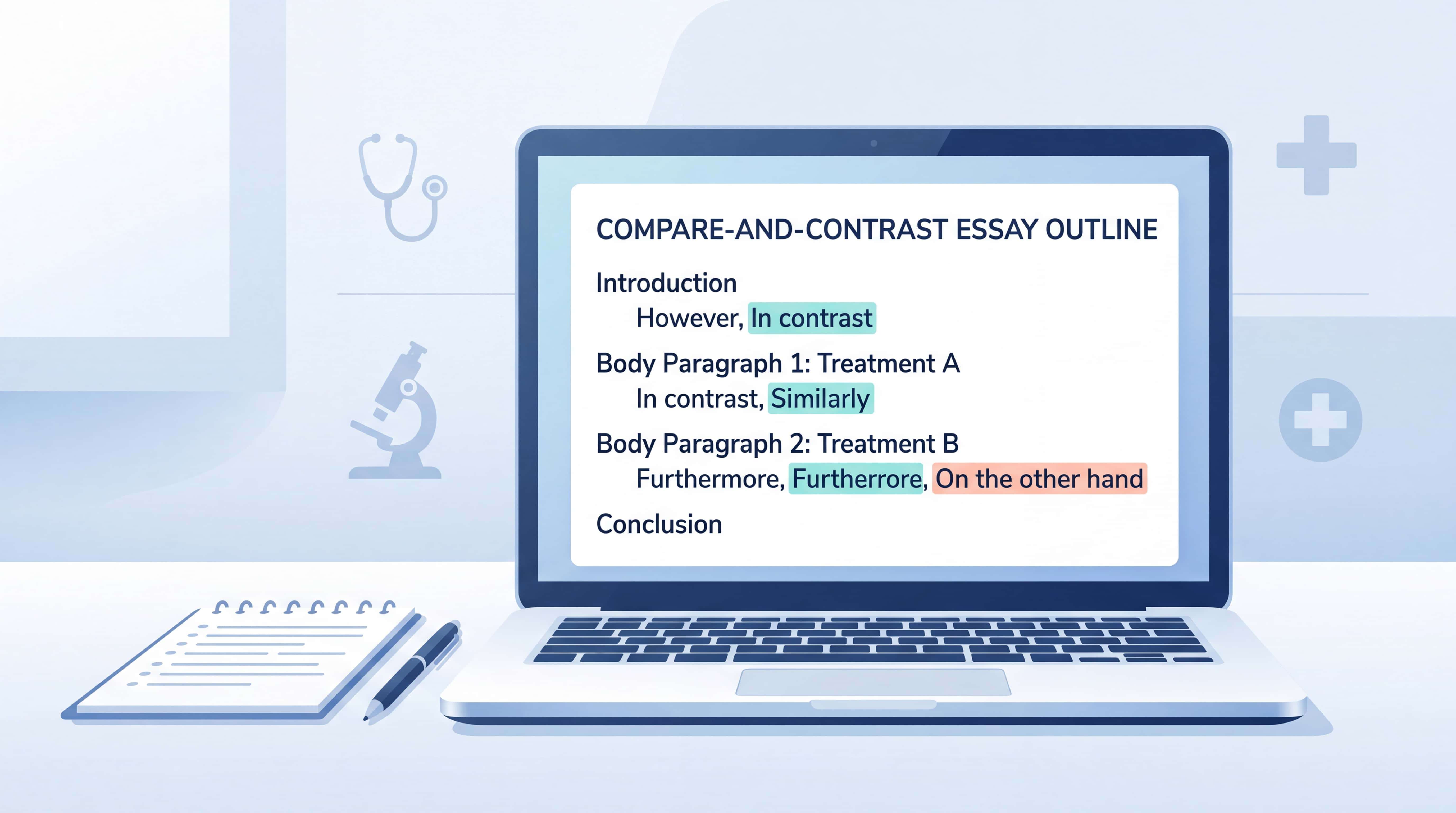
1. Why Transition Words Matter in a Compare and Contrast Essay
1.1 They make scientific logic easier to follow
In academic writing, especially in medicine and research, readers expect a clear chain of reasoning. Transition words show how one idea connects to the next. They tell the reader whether you are adding evidence, showing contrast, or drawing a conclusion.
Without transitions, even a well-researched essay can feel fragmented. A sentence may be correct on its own, but the paragraph may still lack direction. This is a common problem in draft manuscripts, discussion sections, and exam essays.
Strong transitions are not decorative. They are structural tools. They help you compare interventions, interpret findings, and avoid abrupt jumps between ideas.
1.2 They signal the relationship between ideas
A compare and contrast essay often moves between two types of logic. One is similarity. The other is difference. Transition words make that relationship explicit.
For example, a medical writer may use:
- likewise or similarly to show shared findings
- however or in contrast to show opposing results
- therefore or as a result to show a conclusion drawn from the comparison
This matters in scientific writing because your reader should not guess your meaning. The transition should do that work.
1.3 They improve readability and authority
A clear essay is easier to trust. In healthcare writing, trust matters. If your transitions are precise, your argument appears more controlled and professional.
This is especially important when comparing:
- two diagnostic methods
- two treatment strategies
- two patient cohorts
- two research papers with different outcomes
The best compare and contrast writing reads as if each sentence has a reason to be there. Transition words create that effect.
2. Core Transition Words for Similarities
2.1 Use these when two ideas agree
When you want to show similarity, use transitions that connect matching features, shared patterns, or overlapping conclusions. These words are useful in both coursework and manuscript writing.
Common similarity transitions include:
- similarly
- likewise
- in the same way
- equally
- also
- moreover
- in addition
These terms help you show that two studies, findings, or clinical observations are aligned.
For example:
- The new assay improved sensitivity. Likewise, the reference method showed high specificity.
- The intervention reduced pain scores. Similarly, it improved sleep quality.
2.2 When to use “in addition” and “moreover”
Use in addition when you are adding another matching point. Use moreover when you want a stronger academic tone. In formal medical writing, moreover often sounds more polished than “also.”
A good rule is this: use “also” for simple addition, and “moreover” for emphasis.
That distinction matters in a polished essay. It helps you avoid repetitive phrasing while keeping the tone professional.
2.3 Best practice for similarity transitions
Do not use too many similarity words in one paragraph. If every sentence begins with “likewise” or “moreover,” the writing becomes mechanical.
Instead, vary sentence structure. Combine transition words with signal phrases such as:
- the findings suggest
- the results indicate
- both studies demonstrated
- the same pattern was observed
This is especially effective in a compare and contrast essay for research audiences, because it sounds analytical rather than formulaic.
3. Core Transition Words for Differences
3.1 Use these when findings diverge
Difference is the heart of many compare and contrast essays. In medicine, differences can appear in outcomes, methods, side effects, or biological mechanisms.
The most useful contrast transitions include:
- however
- in contrast
- on the other hand
- whereas
- while
- nevertheless
- conversely
- instead
These words help the reader see that the second point modifies, limits, or opposes the first.
Example:
- The first trial reported a modest effect. However, the second trial found no significant benefit.
- One cohort received early intervention, whereas the control group did not.
3.2 Choose the right level of contrast
Not every difference needs the same strength.
- Use however for a general contrast.
- Use in contrast for a direct comparison.
- Use nevertheless when the second point is surprising but still relevant.
- Use on the other hand when presenting an alternative perspective.
Precise contrast words make your argument sound more disciplined. This is important in an essay dealing with clinical evidence, where overstatement can weaken trust.
3.3 Avoid misuse of “while” and “whereas”
These words are powerful, but they must be used carefully. They work best when two clauses are being compared in the same sentence.
Correct:
- While biomarker A was elevated, biomarker B remained stable.
- Treatment X reduced inflammation, whereas treatment Y primarily improved pain.
Incorrect:
- The study was large. While the conclusion was clear.
In a strong compare and contrast essay, syntax should be as clean as the logic.
4. Transition Words for Showing Cause, Result, and Evaluation
4.1 When comparison leads to a conclusion
In academic writing, comparison should not stop at description. It should lead to interpretation. That is why result and conclusion transitions matter.
Useful words include:
- therefore
- thus
- as a result
- consequently
- hence
- overall
- taken together
These words help you move from comparison to judgment.
Example:
- The new method detected more cases in early-stage disease. Therefore, it may be more suitable for screening.
4.2 Use them carefully in scientific writing
In research writing, strong causal words should reflect the strength of the evidence. If the data only suggest a relationship, use suggests, indicates, or may instead of claiming certainty.
A precise essay should avoid making a causal leap that the data cannot support.
Better:
- Taken together, these findings suggest that the intervention may improve adherence.
Less precise:
- Therefore, the intervention definitely works.
Accuracy is part of credibility. This is especially true for medical students, clinicians, and researchers.
4.3 Evaluation words help summarize the comparison
You can also use evaluative transitions such as:
- importantly
- notably
- significantly
- interestingly
- surprisingly
These words are useful when one point deserves attention. For example:
- Notably, the shorter protocol achieved similar diagnostic accuracy.
- Interestingly, the older treatment performed better in one subgroup.
Used properly, these transitions give your essay a more analytical voice.
5. How to Build a Compare and Contrast Essay Paragraph
5.1 Follow a simple structure
A clear paragraph usually follows this pattern:
- Topic sentence.
- First point.
- Transition word.
- Second point.
- Short interpretation.
Example structure:
- Topic: Two imaging methods differ in speed and precision.
- Point 1: Method A is faster.
- Transition: However
- Point 2: Method B provides greater detail.
- Interpretation: The choice depends on the clinical question.
This approach works well in every medical essay because it creates order.
5.2 Use one main comparison per paragraph
Do not overload one paragraph with five unrelated contrasts. Keep the logic tight. Compare one dimension at a time:
- efficacy
- safety
- cost
- accessibility
- time to result
This makes the paragraph easier to read and easier to grade or review.
5.3 Blend transitions with evidence
A transition word should not stand alone. It should connect to a fact, statistic, or observation.
For example:
- Treatment A reduced recurrence by 18%. In contrast, Treatment B showed no significant difference from placebo.
- The new assay was faster by 30 minutes. Likewise, it required less sample volume.
Transitions work best when they are anchored to data. That is the standard expected in a high-quality essay.
6. Common Mistakes to Avoid
6.1 Do not repeat the same transition too often
Using however in every paragraph weakens your writing. It becomes predictable. Mix your transitions with exact logic.
Use:
- in contrast
- whereas
- nevertheless
- similarly
- moreover
Variety improves flow and keeps the reader engaged.
6.2 Do not force contrast where none exists
Some students insert contrast words even when the ideas are not really opposite. That makes the essay feel artificial.
If two studies both support the same conclusion, use similarity transitions. If one study adds another detail, use addition transitions. Choose the word that matches the relationship.
6.3 Do not use casual language in formal writing
In a professional medical essay, avoid overly conversational transitions like “plus,” “anyway,” or “but then.” They can reduce academic tone.
Prefer:
- however
- furthermore
- in addition
- in contrast
- therefore
These are safer choices for scientific and clinical readers.
7. Practical Tips for Medical Students, Doctors, and Researchers
7.1 Match the transition to the purpose
Before writing, ask:
- Am I showing similarity?
- Am I showing contrast?
- Am I adding evidence?
- Am I drawing a conclusion?
That one question can prevent most transition errors in a compare and contrast essay.
7.2 Build a small transition bank
Keep a short list of high-value words for quick use:
- Similarity: similarly, likewise, in addition
- Contrast: however, in contrast, whereas
- Conclusion: therefore, thus, taken together
This saves time during exam writing and manuscript drafting.
7.3 Use AI support to draft faster
If you need help organizing comparisons, tools like scifocus.ai can support outline creation, paragraph flow, and academic phrasing. It is useful when you want to draft a cleaner essay faster and reduce repeated wording.
For medical writing, that can mean:
- faster structure planning
- more consistent transitions
- clearer argument flow
- less time spent rewriting weak sentences
8. Conclusion
8.1 Final takeaway
Strong transition words are the backbone of a clear compare and contrast essay. They help you show similarity, signal difference, and move from evidence to conclusion. For medical students, doctors, and researchers, this is not just a writing skill. It is a clarity skill.
Use transitions with precision. Use them sparingly. Use them to guide the reader, not decorate the page.
8.2 Action step
If you want to write faster and with more structure, try drafting your next academic essay with the support of scifocus.ai. It can help you organize comparisons, refine transitions, and present your ideas in a more professional scientific style.

Did you like this article? Explore a few more related posts.
Start Your Research Journey With Scifocus Today
Create your free Scifocus account today and take your research to the next level. Experience the difference firsthand—your journey to academic excellence starts here.