

Transition Phrases for Topic Sentences
Introduction
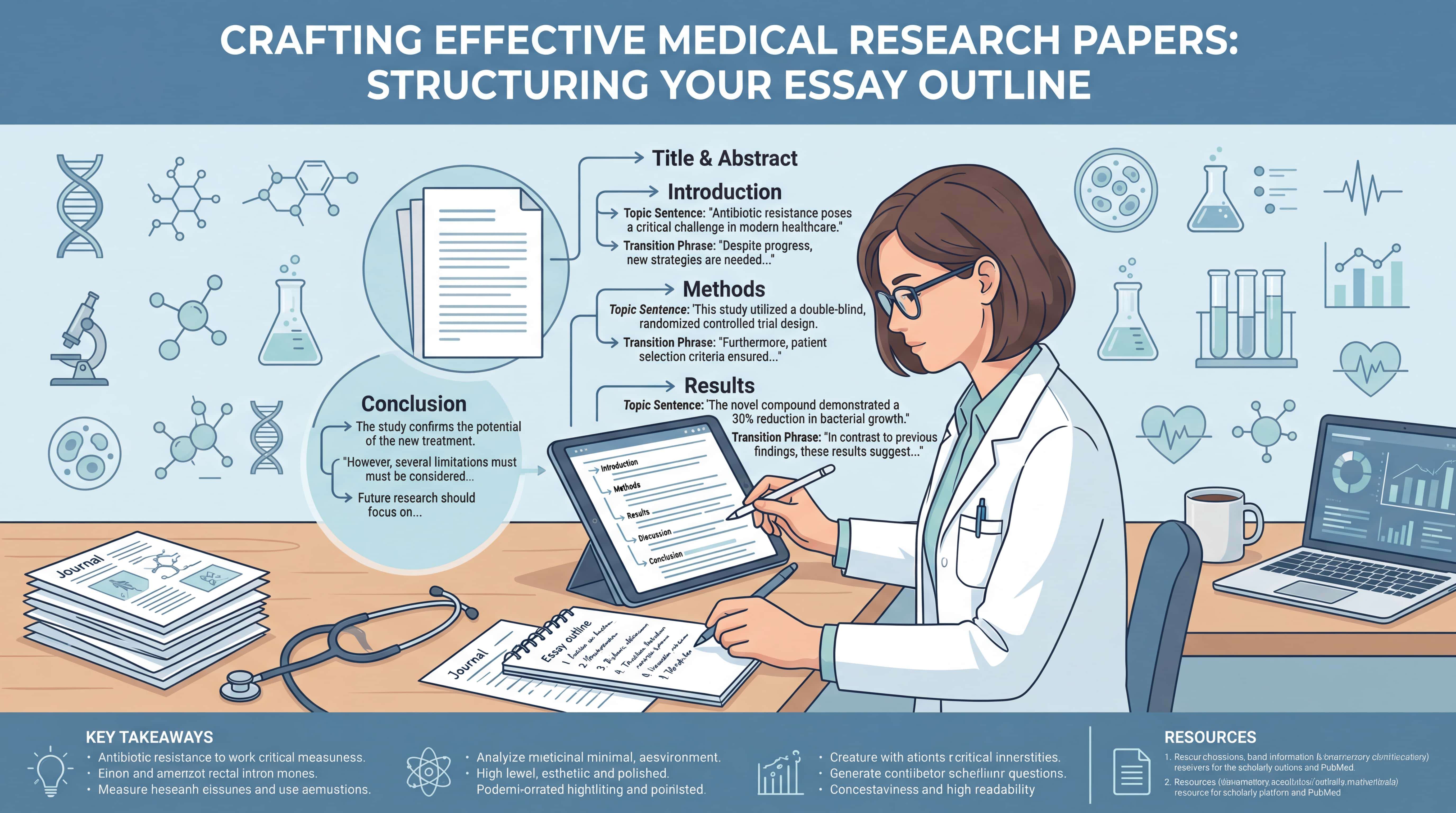
Writing an essay for medical school, clinical training, or research publication often fails at one key point: the topic sentence does not move smoothly. The result is weak logic, unclear argument flow, and lower reader confidence. In scientific writing, that is costly. Strong transition phrases for topic sentences help each paragraph begin with purpose, direction, and precision.
1. Why Topic Sentence Transitions Matter in Scientific Writing
1.1 They guide the reader through your essay
A topic sentence is not just a paragraph opener. It is a signpost. In medical and research writing, it tells the reader what the paragraph will prove, compare, or explain next.
Without a clear transition, even a well-researched essay can feel fragmented. Readers may understand each sentence, yet still miss the logic. That is why transition phrases matter. They create continuity between old information and new information.
A good transition does two jobs at once. It links paragraphs and it narrows attention to the next point.
1.2 They support logical movement in academic argument
Scientific writing is built on reasoning. Background leads to gap. Gap leads to hypothesis. Hypothesis leads to evidence. Evidence leads to interpretation.
Transition phrases help you show that movement. In the knowledge-gap section of a paper, for example, words like however, nevertheless, and although are often used to signal that the discussion is moving from what is known to what remains uncertain. This is more effective than abrupt paragraph shifts.
For medical students, doctors, and researchers, this matters because readers expect the argument to be exact. A vague opener weakens trust. A precise opener strengthens it.
2. How to Choose the Right Transition Phrase
2.1 Match the transition to the relationship
Not every transition phrase means the same thing. The best choice depends on the relationship between two ideas.
Use this simple framework:
- Addition. Use furthermore, moreover, in addition.
- Contrast. Use however, nevertheless, in contrast, although.
- Cause and effect. Use therefore, thus, as a result.
- Example or emphasis. Use for example, specifically, notably.
If you use the wrong signal, the paragraph may sound technically correct but logically awkward. For instance, but is a stronger contrast marker than however. In academic writing, however is often preferred because it sounds more measured and less abrupt.
2.2 Keep the tone formal and controlled
In an essay for medical or scientific audiences, tone matters. Informal transitions can sound unprofessional. Overly dramatic transitions can also distort the logic.
A strong academic transition should be:
- concise
- clear
- neutral
- logically accurate
In most scholarly contexts, use the weakest transition that still expresses the correct relationship. That principle often improves readability. It also prevents your writing from sounding forced.
3. Transition Phrases for Common Topic Sentence Patterns
3.1 Starting a new point in the same argument
When the new paragraph continues the same line of reasoning, use additive transitions.
Examples:
- Furthermore, recent studies have shown…
- In addition, emerging evidence suggests…
- Moreover, this mechanism may explain…
These openers work well when your essay builds step by step. They are especially useful in literature reviews and discussion sections, where the writer must connect multiple studies into one argument.
3.2 Introducing contrast or a limitation
When the next paragraph introduces a limitation, exception, or competing finding, contrast transitions are more appropriate.
Examples:
- However, these findings do not fully explain…
- Nevertheless, the clinical impact remains uncertain.
- In contrast, later studies reported different results.
This is the standard way to write a knowledge gap. It clearly tells the reader that the narrative is changing. In medical research writing, this kind of shift is essential because it frames the importance of the new study.
3.3 Showing consequence or inference
When the next paragraph follows from the previous one, use cause-effect transitions.
Examples:
- Therefore, the authors proposed a new model.
- As a result, the treatment strategy was revised.
- Thus, the data support a different interpretation.
These phrases are useful in results and discussion sections. They help the reader see why the next point matters. They also make the essay feel more structured and less descriptive.
4. How to Write Strong Topic Sentences in an Essay
4.1 Put the main idea first
A topic sentence should contain the central claim of the paragraph. Do not bury the point under background details.
Weak:
- In recent years, with the development of molecular biology and clinical diagnosis, many studies have explored this issue.
Stronger:
- Recent studies have clarified several molecular pathways involved in this process.
The second version is cleaner. It tells the reader what the paragraph is about immediately.
4.2 Add one transition phrase, not three
Many writers overuse transitions. That creates heavy, unnatural prose. One precise phrase is usually enough.
For example:
- However, the available evidence remains limited.
- Moreover, the findings were consistent across cohorts.
Do not stack similar connectors in one sentence. Clarity matters more than decoration. In an academic essay, over-transitioning can reduce impact.
4.3 Keep the sentence linked to what came before
A topic sentence works best when it echoes the previous paragraph. This creates a bridge.
For example:
- Previous paragraph ends with diagnostic uncertainty.
- Next paragraph begins with: However, this uncertainty also creates an opportunity to identify more precise biomarkers.
This method improves flow. It also helps the reader follow your logic without having to re-read.
5. Practical Examples for Medical and Research Writing
5.1 Example for an introduction paragraph
However, despite major advances in cancer genomics, the mechanism remains incompletely understood.
This sentence works because it does three things at once. It signals contrast. It summarizes progress. It introduces a gap.
5.2 Example for a results or discussion paragraph
In addition, the expression pattern was consistent across all analyzed samples.
This is useful when adding a supporting result. It keeps the paragraph connected to the one before it.
5.3 Example for a conclusion paragraph
Therefore, these findings support the use of BIRC3 as a potential therapeutic target.
This type of sentence is strong because it moves from evidence to implication. It is concise and direct.
6. Common Mistakes to Avoid
6.1 Using the same transition repeatedly
If every paragraph starts with however, the essay sounds repetitive. Readers notice patterns quickly. Vary your transitions based on function.
6.2 Using a transition that does not fit the logic
Do not use contrast words when you mean addition. Do not use cause-effect words when you are only shifting topics. The logic must be exact.
6.3 Writing long, overloaded topic sentences
A topic sentence should orient the reader, not summarize the entire section. If it contains too many clauses, the paragraph loses focus.
Shorter is usually stronger in academic writing.
7. How SciFocus.ai Can Help You Write Better Essays
7.1 Faster structure, better flow
For medical students, doctors, and researchers, the hardest part of writing is often not the data. It is the structure. SciFocus.ai can help you organize ideas into a clean academic flow, so your topic sentences and transitions feel deliberate, not random.
7.2 Better transitions, less editing time
If your draft feels repetitive or disjointed, tools like SciFocus.ai can support revision by refining paragraph logic, improving transitions, and reducing sentence-level friction. That can save time during manuscript preparation, thesis writing, or conference abstract drafting.
7.3 Useful when writing under pressure
When deadlines are tight, clear structure matters even more. A focused writing assistant can help you move from outline to polished draft faster, especially when you need to produce a professional essay with strong academic tone.
Conclusion
Transition phrases for topic sentences are small tools, but they have a large effect. They improve clarity, guide the reader, and strengthen the logic of your essay. For medical students, physicians, and researchers, the goal is not to use more transitions. It is to use the right one at the right time. If you want to write faster and with greater precision, explore SciFocus.ai and use it to build cleaner academic paragraphs.

Did you like this article? Explore a few more related posts.
Start Your Research Journey With Scifocus Today
Create your free Scifocus account today and take your research to the next level. Experience the difference firsthand—your journey to academic excellence starts here.