
Tips for Writing a Successful Grant Proposal
Introduction
Writing a successful essay for a grant proposal is difficult for many medical students, physicians, and researchers. The challenge is not only to explain a clinical need, but also to show novelty, feasibility, and impact in a limited space. A weak proposal often fails because it stays at the level of description. A strong one shows a clear scientific question, solid preliminary work, and a realistic research plan.
1. Start with a Clear Clinical and Scientific Problem
1.1 Define the problem in one sentence
A strong grant proposal begins with a precise problem statement. For medical applicants, this usually means a clinical pain point such as treatment resistance, poor prognosis, or unclear mechanism. If the problem is vague, the whole proposal becomes weak.
In one short paragraph, explain why the issue matters. Use concrete context. For example, describe the patient group, the unmet need, and the consequence of inaction. This helps reviewers understand why the project deserves support.
1.2 Move from clinical need to scientific question
A good proposal does not stop at “this disease is important.” It must move toward a testable scientific question. For example, in translational research, the key is often to identify whether a phenomenon is only correlated or truly causal.
Reviewers look for depth, not just association. If the proposal only describes that A and B rise together, but never asks whether A drives B, the scientific value is limited. A stronger proposal asks what mechanism links them.
2. Build the Proposal on Solid Preliminary Work
2.1 Show evidence, not enthusiasm
One of the most important tips for writing a successful grant proposal is to present strong preliminary data. Reviewers need proof that the project is not a guess. They want evidence that you have already explored the topic and generated real findings.
This can include pilot experiments, published papers, retrospective clinical data, or validated observations from your team. Preliminary work is what makes innovation believable. Without it, even a good idea can look risky.
2.2 Use existing work to support novelty
If your project extends an existing line of research, explain how it moves one step further. For example, you may already have a known clinical phenotype. The new value may come from a new molecule, a new pathway, or a new regulatory mechanism.
A common mistake is to copy a familiar model without adding a new layer. Another mistake is to focus only on surface description. In grant writing, innovation is stronger when the logic becomes deeper, such as from phenotype to mechanism, or from correlation to causation.
3. Structure the Scientific Logic Like a Professional
3.1 Use a four-part argument
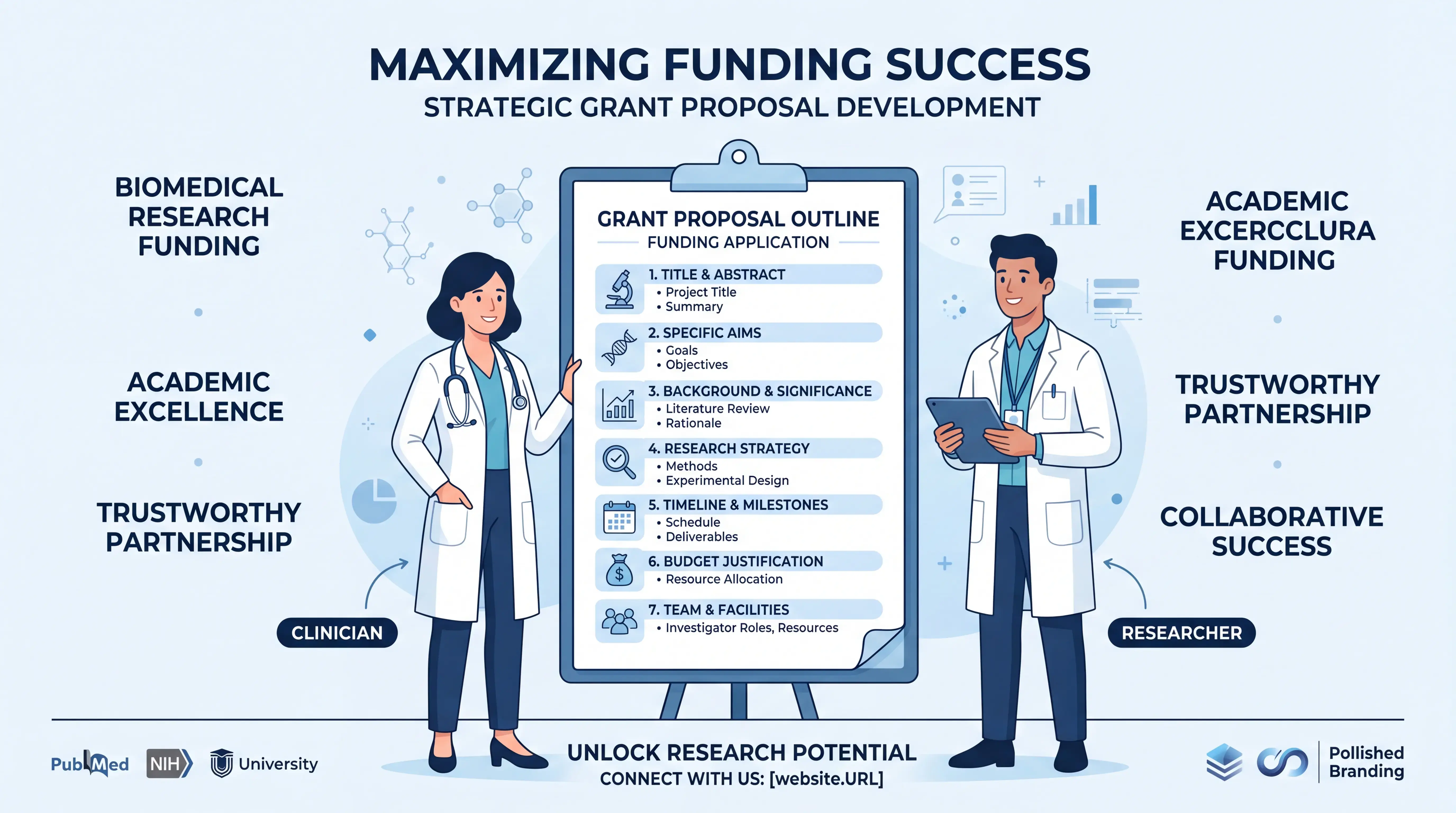
A well-written proposal usually follows a clean logic chain:
- Clinical problem.
- Scientific gap.
- Preliminary discovery.
- Mechanistic hypothesis.
This structure helps reviewers follow your reasoning quickly. It also keeps the essay focused. If each section answers one clear question, the proposal feels mature and credible.
For medical applicants, this is especially important because grant reviewers often read quickly. They need to see your logic in the first pass. Clear headings, short paragraphs, and direct sentences improve comprehension.
3.2 Avoid “pattern-based” writing
Many applications fail because they look too familiar. They use standard phrases, standard themes, and standard conclusions. But familiar is not the same as strong.
To stand out, the proposal must include something that is specifically yours. That may be a cohort, a specimen set, a model system, or an original hypothesis. The best grant proposals feel grounded in real work, not copied from literature.
4. Present a Hypothesis That Can Be Tested
4.1 Turn the research question into a scientific hypothesis
A hypothesis is stronger than a general question because it tells reviewers what you expect to find and how you will test it. In biomedical research, this often means proposing that a molecule regulates a phenotype through a defined mechanism.
This matters because a hypothesis gives structure to the whole proposal. It links background, methods, and expected results. Without it, the project may read like a list of experiments instead of a coherent research plan.
4.2 Make the hypothesis specific
A weak hypothesis is broad and abstract. A strong hypothesis is narrow enough to test. It should connect the clinical problem to the molecular mechanism and explain why the mechanism matters.
For example, if your topic is drug resistance, do not only say you will “study the pathway.” Instead, specify what factor changes, what phenotype it affects, and what downstream process may explain the result. Specificity is a major sign of expertise.
5. Design Research Content That Matches the Hypothesis
5.1 Keep the study plan aligned
The research content should directly answer the hypothesis. If the proposal claims to study mechanism, then the methods must go beyond observation. Pure descriptive work is usually not enough for competitive funding.
A strong project often includes several levels:
- Clinical or tissue evidence.
- Cellular experiments.
- Functional validation.
- Mechanistic rescue experiments.
This layered design is persuasive because it shows the proposal can explain both “what happens” and “why it happens.”
5.2 Include feasibility in the design
Feasibility is not a separate decoration. It should be embedded in the study design. Reviewers ask whether the team can actually complete the work.
To improve feasibility, make sure the project includes:
- Accessible samples or datasets.
- Methods your team already knows.
- A realistic timeline.
- Clear fallback options if one experiment fails.
A feasible proposal is often more fundable than a brilliant but impractical one.
6. Write for Fast Reviewers
6.1 Use short paragraphs and clear headings
Grant reviewers are busy. They rarely read line by line with equal attention. That means the proposal must be easy to scan.
Use headings that summarize the point. Keep paragraphs short. Put the most important sentences early. For key claims, use bold text sparingly to help the reviewer catch them quickly. This is not decoration. It is a readability strategy.
6.2 Make every section serve one purpose
Each part of the proposal should do one job:
- The introduction defines the problem.
- The background shows the gap.
- The preliminary data prove you can do it.
- The methods show how you will do it.
- The conclusion explains the value.
If a paragraph does not advance the argument, remove it. Concise writing is usually stronger writing.
7. Use Tools That Improve Quality and Speed
7.1 Reduce writing friction
Medical researchers often lose time searching for references, organizing notes, or rewriting the same section repeatedly. A structured writing tool can reduce this burden. This is where platforms like scifocus.ai can help.
A well-designed research writing assistant can support literature organization, outline building, and section refinement. For applicants who struggle with grant writing, that saves time and reduces avoidable errors.
7.2 Improve revision, not just drafting
A grant proposal is rarely successful on the first draft. Revision is where clarity improves. Look for places where the logic is weak, the evidence is thin, or the wording is too general.
Using a smart workflow makes revision more systematic. scifocus.ai can help researchers organize ideas, refine structure, and turn scattered notes into a more persuasive proposal. For busy clinicians and scientists, that can make the difference between a rushed draft and a competitive application.
Conclusion
A successful grant proposal is built on five essentials: a real problem, a clear hypothesis, strong preliminary data, a logical research design, and concise presentation. For medical students, physicians, and researchers, the goal is not to write more. It is to write with precision, evidence, and structure.
If you want to improve your next essay and turn it into a stronger grant application, consider using scifocus.ai to streamline your drafting and revision process. Better organization leads to better proposals. With the right tools and a disciplined writing strategy, your grant proposal can become clearer, more credible, and more competitive.
Did you like this article? Explore a few more related posts.
Start Your Research Journey With Scifocus Today
Create your free Scifocus account today and take your research to the next level. Experience the difference firsthand—your journey to academic excellence starts here.