
Tips for Proofreading Your Own Essay
Introduction
Proofreading your own essay is harder than it looks. You already know what you meant to write, so your brain often skips missing words, weak logic, and small grammar errors. For medical students, doctors, and researchers, those mistakes can weaken credibility. A clear, polished essay is not only easier to read, but also more likely to be trusted.
1. Start with the Big Picture, Not the Details
1.1 Check whether the essay answers the main point
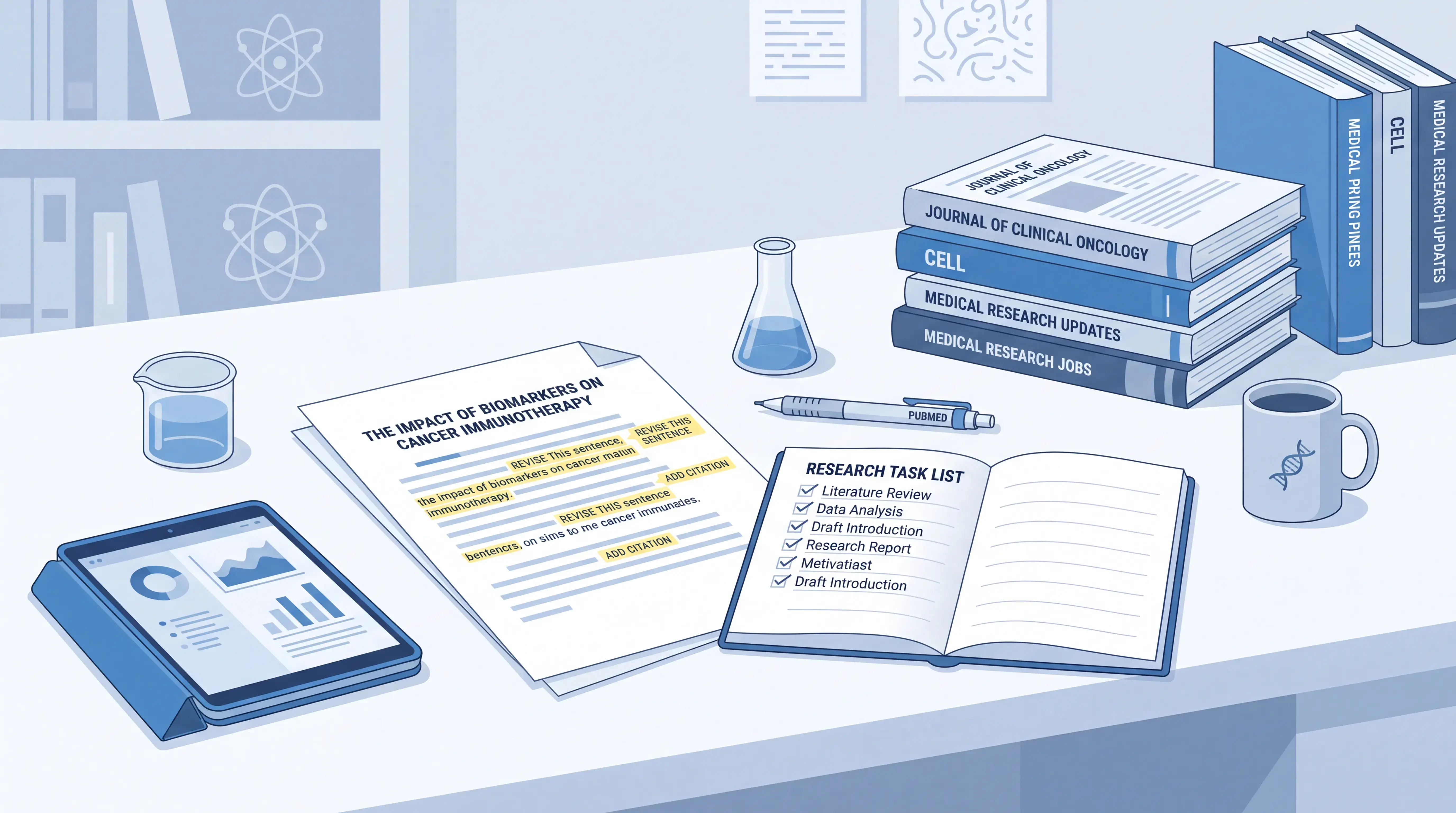
Before line-by-line editing, read the essay once for structure. Ask a simple question: does every section support the central argument? In academic writing, weak structure is often more damaging than minor grammar errors.
For medical and scientific readers, the argument must stay focused. If a paragraph drifts into background information or repeats a previous idea, cut or rewrite it. A strong essay should move forward with purpose.
1.2 Review paragraph balance and flow
Each paragraph should have one clear job. The topic sentence should tell the reader what the paragraph is about. The remaining sentences should support that idea.
Look for transitions between paragraphs. If one paragraph jumps to a new concept without a bridge, the essay feels fragmented. A good test is to read only the first sentence of each paragraph. If the logic is clear, the structure is working.
1.3 Compare the essay with the assignment or journal guidance
If you are writing for class, confirm that the essay meets the prompt. If you are preparing a manuscript, follow the journal’s Author Guidelines. These may include format, word count, citation style, and submission rules.
Ignoring instructions can cause avoidable rejection. In professional writing, compliance matters as much as style.
2. Edit the Language for Precision
2.1 Replace vague words with specific terms
Scientific and medical writing should be exact. Avoid expressions like “very important,” “a lot,” or “good results” when a precise term is possible. Instead, use measurable or clearly defined language.
For example:
- Weak: the treatment was very effective
- Better: the treatment reduced symptoms by 25% over four weeks
Precision improves trust. It also makes your essay sound more authoritative and easier to verify.
2.2 Remove grammar and spelling errors
Read slowly and focus on one type of error at a time. First check spelling. Then check verb tense. Then check subject-verb agreement. This method is faster than trying to catch everything at once.
If English is not your first language, pay special attention to:
- article use, such as a, an, and the
- plural forms
- tense consistency
- word choice confusion, such as affect and effect
A single repeated grammar error can distract readers and reduce confidence in the essay.
2.3 Keep the tone formal and objective
For medical students, doctors, and researchers, the tone should remain neutral. Avoid emotional language, exaggerated claims, and informal phrasing. Words like “huge,” “amazing,” or “they” can weaken academic authority if used carelessly.
Use active voice when it improves clarity. Use passive voice when the action matters more than the actor. The key is consistency. A professional essay sounds calm, factual, and deliberate.
3. Strengthen Logic, Evidence, and Citation Accuracy
3.1 Check whether each claim is supported
A polished essay needs more than clean grammar. It also needs reliable reasoning. Every major claim should connect to evidence, data, or a cited source.
Read each paragraph and ask:
- Is this claim supported?
- Is the evidence relevant?
- Does the conclusion match the data?
If a paragraph makes a broad statement without support, revise it. Unsupported claims stand out quickly to academic readers.
3.2 Verify references and in-text citations
Reference errors are common and often overlooked. Check that every citation in the text appears in the reference list. Check that every source in the reference list is cited in the text.
Also confirm:
- author names are spelled correctly
- publication years are accurate
- journal titles and page numbers are complete
- citation style is consistent
In research writing, citation accuracy is part of trust. A strong essay loses value if the references are careless.
3.3 Make sure the logic is easy to follow
Read one paragraph at a time and ask whether the ideas move in a logical sequence. The best essays do not just list facts. They guide the reader.
A useful method is to identify the first and last sentence of each paragraph. If the paragraph starts with one idea and ends with another unrelated one, it needs revision. Logical flow is especially important in medical and scientific contexts, where readers expect clear reasoning.
4. Use a Two-Pass Proofreading System
4.1 First pass: content and structure
In the first pass, ignore small errors. Focus on the essay as a whole. Check the argument, paragraph order, evidence, and transitions. This pass helps you fix major problems before polishing sentences.
Take a short break before the second round. Even 15 to 30 minutes can improve your ability to spot mistakes. If possible, leave the essay overnight. Fresh eyes catch more.
4.2 Second pass: sentence-level accuracy
In the second pass, read for grammar, punctuation, and word choice. Read the essay aloud if possible. Hearing the text often reveals awkward phrasing that silent reading misses.
You can also read backward, sentence by sentence. This reduces the tendency to skip over errors because you already know the meaning. Slow review is one of the most effective proofreading techniques.
4.3 Final pass: formatting and consistency
Check the final presentation. Make sure headings, spacing, punctuation, and citation style are consistent. If tables, figures, or abbreviations appear in the essay, confirm they are labeled clearly.
For researchers, formatting is not cosmetic. It signals care and discipline. A clean manuscript suggests the author has taken the work seriously.
5. Use Tools, but Do Not Rely on Them Blindly
5.1 Combine manual review with digital support
Grammar tools can help catch surface errors. Similarity checkers can help identify copied phrasing. But these tools cannot judge argument quality, clarity, or academic tone on their own.
Use them as support, not as a replacement for careful reading. An automated suggestion is not always the best choice for a technical essay.
5.2 Get a second reader when possible
A colleague, mentor, or coauthor may notice issues you cannot see. This is especially useful if the essay contains dense technical material. Another reader can identify unclear transitions, missing context, or overly long sentences.
If you cannot get help from a person, use a structured checklist. That still works better than casual rereading.
5.3 Save time with an AI-assisted workflow
If you write often, a smart workflow matters. Tools such as scifocus.ai can support drafting, refinement, and cleanup in one place. That is useful for busy medical students, clinicians, and researchers who need speed without losing quality.
The goal is not to let AI write your essay for you. The goal is to make proofreading faster, more systematic, and more reliable. With the right workflow, you can spend less time fixing basic errors and more time improving the substance.
Conclusion
Proofreading your own essay is a skill, not a guess. Start with structure. Then refine language. Then verify logic, evidence, and references. Use a two-pass system, take breaks, and check consistency carefully. For medical students, doctors, and researchers, this process protects both clarity and credibility. If you want a more efficient way to polish academic writing, explore scifocus.ai and build a cleaner proofreading workflow today.
Did you like this article? Explore a few more related posts.
Start Your Research Journey With Scifocus Today
Create your free Scifocus account today and take your research to the next level. Experience the difference firsthand—your journey to academic excellence starts here.