
Introduction
Coming up with a strong essay topic or research idea is often the hardest part of academic writing. For medical students, doctors, and researchers, the challenge is not lack of knowledge, but too many possible directions and too little time. A weak idea leads to a weak paper. A focused idea leads to clearer arguments, better evidence, and stronger publication potential. In this article, you will learn practical, evidence-based ways to brainstorm academic ideas with more structure and less guesswork.
1. Start with a Real Clinical or Research Problem
1.1 Identify pain points in daily work
The best academic ideas often begin with a real problem. In clinical settings, this may be a delay in diagnosis, poor patient adherence, treatment side effects, or gaps in follow-up care. In research, it may be an inconsistency in the literature or a method that has not been tested in a specific population.
A strong essay idea should answer a question that matters in practice. That is especially important for medical audiences, because relevance improves both academic value and reader interest.
1.2 Turn observations into questions
A useful method is to convert what you see into a researchable question. Ask:
- What is happening repeatedly?
- Which patient group is most affected?
- What is still unclear?
- What outcome would improve care?
For example, if you notice that diabetic patients struggle with anxiety during a public health crisis, that observation can become a focused essay topic on mental health, access to care, or disease control.
1.3 Keep the scope manageable
A good idea is not the broadest one. It is the one that can be answered with available data, time, and methods. Narrow the population, intervention, exposure, or outcome early. This reduces the risk of an unfocused essay and makes the writing process more efficient.
2. Use Interdisciplinary Thinking
2.1 Look for overlap between fields
Modern science increasingly advances through interdisciplinary work. Many high-impact studies come from the overlap of medicine, chemistry, biology, data science, and public health. These intersections often contain unanswered questions.
Interdisciplinary topics are attractive because they often combine novelty with practical value.
A good example from the knowledge base is research linking chemistry and biology to improve radiosensitivity in osteosarcoma cells. That kind of cross-field thinking creates new directions that may not appear in a single discipline alone.
2.2 Combine methods and perspectives
You do not need to master another discipline overnight. Start by asking how another field could help solve your current problem. Examples include:
- Machine learning for risk prediction
- Molecular biology for mechanism exploration
- Public health methods for population-level analysis
- Behavioral science for adherence studies
This approach can produce a more original essay because it avoids repeating standard one-field questions.
2.3 Match innovation with feasibility
Innovation matters, but feasibility matters more. An idea is only useful if you can gather data, apply methods, and write it clearly. Before committing, confirm that the needed literature, patient records, instruments, or collaborators are available.
3. Learn from Literature Efficiently
3.1 Search databases with purpose
Academic idea generation should be guided by structured literature searching. Use databases such as PubMed, Web of Science, and Google Scholar. Start with broad keywords, then narrow by disease, population, method, or outcome.
This process helps you see what has already been studied and where the gaps remain. A well-informed essay is less likely to repeat existing work.
3.2 Read reviews before reading everything
Reviews are efficient because they summarize trends, debates, and missing links. They help you identify where a field is crowded and where the open questions are.
A practical workflow is:
- Read one recent review.
- Read several original studies cited in that review.
- Check the latest papers from the past 12 months.
- Note where results are inconsistent or incomplete.
This method can reveal ideas that are both relevant and publishable.
3.3 Track disagreement in the literature
Academic debate is a valuable source of ideas. If two studies report different results, ask why. The difference may come from sample size, population, measurement, or study design.
Contradictions often point to the next strong essay topic. A good academic paper does not always need a completely new subject. Sometimes it needs a better explanation, a stronger dataset, or a more precise comparison.
4. Follow Hot Topics Without Losing Focus
4.1 Use trends as entry points
Hot topics can help your work gain attention, but they should not be chosen only because they are popular. The knowledge base highlights areas such as COVID-19, gut microbiota, machine learning, model building, and chronic disease prevention. These themes remain relevant because they connect directly to current clinical and public health concerns.
A good essay uses a trend as a lens, not as a substitute for thinking.
4.2 Connect the trend to your specialty
The most useful questions often come from combining a major trend with your own clinical setting. For example:
- Mental health changes in diabetic patients during a pandemic
- Changes in healthcare-seeking behavior among chronic disease patients
- Predictive modeling for readmission risk
- Microbiome links in specific disease subgroups
This strategy keeps the work grounded and practical. It also helps you avoid vague topics that are difficult to defend.
4.3 Watch for topic saturation
Not every hot topic is a good topic. Some areas are already crowded. Before starting, check whether the field has too many similar studies. If so, refine your population, endpoint, or method. A sharper angle often produces a stronger academic essay than a broad, repetitive one.
5. Build an Idea System, Not Just One Idea
5.1 Use a repeatable workflow
Good academic writing is easier when brainstorming becomes a system. Use a simple process:
- Observe a real problem.
- Search the literature.
- Identify a gap or controversy.
- Test interdisciplinary angles.
- Check feasibility and novelty.
- Draft a focused research question.
This sequence reduces random thinking and improves the quality of your essay from the start.
5.2 Keep a running idea bank
Do not rely on memory. Keep a document where you save:
- Interesting clinical observations
- Unresolved questions
- Useful review articles
- Potential collaborators
- New methods or datasets
Over time, this becomes a personal research map. It also makes it easier to connect small insights into a stronger project later.
5.3 Ask whether the idea serves a clear audience
For medical students, doctors, and researchers, the best topics usually have one of three values:
- They improve clinical decision-making
- They explain a meaningful mechanism
- They support public health or policy decisions
If your idea does none of these, it may still be interesting, but it may not be strong enough for a serious academic essay.
6. Use Tools That Reduce Friction
6.1 Let technology support the thinking process
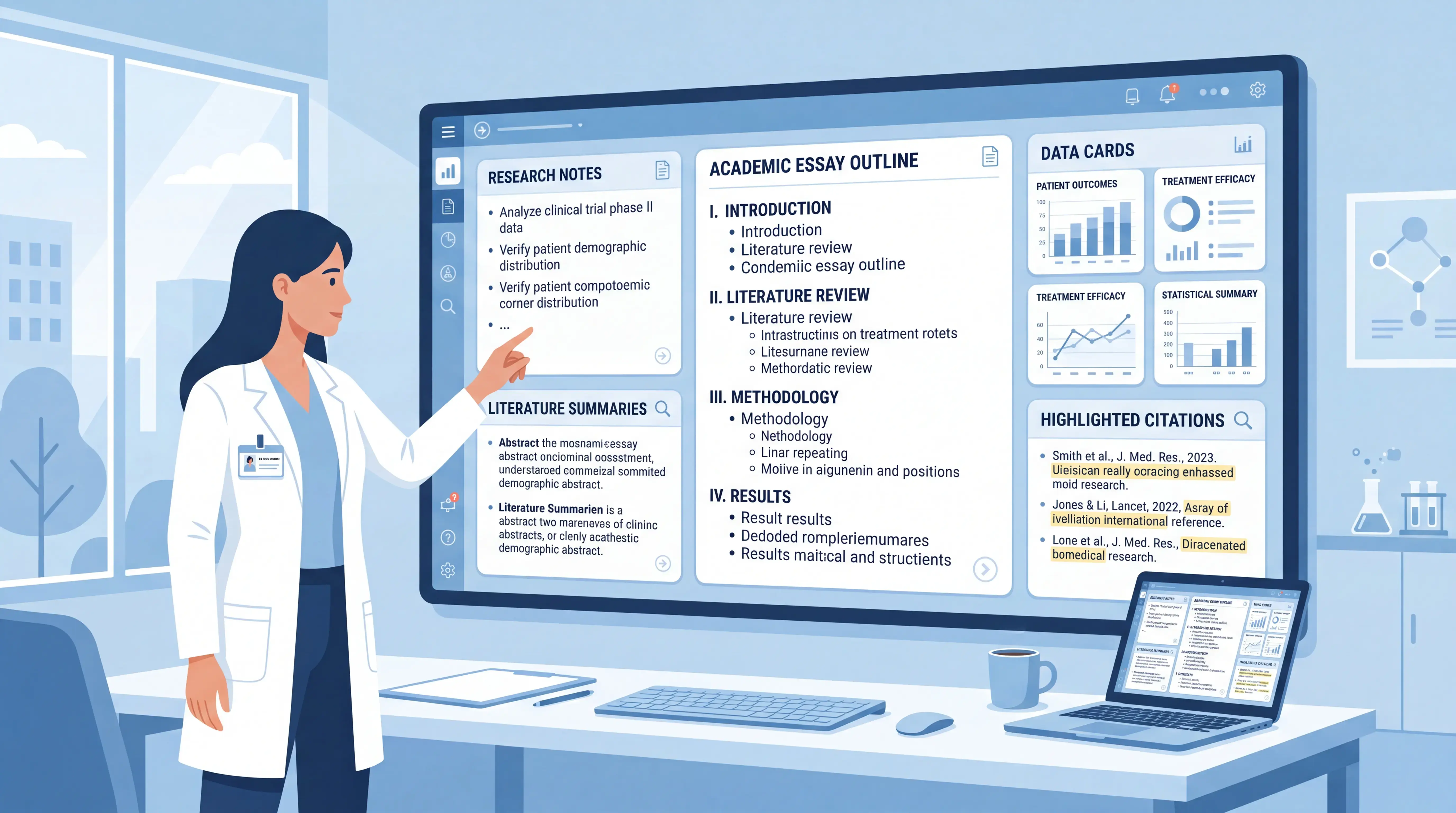
Idea generation can be slow when you are manually scanning papers, notes, and drafts. Tools like scifocus.ai can help organize sources, surface patterns, and support faster topic refinement. That matters when you need to move from scattered observations to a usable academic outline.
The goal is not to replace judgment. The goal is to make your judgment faster and more organized.
6.2 Move from brainstorming to drafting faster
Once you have a potential topic, the next step is to turn it into a clear outline. A good outline usually includes the question, background, gap, method, and expected contribution. This reduces revision later and keeps the essay focused.
6.3 Protect your time and attention
Medical professionals often work under time pressure. That makes efficiency critical. A structured workflow, combined with a research support tool, can save hours in literature sorting and topic development. For teams and individuals who want to produce better academic writing with less friction, scifocus.ai can be a practical part of the process.
Conclusion
Strong academic ideas do not come from luck. They come from observation, literature review, interdisciplinary thinking, and disciplined narrowing. For medical students, doctors, and researchers, the best essay topics are usually specific, relevant, and feasible. Start with a real problem. Check the literature. Look for disagreement. Use trends carefully. Then shape the idea into a clear research question. If you want to speed up that process and organize your thinking more effectively, scifocus.ai can help you move from scattered notes to a structured academic direction.
Did you like this article? Explore a few more related posts.
Start Your Research Journey With Scifocus Today
Create your free Scifocus account today and take your research to the next level. Experience the difference firsthand—your journey to academic excellence starts here.