

There vs Their vs They’re
Introduction
If you write an essay for medical school, a clinical report, or a research manuscript, small grammar errors can damage credibility fast. Among the most common confusions are there vs their vs they’re. These three words sound alike, but they do very different jobs in English. In academic writing, that matters. A single wrong choice can weaken clarity, interrupt flow, and make your work look less precise. Understanding these words is a simple way to improve accuracy, readability, and trust.
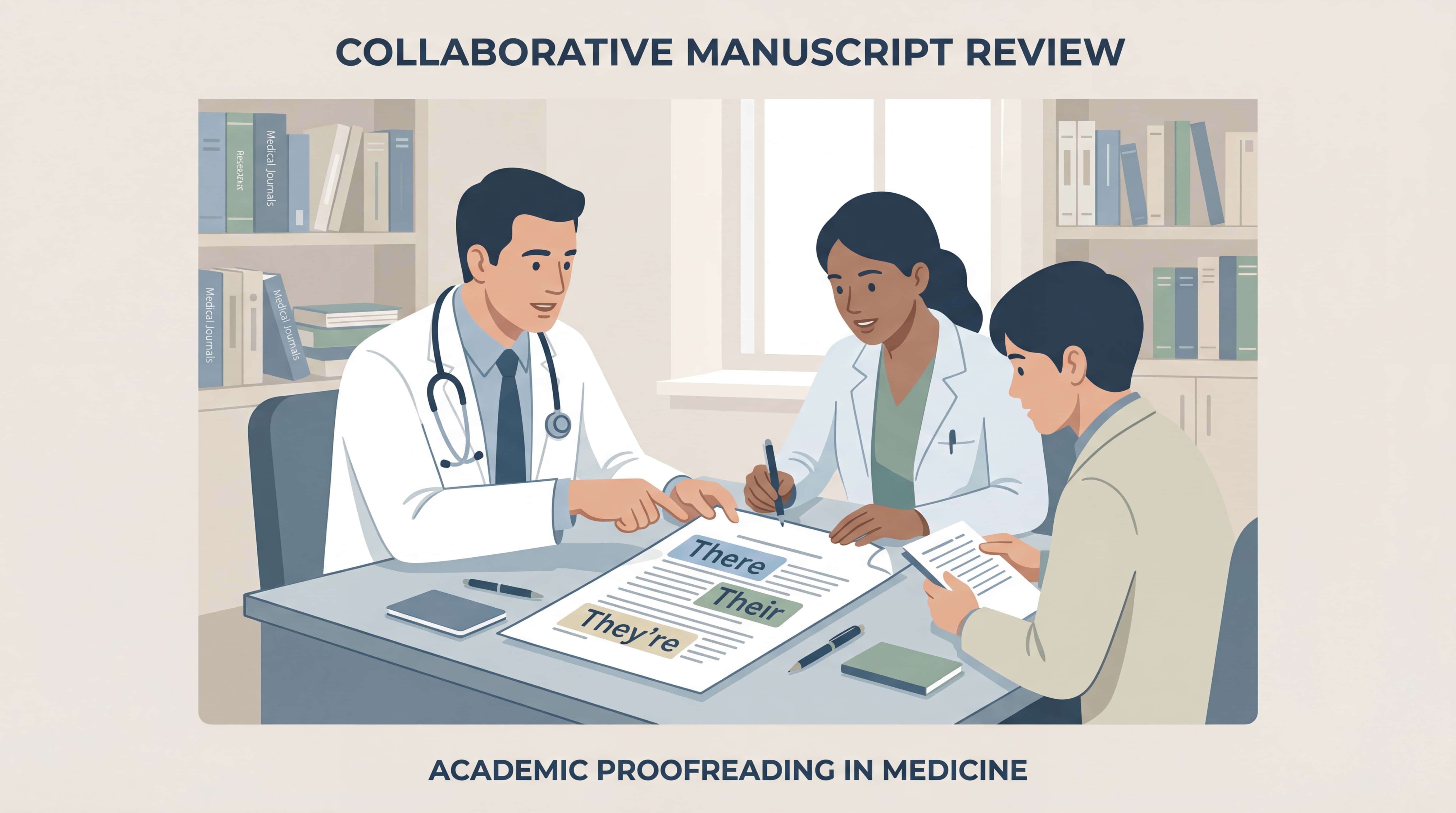
1. Why There vs Their vs They’re Matters in Academic Writing
1.1 Small grammar errors create a big impression
In scientific and medical writing, readers expect precision. That includes grammar. A research article, case summary, or application essay should sound controlled and professional. When a common word is misused, the reader may pause and question the author’s attention to detail.
This is especially important for medical students, doctors, and researchers. Your writing often competes for limited time and attention. Clear language helps your message move faster. Confused language forces readers to slow down.
1.2 Why these words are often confused
The problem is simple. The three forms are homophones. They sound almost identical in speech, but each has a different function.
- there refers to a place, or introduces a statement.
- their shows possession.
- they’re is a contraction of they are.
Because the sound is the same, spelling alone must guide the choice. That is why proofreading matters so much in an academic essay.
1.3 Why spellcheck is not enough
Spellcheck tools can miss this problem because each word is spelled correctly on its own. Grammar tools may also fail if the sentence is structurally valid. That means the burden falls on the writer.
In research writing, that is a real risk. A sentence can look correct at first glance and still contain the wrong word. Manual review is still essential, especially when preparing a submission, thesis draft, or grant-related essay.
2. The Difference Between There, Their, and They’re
2.1 There: place or existence
Use there when you mean a location or when introducing the existence of something.
Examples:
- The patient is there in the waiting room.
- There are three possible explanations for the result.
- There is a strong need for clearer reporting standards.
In academic writing, the existential form is especially common. There are, there is, and there were often introduce findings or observations without sounding repetitive.
2.2 Their: possession
Use their when something belongs to them.
Examples:
- The residents submitted their case notes.
- The researchers revised their manuscript.
- The patients returned their questionnaires.
This form answers the question: whose? If the answer is “they,” then their is usually correct. In an essay, this form helps you show ownership clearly without adding extra words.
2.3 They’re: they are
Use they’re only when you can expand it to they are.
Examples:
- They’re reviewing the data now.
- They’re expected to present the case tomorrow.
- They’re aware of the protocol changes.
A quick test helps. Replace the word with they are. If the sentence still works, they’re is likely correct. If the replacement fails, do not use they’re.
3. How to Choose the Correct Word Quickly
3.1 Use a three-step check
A practical method can reduce errors in any essay, abstract, or paper draft.
- Ask whether the word refers to a place or existence. If yes, use there.
- Ask whether the word shows ownership. If yes, use their.
- Ask whether it means they are. If yes, use they’re.
This method is fast. It works well during final proofreading, especially when you are reviewing several pages under time pressure.
3.2 Read the sentence aloud
Reading aloud helps because these words are not distinguished by sound. Instead, the surrounding sentence exposes the meaning.
For example:
- There is a gap in the literature.
- Their hypothesis is well supported.
- They’re preparing a revised analysis.
If the sentence sounds wrong when expanded, it usually is wrong in the original form. This is a useful strategy for students writing a class essay or clinicians polishing a manuscript.
3.3 Look at the grammar around the word
The surrounding structure often gives the answer.
- If a noun follows and ownership is involved, think their.
- If a verb follows and you can replace the phrase with they are, think they’re.
- If the word starts a clause about existence, think there.
Grammar context matters more than memorized rules. That is why careful reading is better than guessing.
4. Common Mistakes in Medical and Research Writing
4.1 “There” is not always about location
Many writers learn that there means “in that place.” That is only part of the story. In formal writing, there often acts as a structural word.
Examples:
- There was no significant difference between groups.
- There are several limitations to this study.
- There is evidence supporting this interpretation.
These uses are common in scientific prose because they allow the writer to present results neutrally. They are useful in an essay when you want to sound objective and precise.
4.2 “Their” should not replace every plural subject
Some writers overuse their because it seems convenient. But possession must still be clear.
Incorrect:
- The nurses completed their was recorded in the chart.
Correct:
- The nurses completed their forms, and the data were recorded in the chart.
The sentence must still make logical sense. Possession should connect directly to the noun that owns the item. Otherwise, the sentence becomes confusing.
4.3 “They’re” is often overused in drafts
In fast drafting, writers sometimes insert they’re when they are unsure. That is risky. In academic work, ambiguity is costly. If you mean possession, their is correct. If you mean a location or existence, there is correct.
Never use they’re just because it feels natural. Confirm the contraction first. This habit improves every essay, from coursework to publication-related writing.
5. Practical Examples for Students, Doctors, and Researchers
5.1 Examples in medical contexts
Here are clear examples that fit professional writing:
- There is a high prevalence of anemia in this population.
- The patients brought their medication lists.
- They’re scheduled for follow-up next week.
Each sentence uses the word with a different function. That distinction is small, but important.
5.2 Examples in research writing
Scientific writing often uses there to report results and their to describe ownership or attribution.
- There were 48 participants in the final analysis.
- The authors clarified their methodology.
- They’re comparing the new model with standard practice.
These forms appear simple, but they help create a clean and credible academic tone. A well-written essay depends on this level of accuracy.
5.3 Examples to avoid
Common errors include:
-
Their is a solution to the problem.
Correct: There is a solution to the problem. -
There manuscript was accepted.
Correct: Their manuscript was accepted. -
They’re findings were consistent.
Correct: Their findings were consistent.
These mistakes are easy to make when typing quickly. They are also easy to fix with a structured review.
6. A Simple Proofreading Method for Better Results
6.1 Scan for homophones during final review
When editing an essay or manuscript, do a specific pass for confusing words. Do not read only for ideas. Read for word choice.
Focus on:
- there
- their
- they’re
- its and it’s
- your and you’re
- affect and effect
Targeted proofreading catches errors that broad reading often misses.
6.2 Build a personal error list
Writers who improve fastest usually track their own recurring mistakes. Keep a short list of words you confuse. Review it before submission.
This works well for busy clinicians and researchers. You may not have time for a full line edit every day, but you can still improve accuracy with a 2-minute checklist.
6.3 Use tools, but do not depend on them
Digital tools help, but they do not replace judgment. A sentence can be grammatically possible and still be wrong in meaning. That is why human review remains necessary.
For writers who need stronger support, scifocus.ai can help streamline academic drafting and editing. It is designed to support clearer, more precise writing, which is especially useful when preparing an essay, manuscript, or professional report.
Conclusion
Knowing the difference between there vs their vs they’re is not a minor grammar lesson. It is a practical writing skill that improves clarity, professionalism, and reader trust. There refers to place or existence. Their shows possession. They’re means they are. If you use the three-step check, read aloud, and proofread for homophones, you can eliminate one of the most common errors in academic English. For faster, more confident drafting, consider using scifocus.ai to support your next essay or research document.

Did you like this article? Explore a few more related posts.
Start Your Research Journey With Scifocus Today
Create your free Scifocus account today and take your research to the next level. Experience the difference firsthand—your journey to academic excellence starts here.