

Then vs Than
Introduction
If you write an essay for medical school, a journal submission, or a research report, small grammar errors can weaken credibility fast. One of the most common is then vs than. These two words look similar, but they serve different functions. Using the wrong one can make your writing seem careless, even when your science is strong. In academic writing, precision matters as much as content.
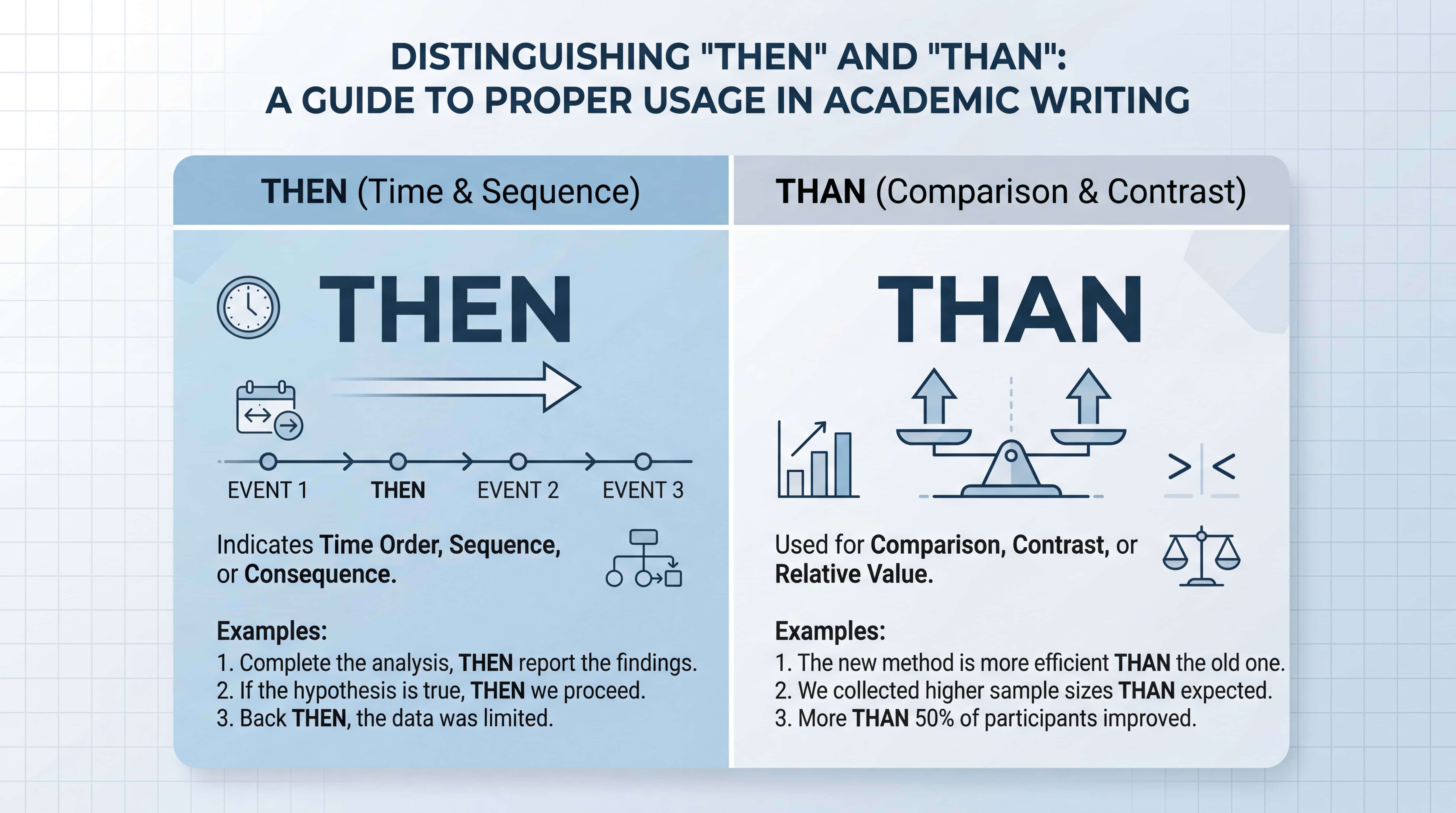
1. The Core Difference Between Then and Than
1.1 Then Means Time or Sequence
Then usually refers to time, order, or a result. It answers questions like when, what happened next, or what followed.
For example:
- We collected the samples, then analyzed the results.
- If the test is positive, then further imaging is needed.
In scientific and clinical writing, then helps you show process flow. It is useful in methods, case descriptions, and step-by-step explanations. A clear sequence improves readability.
1.2 Than Means Comparison
Than is used for comparisons. It appears after comparative words such as more, less, higher, lower, better, worse, and faster.
For example:
- The biomarker level was higher than expected.
- This method is more accurate than the traditional assay.
In an essay or research paper, than should appear whenever you compare two variables, groups, or outcomes. If the sentence shows difference, preference, or degree, than is usually the correct choice.
2. Why This Error Matters in Academic Writing
2.1 It Affects Clarity and Credibility
In medicine and research, readers expect exact language. A wrong word choice may not destroy the meaning, but it lowers trust. Editors, reviewers, and supervisors notice these issues quickly.
For example:
- Incorrect: The patient improved then the control group.
- Correct: The patient improved than the control group.
The first sentence is grammatically wrong because the writer intended a comparison. In an essay, this kind of mistake can distract from the argument and reduce the impact of the entire paragraph.
2.2 It Can Change the Meaning of a Sentence
Because then and than play different roles, swapping them can make a sentence confusing or incorrect.
Compare:
- Then: We completed the biopsy, then sent the tissue for analysis.
- Than: The biopsy sample was smaller than expected.
These are not interchangeable. One shows sequence. The other shows comparison. That distinction is especially important in clinical documentation, literature reviews, and discussion sections where precision is essential.
3. How to Choose the Right Word Quickly
3.1 Use a Simple Test
Ask yourself one question.
- If the sentence shows time or sequence, choose then.
- If the sentence shows comparison, choose than.
This quick check works well during drafting and editing. It is especially helpful when you are writing under time pressure, such as during exams, manuscript revisions, or grant preparation.
3.2 Look for Signal Words
Certain words strongly suggest than:
- more than
- less than
- better than
- fewer than
- greater than
- different from, sometimes replaced by than in informal comparison
Certain structures often need then:
- after that
- next
- afterward
- if...then
- first...then
In a scientific essay, these signals help you spot the correct form before you submit.
4. Common Mistakes in Medical and Research Writing
4.1 Using Then in a Comparison
This is one of the most frequent mistakes.
Incorrect:
- The treatment group had a lower mortality rate then the control group.
Correct:
- The treatment group had a lower mortality rate than the control group.
Here, the writer compares two groups. So than is required. This error often appears in abstracts, results sections, and discussion paragraphs.
4.2 Using Than in a Sequence
This mistake is less common, but it still happens.
Incorrect:
- We extracted the RNA, than performed reverse transcription.
Correct:
- We extracted the RNA, then performed reverse transcription.
The sentence describes a process. That requires then. In procedural writing, the sequence should be easy to follow.
4.3 Confusing Than with Other Comparison Forms
Sometimes writers use than correctly, but the full comparison is incomplete.
Incorrect:
- The new assay is more sensitive than the old one is sensitive.
Correct:
- The new assay is more sensitive than the old one.
In strong academic writing, avoid repeating unnecessary words. Keep the comparison parallel and concise. This improves both grammar and style.
5. Practical Examples for Students, Doctors, and Researchers
5.1 In Medical School Writing
If you are writing an essay about diagnosis or treatment, use then for steps and than for comparisons.
Examples:
- The physician reviewed the history, then ordered laboratory tests.
- This imaging method is faster than ultrasound in some settings.
These patterns are common in case reports and reflective writing. Clear grammar supports clear clinical reasoning.
5.2 In Research Manuscripts
Research writing often includes comparisons between groups, methods, or outcomes.
Examples:
- The experimental group showed a higher response rate than the placebo group.
- The samples were processed, then stored at -80°C.
The first sentence compares outcomes. The second describes procedure. Choosing the right word helps the reader move through your logic without friction.
5.3 In Discussion Sections
Discussion sections often require careful comparison with prior studies.
Examples:
- Our findings were consistent with those of earlier studies, then the model was refined.
- The new protocol required less time than the standard workflow.
If you mix up these two words in a discussion section, the argument can become less convincing. Precision supports authority.
6. A Fast Editing Strategy Before You Submit
6.1 Read Every Sentence for Function
During proofreading, scan each use of then and than. Do not rely on spelling alone. Ask what the word is doing.
A practical checklist:
- Is the sentence about time or order?
- Is the sentence about comparison?
- Does the sentence contain a comparative adjective or adverb?
- Does the sentence describe a sequence of actions?
This simple method can catch many errors before they reach reviewers or instructors.
6.2 Use Writing Support Tools Wisely
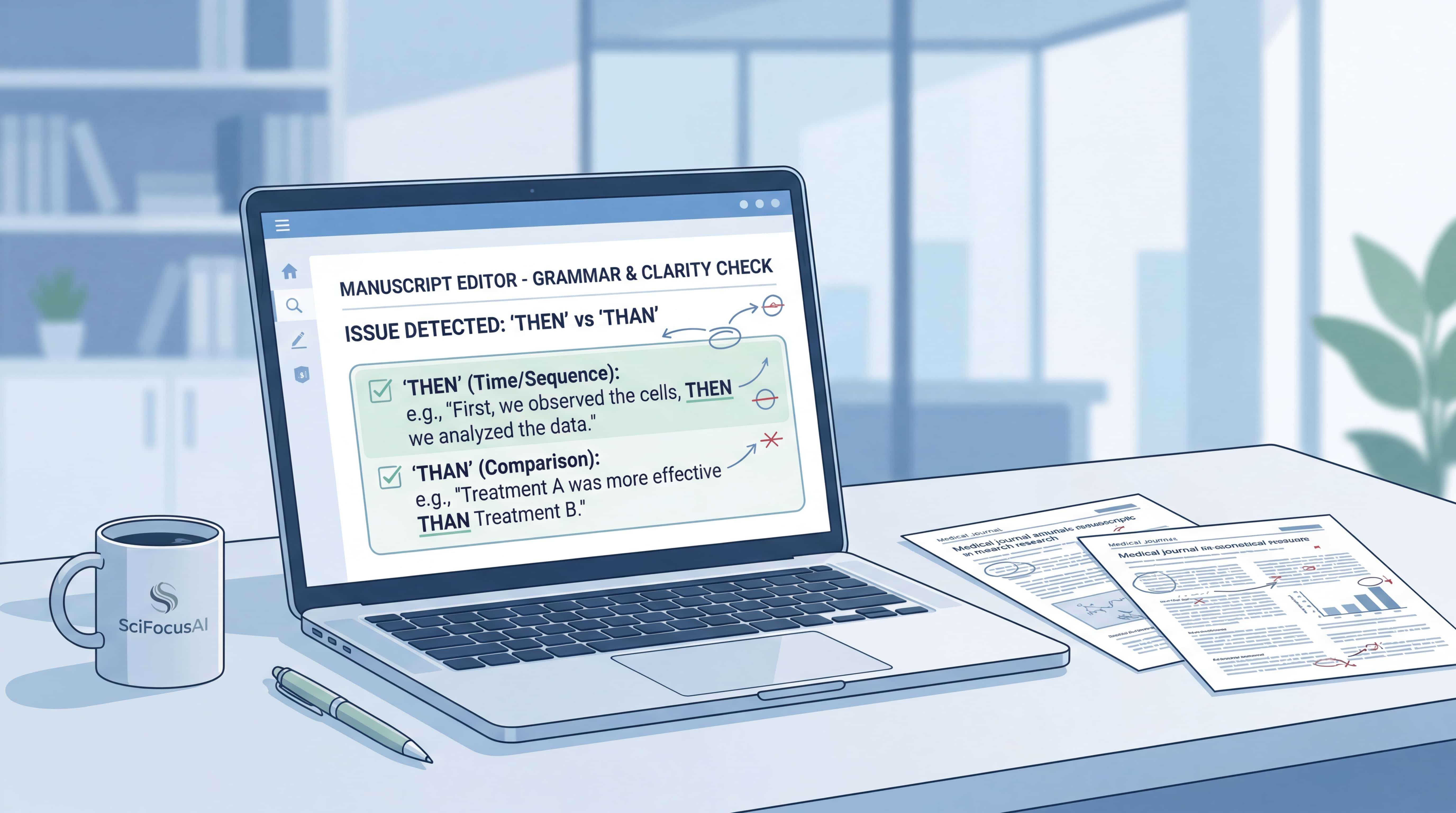
Grammar tools can help, but they are not perfect. They may miss context, especially in technical writing. If you work on an essay, thesis, manuscript, or abstract, a dedicated writing platform can save time.
scifocus.ai is designed to support academic writing workflow. It can help you refine clarity, improve structure, and reduce avoidable language errors before submission. For medical students, doctors, and researchers, that means fewer distractions and stronger writing.
Strong content deserves precise language. A reliable writing tool can help you keep both.
Conclusion
The difference between then vs than is simple, but it matters. Then shows time or sequence. Than shows comparison. If you are writing an essay for medical school, clinical training, or research, mastering this distinction will make your writing clearer and more credible. Before you submit, read each sentence carefully, check the function of the word, and remove avoidable errors. If you want faster, cleaner academic writing, explore scifocus.ai as a practical support tool for your next draft.
Did you like this article? Explore a few more related posts.
Start Your Research Journey With Scifocus Today
Create your free Scifocus account today and take your research to the next level. Experience the difference firsthand—your journey to academic excellence starts here.