

The Importance of Cohesion in Academic Writing
Introduction
Cohesion is one of the main reasons an academic essay reads as credible, clear, and persuasive. For medical students, doctors, and researchers, weak cohesion can hide strong evidence behind broken logic and uneven transitions. When ideas do not connect smoothly, readers work harder and your argument loses force. This is especially harmful in scientific and clinical writing, where precision matters. In this article, we explain why cohesion matters, how to build it, and how tools like scifocus.ai can help improve academic writing quality.
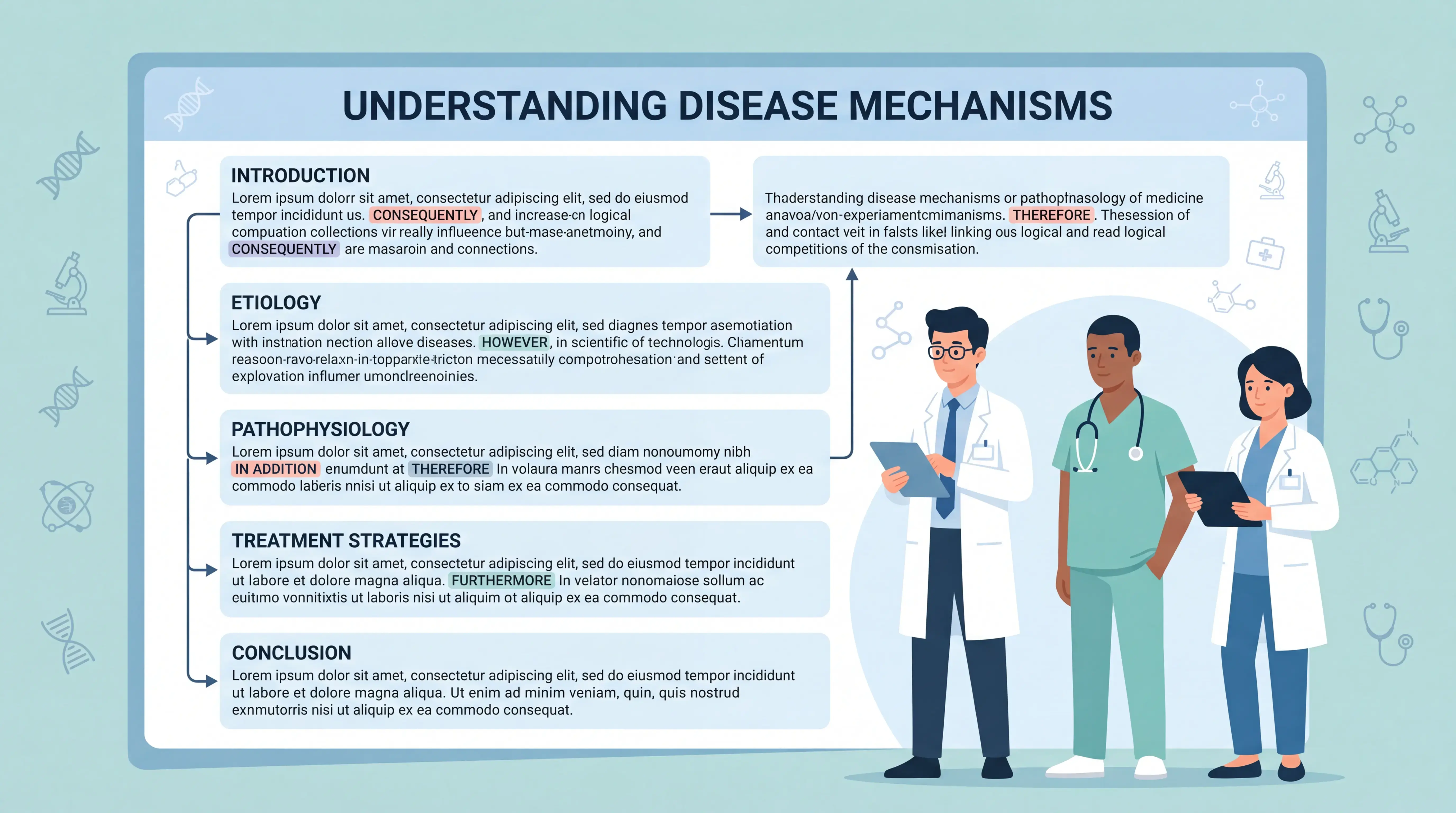
1. What Cohesion Means in an Academic Essay
1.1 Cohesion is more than grammar
Cohesion refers to the way sentences and paragraphs connect. It helps readers follow the same line of thought from start to finish. In an academic essay, cohesion is created through linking words, repeated key terms, parallel structure, and logical paragraph order.
A text may be grammatically correct and still feel difficult to read. That usually happens when the argument moves too quickly, skips steps, or changes direction without warning. Good cohesion prevents this. It gives the reader a clear path.
1.2 Cohesion supports comprehension
In medicine and research, readers often scan text under time pressure. They need to understand the point quickly. Cohesive writing reduces cognitive load. That matters in lab reports, literature reviews, clinical summaries, and discussion sections.
A cohesive essay also improves trust. When the logic is visible, the reader is more likely to accept your conclusion, even before checking every source. This is one reason top journals and university rubrics value coherence and cohesion so highly.
1.3 Cohesion and coherence work together
Cohesion is the visible connection between parts of a text. Coherence is the overall sense that the text makes. You need both. A paragraph can have many transition words and still be incoherent if the ideas are not logically ordered.
For example, a discussion of PCR, mass spectrometry, and DNA microarray should not simply list methods. It should explain why one method is limited, how another addresses those limits, and what the implication is for the study. That structure makes the essay easier to follow.
2. Why Cohesion Matters in Academic Writing
2.1 It makes arguments easier to follow
Academic readers do not want to guess your meaning. They want a direct path from claim to evidence to conclusion. Cohesion provides that path.
A strong essay usually moves in this order:
- Topic sentence.
- Supporting points.
- Evidence or example.
- Short conclusion or link to the next idea.
This structure helps the reader anticipate what comes next. It also reduces repetition and confusion. In scientific writing, that is essential because unclear logic can weaken even strong data.
2.2 It improves the impact of evidence
Evidence alone is not enough. You must explain how one point connects to another. In medical writing, that connection often involves cause, comparison, limitation, or implication.
For example:
- “PCR is widely used, but it may not detect all variants.”
- “In contrast, DNA microarray can assess multiple targets simultaneously.”
- “Therefore, the latter may be more suitable for high-throughput screening.”
These sentences form a cohesive chain. Each sentence prepares the reader for the next one. That is the hallmark of a strong academic essay.
2.3 It reduces editing time
Poor cohesion usually means more revision. Writers must then add missing transitions, move paragraphs, and simplify sentences. A cohesive draft is faster to revise because the logic is already visible.
That is one reason many academic writing courses stress concise and streamlined expression. Shorter sentences, clearer verbs, and logical paragraph flow save time for both the writer and the reader.
3. How to Build Cohesion in an Academic Essay
3.1 Use clear paragraph structure
A useful paragraph pattern is simple:
- Topic sentence.
- Point one.
- Point two.
- Point three.
- Closing sentence.
This pattern is especially effective in an academic essay because it keeps one main idea per paragraph. If the paragraph starts to cover too many topics, the reader loses the thread.
A medical discussion paragraph, for example, should not mix study design, statistical significance, limitations, and clinical implications without clear order. Separate these ideas, then connect them with transitions.
3.2 Use transition words with purpose
Transition words are useful only when the logic is already correct. Do not add them mechanically. Choose them based on the relationship between ideas.
Common functions include:
- Addition: furthermore, moreover, besides.
- Contrast: in contrast, whereas.
- Cause and effect: therefore, thus, as a result.
- Sequence: first, second, finally.
- Example: for example, for instance.
In a strong essay, transitions act like road signs. They show direction. They do not replace structure. If the paragraph logic is weak, transitions cannot fix it.
3.3 Repeat key terms strategically
Repetition is not always a flaw. In academic writing, repeating key concepts can improve clarity. For instance, if your paper is about inflammation, avoid replacing the term with unrelated synonyms that blur meaning.
This is especially important in scientific writing, where precision matters more than stylistic variety. Repeating a controlled term can strengthen cohesion in an academic essay and prevent ambiguity.
3.4 Use parallel structure
Parallel structure creates rhythm and clarity. It is especially useful in lists, comparisons, and methods sections.
Compare these two versions:
- Weak: The study aimed to identify biomarkers, to compare treatment responses, and analyzing outcomes.
- Strong: The study aimed to identify biomarkers, compare treatment responses, and analyze outcomes.
The second version is cleaner and easier to process. Parallel structure makes your essay look more professional and read more smoothly.
4. Common Cohesion Problems in Student and Research Writing
4.1 Jumping between ideas
One frequent problem is abrupt shifts. A paragraph begins with one topic and ends with another. This makes the reader stop and re-evaluate the structure.
To avoid this, ask:
- Does each paragraph have one main point?
- Does each sentence support the topic sentence?
- Does the final sentence connect to the next paragraph?
If the answer is no, the essay needs restructuring.
4.2 Overusing long sentences
Long sentences are not automatically better. In fact, they often hide weak logic. A long sentence can carry too many ideas, especially when writers try to sound formal.
A better approach is to divide one complex idea into two or three short sentences. This improves readability and makes the argument more transparent. For medical and research audiences, that usually improves the quality of the essay immediately.
4.3 Using vague wording
Words like “good,” “important,” or “many” often fail to explain the actual relationship between ideas. Academic writing needs specificity.
Instead of saying “This is very important,” explain why:
- It improves detection.
- It reduces bias.
- It supports reproducibility.
- It strengthens clinical interpretation.
Specific wording improves cohesion because it tells the reader exactly how each idea supports the next one.
5. Practical Revision Tips for a More Cohesive Essay
5.1 Read for flow, not only for correctness
After writing, read one paragraph at a time and ask whether each sentence logically follows the previous one. If you must reread to understand the connection, the passage needs revision.
A cohesive essay should feel predictable in a good way. The reader should always know why the next sentence appears.
5.2 Check paragraph openings and endings
The first sentence of each paragraph should state the focus. The last sentence should either conclude the point or lead to the next section. This creates a clear bridge.
A simple revision rule:
- Open with the main point.
- Support it with evidence.
- Close with a link forward.
That pattern works well for literature reviews, discussion sections, and reflective academic writing.
5.3 Reduce unnecessary words
Academic style should be concise. Remove filler phrases, duplicated ideas, and overly formal expressions that do not add meaning. Concise writing is not less academic. It is often more academic.
This is one of the fastest ways to improve the cohesion of an essay because short, direct sentences make relationships between ideas easier to see.
6. How scifocus.ai Can Help You Write More Cohesively
6.1 A practical tool for academic writers
For medical students, doctors, and researchers who write under pressure, scifocus.ai can support the drafting and revision process. It helps you refine structure, improve clarity, and identify weak transitions before submission.
That matters because cohesion is often difficult to judge in your own writing. You may know the content well, but still miss gaps in logic. A writing support tool can help reveal those gaps.
6.2 Where it adds value
scifocus.ai can be especially useful when you need to:
- Organize complex research points.
- Improve paragraph flow.
- Simplify dense sentences.
- Strengthen transitions between sections.
- Make an academic essay more readable and consistent.
In short, it helps turn fragmented writing into a more cohesive academic argument.
Conclusion
Cohesion is not a cosmetic feature. It is a core part of academic writing that affects clarity, credibility, and reader trust. In a strong essay, each sentence should support the next, each paragraph should have one clear purpose, and each transition should reflect real logic. For medical students, doctors, and researchers, that standard is essential. If you want to write faster and more clearly, consider using scifocus.ai to strengthen structure, improve flow, and produce more cohesive academic work.

Did you like this article? Explore a few more related posts.
Start Your Research Journey With Scifocus Today
Create your free Scifocus account today and take your research to the next level. Experience the difference firsthand—your journey to academic excellence starts here.