
Techniques for Avoiding Wordiness in Writing
Introduction
Wordiness weakens an essay fast. For medical students, doctors, and researchers, it can blur meaning, slow peer review, and make strong evidence look less precise. A concise essay is easier to read, easier to trust, and easier to publish. In scientific writing, every extra word should earn its place. This article explains practical techniques for cutting clutter without losing meaning.
1. Why Wordiness Hurts an Academic Essay
1.1 It hides the main message
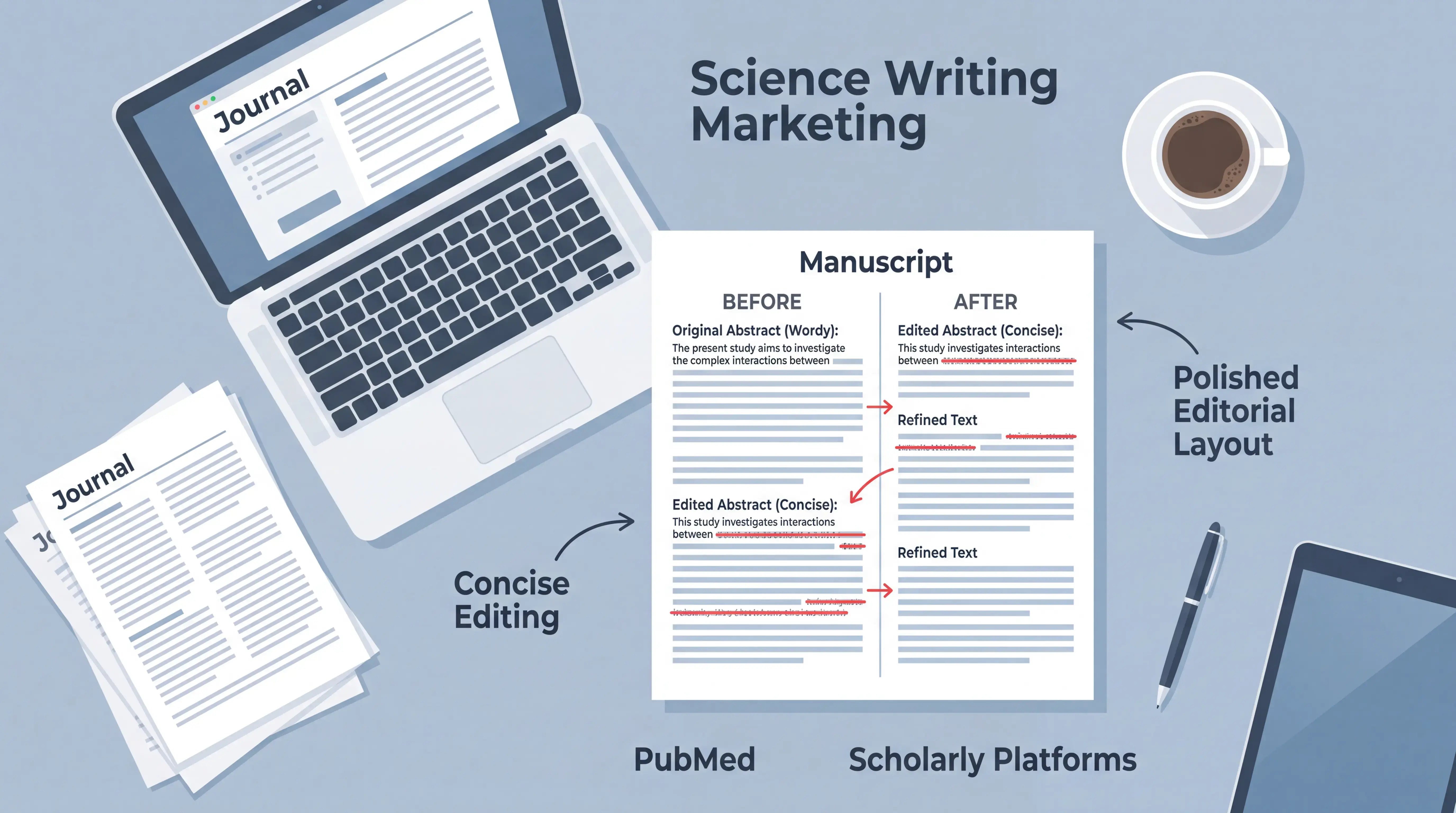
A wordy essay forces readers to work harder than necessary. In clinical and research contexts, that is a real problem. Reviewers want the key point quickly. Clinicians need clear conclusions. Students need to communicate ideas with accuracy.
Long sentences often bury the verb. Weak structures such as “there is” or “it is” make writing less direct. Strong writing uses precise verbs and clear subject-verb order. That improves both readability and authority.
1.2 It can weaken scientific credibility
In academic writing, style affects perception. A dense essay can look less disciplined, even when the data are strong. Wordiness may also increase the chance of repetition, vague claims, and unclear logic.
For example, “There is an increased risk of lung cancer associated with smoking” is weaker than “Smoking increases the risk of lung cancer.” The second version is shorter and more forceful. It tells the reader exactly what happens.
1.3 It slows editing and publication
Many journal editors and reviewers notice unnecessary length quickly. They often expect concise framing, especially in methods, results, and discussion sections. Efficient writing reduces editing time and improves the chance that the core argument survives review intact.
A good essay should not sound compressed. It should sound controlled. That is a different standard.
2. Core Techniques for Avoiding Wordiness
2.1 Replace weak verb forms with action verbs
One of the fastest ways to improve an essay is to strengthen the verb. Academic writing often overuses “is,” “are,” “have,” and “has.” These forms can make sentences static.
Use action verbs instead:
- increase, decrease
- prolong, shorten
- strengthen, weaken
- activate, inhibit
- stabilize, destabilize
- stimulate, transform
For example, change “The other method is dependent on DNA uptake” to “The other method depends on DNA uptake.” The revised version is shorter and more precise.
A strong verb often removes several unnecessary words.
2.2 Turn passive structures into active ones when possible
Passive voice is not always wrong. In methods, it can be useful when the process matters more than the actor. But overuse makes an essay feel distant and heavy.
Compare these versions:
- Weak: “Biochemical analysis was performed by us.”
- Better: “We performed biochemical analysis.”
- Best: “Our biochemical analysis showed that…”
The last version is not only active. It is also more informative. Use active voice whenever clarity is improved.
2.3 Remove empty lead-ins
Many sentences begin with filler phrases that delay the point. Common examples include:
- there is
- there are
- it is
- it was
- there have been
These can often be removed.
For example:
- Weak: “There are several studies that show a decrease in mortality.”
- Better: “Several studies show a decrease in mortality.”
This edit trims clutter and improves rhythm. The reader should reach the main claim immediately.
2.4 Shorten long chains of nouns
Scientific writing often stacks nouns together, especially in biology and medicine. That can make an essay sound technical but vague.
Instead of writing long noun strings, use verbs and clearer relationships.
For example:
- Weak: “The gene expression regulation pathway analysis results”
- Better: “The results of pathway analysis on gene expression regulation”
The second version is clearer because the grammar shows the relationship between ideas. When the phrase becomes too dense, split it.
2.5 Split overloaded sentences
Some writers try to fit too much into one sentence. This usually produces wordiness and weakens meaning. If a sentence contains several ideas, consider splitting it into two.
Example:
- Weak: “Several epidemiologic studies have shown a drastic decrease in the rates of mortality from liver cancer in Japanese immigrants in Brazil, which suggests that environmental factors may play a major role.”
- Better: “Several epidemiologic studies have shown a drastic decrease in liver cancer mortality among Japanese immigrants in Brazil. This suggests that environmental factors may play a major role.”
Shorter sentences often improve precision, not just readability.
3. Editing Methods That Cut Words Without Cutting Meaning
3.1 Rewrite by changing word order
Wordiness is not only about length. It is also about structure. Reordering a sentence can make it more direct.
Useful changes include:
- moving the main idea earlier
- changing cause and effect order
- shifting modifier placement
- rewriting passive constructions into active forms
For example, “The increased risk of disease is caused by smoking” can become “Smoking increases disease risk.” This saves words and sharpens the claim.
3.2 Replace general words with field-specific terms
In a scientific essay, vague language often takes up space without adding value. Use terms that match the discipline.
For instance, instead of saying “X affects Y,” use a more exact verb such as:
- increases
- decreases
- prolongs
- inhibits
- activates
That is especially important in biomedical writing, where action matters. Precise verbs reduce the need for explanation later.
3.3 Cut repeated ideas
Repetition is a major source of wordiness. Writers often restate the same point in different forms within one paragraph. In an essay, that weakens momentum.
Ask three questions during revision:
- Have I already said this?
- Does the sentence add new information?
- Can this be merged with another line?
If the answer is no, delete it. If the answer is partly, rewrite it.
3.4 Trim unnecessary modifiers
Adverbs and adjectives can help, but too many create clutter. Phrases like “very important,” “highly significant,” or “extremely crucial” are often weaker than a direct statement.
Prefer evidence over intensifiers.
For example:
- Weak: “This is a very important and highly relevant finding.”
- Better: “This finding has direct clinical relevance.”
The second sentence is cleaner and more credible.
3.5 Use the deletion test
A reliable editing method is simple. Read each sentence and delete one word at a time. If meaning stays intact, the word was likely unnecessary.
This works especially well for:
- filler phrases
- repeated qualifiers
- long transitions
- vague intensifiers
It is a fast way to tighten an essay without harming content.
4. A Practical Revision Workflow for Medical Writers
4.1 Edit in layers
Do not try to fix everything at once. Start with structure, then sentence-level clarity, then word choice. This is more efficient than line-by-line polishing on the first pass.
A good workflow is:
- Check the argument.
- Remove repeated ideas.
- Shorten long sentences.
- Replace weak verbs.
- Clean grammar and punctuation.
This order protects meaning while reducing wordiness.
4.2 Read aloud for rhythm and clarity
Reading aloud helps identify awkward phrasing. If you need to pause too often, the sentence is probably too long or too dense. This is useful in an essay intended for journal submission or academic assessment.
When you read aloud, listen for:
- repeated words
- slow openings
- stacked prepositional phrases
- unnecessary nominalizations
These are common signs of wordiness.
4.3 Use revision tools carefully
AI-assisted writing tools can help identify repetition, passive voice, and awkward syntax. They are especially helpful for non-native English speakers working on academic essays. But the final judgment should always come from the author.
Tools should support expertise, not replace it. That is where a platform like scifocus.ai can be useful. It can help streamline revision, improve clarity, and support more concise scientific writing while keeping the author in control of the final text.
4.4 Apply the same standard across sections
Wordiness can appear anywhere in an essay, but it is most damaging in the abstract, introduction, and discussion. These sections carry the highest interpretive weight. Keep them lean.
Methods can allow more detail, but even there, direct language is better than inflated prose. The goal is not to sound “academic.” The goal is to be accurate.
5. Common Wordy Patterns to Fix Immediately
5.1 “Due to the fact that” and similar phrases
These phrases add length without adding value.
Better alternatives include:
- because
- since
- as
5.2 “In order to”
Often replace with “to.”
- Weak: “In order to reduce bias, we randomized the sample.”
- Better: “To reduce bias, we randomized the sample.”
5.3 “At this point in time”
Usually replace with “now.”
5.4 “Has the ability to”
Usually replace with “can.”
These small changes make an essay more concise and professional.
6. How scifocus.ai Can Support Concise Academic Writing
A strong essay is not just shorter. It is more exact. That takes revision, discipline, and a reliable workflow. scifocus.ai can help medical students, doctors, and researchers refine language, remove unnecessary words, and improve sentence clarity faster.
For authors preparing manuscripts, this matters. Clearer writing can improve readability, reduce editing friction, and help the science stand out. If your goal is to publish with confidence, a tool built for academic precision can save time and support better outcomes.
Conclusion
Avoiding wordiness is one of the most valuable skills in academic writing. It improves clarity, strengthens argumentation, and helps readers reach the key message faster. Use stronger verbs, cut filler, simplify sentence structure, and remove repetition. For a polished essay, revision matters as much as drafting. If you want faster, more precise scientific writing, consider using scifocus.ai to support your next revision.
Did you like this article? Explore a few more related posts.
Start Your Research Journey With Scifocus Today
Create your free Scifocus account today and take your research to the next level. Experience the difference firsthand—your journey to academic excellence starts here.