

Stop Fixing Grammar Alone! Here Are the 5 Things High-Quality Thesis Editing Should Really Do
Introduction
Many medical students, doctors, and researchers think paper polishing means grammar correction only. That is a costly mistake. A paper can be grammatically correct and still feel weak, unclear, or unconvincing. High-quality paper polishing improves language, logic, content, structure, style, and references. It helps your paper read like a serious academic work, not a rough draft. In SCI writing, that difference can decide whether reviewers trust your work.
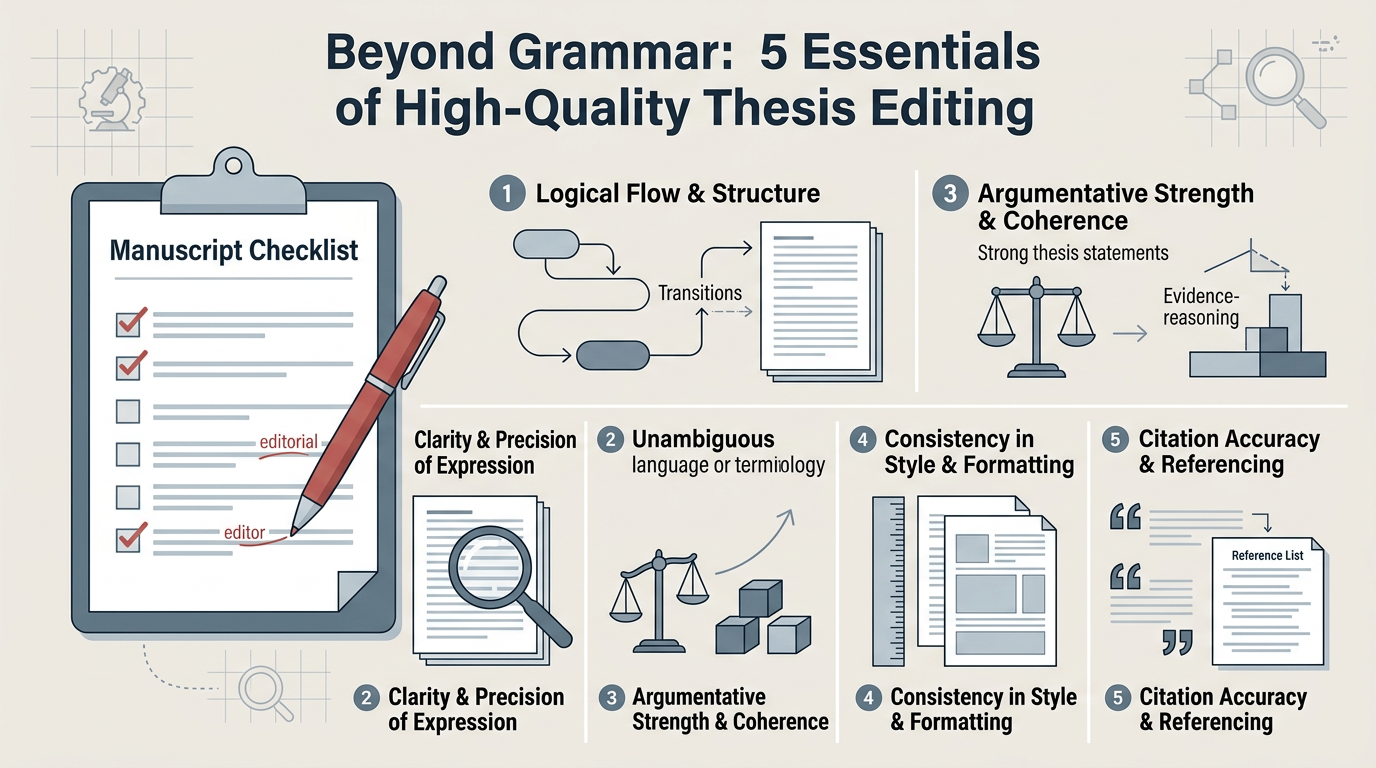
1. Edit the Language, But Do Not Stop There
1.1 Correct terminology, grammar, and expression
Language is the first layer of paper polishing. It includes spelling, grammar, punctuation, and terminology. For medical and scientific writing, one wrong term can change meaning. A misuse of a disease name, method name, or statistical term can damage credibility.
You should also remove Chinglish, vague phrasing, and awkward sentence patterns. Shorter sentences are often better in academic English. They reduce ambiguity and make your argument easier to follow.
High-quality language editing is not about sounding fancy. It is about sounding precise.
1.2 Keep voice and tone consistent
Academic writing should stay objective, concise, and restrained. Avoid emotional language, unsupported claims, and overly casual expressions. Do not mix active and passive voice randomly. Choose a style and keep it stable across the paper.
For reviewers, consistency signals control. It tells them the author understands academic discipline, not just English rules. This is why paper polishing must go beyond grammar correction.
2. Refine the Content, Not Just the Sentences
2.1 Check whether every section supports the main argument
A strong paper is not only well written. It is also well built. During paper polishing, check whether each paragraph supports the study aim. Ask whether the introduction, methods, results, and discussion move in the right direction.
If a paragraph does not serve the core argument, cut it or rewrite it. If an idea appears too early or too late, adjust its position. Reviewers often notice weak content flow faster than grammar issues.
2.2 Balance detail and brevity
Research writing should be complete, but not bloated. A common problem is over-explaining minor points while underdeveloping the key finding. Good paper polishing restores balance.
Use enough detail to make the logic clear. But avoid repeating the same idea in three different ways. In scientific articles, precision matters more than volume. A concise paper often feels more authoritative than a long one.
2.3 Make claims match the data
This is especially important for medical and biomedical papers. Do not let the conclusion go beyond the evidence. If the sample size is small, if the design is observational, or if the analysis is limited, the text should reflect that reality.
Reviewers value honest framing. They reject inflated claims quickly. Content polishing should therefore align every statement with the actual data, methods, and scope of the study.
3. Rebuild the Logic So the Reader Never Gets Lost
3.1 Strengthen transitions between paragraphs
Good paper polishing should make the article feel easy to move through. Each paragraph should connect naturally to the next. The reader should always understand why one point leads to another.
Weak transitions create friction. Strong transitions reduce cognitive load. This matters in scientific writing because reviewers read quickly and judge structure fast.
Use topic sentences that preview the paragraph purpose. Use transitional phrases only when they truly help. Do not force connectors into every paragraph. The goal is flow, not decoration.
3.2 Make the argument progression visible
A strong paper moves from problem, to method, to evidence, to interpretation. If that path is unclear, even good data may look messy. During paper polishing, check whether the order of ideas supports understanding.
For example:
- Does the introduction move from general background to specific gap?
- Does the discussion start with the main finding?
- Does each section answer the question the previous one raised?
If the answer is no, revise the sequence. Logic is one of the most important parts of high-quality thesis editing.
3.3 Avoid hidden contradictions
Sometimes a paper sounds fine sentence by sentence, but the overall logic is unstable. One section may claim caution, while another overstates certainty. One paragraph may suggest a broad implication, while the next narrows the claim sharply.
These contradictions weaken trust. Proper paper polishing should uncover them. This is where expert judgment matters. It is not only about grammar skills. It is also about reading like a reviewer.
4. Standardize Style and Format Across the Whole Manuscript
4.1 Keep terminology, tense, and structure unified
Academic papers should not feel patched together. During paper polishing, standardize repeated terms, abbreviations, tense usage, and sentence style. If one term is used in three forms, pick one and use it consistently.
This is especially important in medical writing, where terminology carries technical meaning. Inconsistent wording can make the paper look less rigorous than it really is.
Also check whether the paper uses one stable style for methods, results, and discussion. A uniform structure improves readability and creates a professional impression.
4.2 Follow the journal’s Author Guidelines
Many authors overlook this step. But journal-specific formatting is part of high-quality paper polishing. Different journals may require different headings, reference styles, figure formats, word limits, and file structures.
Before submission, check the journal’s:
- Instructions for Authors
- Guide for Authors
- General Information for Authors
- Advice to Contributors
These documents often contain formatting rules and fee information. If your paper ignores them, reviewers and editors may see it as careless. Formatting errors are avoidable, and avoidable errors reduce trust.
4.3 Make tables, figures, and citations clean
Visual materials should be easy to read and accurately labeled. Units, sources, and legends must be correct. References should match the claims in the text.
In paper polishing, citation accuracy is not a minor task. A weak or mismatched reference list can suggest poor preparation. For scientific authors, that is a serious problem.
5. Polish With the Reviewer’s Standards in Mind
5.1 Ask whether the paper is clear, credible, and useful
Reviewers usually care about three things:
- Is the content clear?
- Is the evidence reliable?
- Is the work useful or innovative?
Good paper polishing should answer these questions before the reviewer asks them. That means eliminating vague language, checking data presentation, and tightening the explanation of novelty and value.
If the paper includes experiments, the methods must be detailed enough for others to understand or reproduce them. If it includes clinical or observational data, the interpretation must stay within the evidence.
5.2 Check the discussion and conclusion carefully
The discussion should explain findings, compare them with prior research, and state limitations honestly. The conclusion should be brief and proportionate. It should not introduce new ideas or exaggerate the impact.
This is often where manuscripts lose strength. They start well, but the final sections become too broad, too speculative, or too repetitive. High-quality paper-polishing fixes that problem.
5.3 Use a professional workflow, not guesswork
A reliable editing process usually includes:
- Language correction.
- Content review.
- Logic and structure review.
- Style and format standardization.
- Reference and final proof check.
This workflow is efficient because it separates different kinds of problems. It prevents authors from spending time only on grammar while missing deeper issues.
For researchers who want a faster and more systematic process, scifocus.ai can support thesis editing with structured polishing across language, logic, and academic presentation. That matters when you need your manuscript to read like a submission-ready paper, not a draft under revision.
Conclusion
High-quality paper polishing is not just grammar correction. It is a complete revision process that improves language, content, logic, style, and compliance with journal rules. For medical students, doctors, and researchers, this is the difference between a paper that looks edited and a paper that looks publishable. If you want stronger academic writing and a more efficient revision workflow, try scifocus.ai and let your manuscript move closer to submission-ready quality.

Did you like this article? Explore a few more related posts.
Start Your Research Journey With Scifocus Today
Create your free Scifocus account today and take your research to the next level. Experience the difference firsthand—your journey to academic excellence starts here.