

Step-by-Step Guide to Paraphrasing Effectively
Introduction
Paraphrasing is a core skill in academic writing, yet many medical students, doctors, and researchers still struggle with it. The challenge is not only rewriting an essay in different words. It is preserving meaning, tone, and scientific accuracy without sounding repetitive or careless. In medicine, one weak paraphrase can distort evidence. That is why a step-by-step method matters.

1. Understand What Paraphrasing Really Means
1.1 Paraphrasing is not simple word swapping
A strong paraphrase keeps the original idea but changes the structure, vocabulary, and sentence rhythm. It is different from copying with synonyms. It is also different from summarizing. In an essay, paraphrasing should retain key detail while avoiding close duplication.
For medical and scientific writing, this matters because precision is essential. A paraphrase must preserve terms like disease names, biomarkers, outcomes, and mechanisms exactly when they carry scientific meaning. If the technical meaning changes, the paraphrase fails.
1.2 When to paraphrase in academic writing
Paraphrasing is useful when you need to explain prior findings, interpret evidence, or integrate multiple sources into a literature review. It is especially important when writing discussion sections, background sections, and review articles.
It also helps you avoid overusing direct quotations, which are uncommon in scientific writing. In most journal manuscripts, readers expect concise, original prose that synthesizes evidence. A well-written essay or paper should sound informed, not copied.
2. Start with Full Comprehension
2.1 Read the source until you can explain it
Before rewriting anything, read the source text carefully. Ask three questions:
- What is the main claim?
- What are the key supporting details?
- Which terms must remain unchanged?
If you cannot explain the passage in your own words, you are not ready to paraphrase it. This step is especially important in medicine, where one sentence may contain disease context, molecular function, and outcome data.
2.2 Break the original into meaning units
Do not rewrite sentence by sentence at first. Break the source into small meaning units. This makes it easier to rebuild the idea in a new form.
For example, if a study says that a molecule is associated with inflammation, regulates cell migration, and may serve as a biomarker, each of these ideas should be identified separately. Then you can reorganize them in a clearer order for your essay.
3. Rewrite Structure Before You Rewrite Words
3.1 Change sentence order and grammar
A safe paraphrase usually changes sentence structure first. You can shift from active voice to passive voice, combine short sentences, or split long ones. You can also move from a cause-effect order to a problem-solution order.
This approach is more effective than synonym replacement. For example, instead of replacing just a few words, you might:
- Change the subject.
- Change the verb form.
- Change the clause order.
- Add a transition word.
That is how a paraphrase becomes genuinely new while remaining accurate.
3.2 Use transitions to guide logic
Scientific writing depends on logical flow. Transitional words help the reader follow your reasoning. Common choices include:
- therefore
- however
- in addition
- likewise
- moreover
- in contrast
- nevertheless
These words are useful when you are linking studies, comparing findings, or explaining a gap in knowledge. In a medical essay, they also improve readability and help the text sound disciplined and coherent.
4. Replace Words Carefully, Not Blindly
4.1 Use domain-appropriate alternatives
Not every word should be changed. Technical terms should remain precise. For instance, “myocardial infarction,” “tumor progression,” or “cytokine signaling” should not be replaced with vague alternatives.
Instead, focus on ordinary words and phrase patterns. Change “shows that” to “indicates,” “suggests,” or “demonstrates” when appropriate. Change “is important for” to “plays a critical role in” if the context supports it. Accuracy always comes before variety.
4.2 Avoid synonym traps
Some words have similar meanings in general English but different meanings in scientific writing. For example, “significant” may refer to statistical significance, not just importance. “Increase” and “elevate” may not always be interchangeable if the context is quantitative or clinical.
A strong essay uses language that is both varied and exact. If a synonym introduces ambiguity, keep the original term.
5. Follow a Reliable Paraphrasing Workflow
5.1 A five-step method for efficient paraphrasing
Here is a practical workflow you can use:
- Read the source and identify the main point.
- Highlight technical terms that must stay unchanged.
- Write a version from memory, without looking at the original line by line.
- Compare the draft with the source to check meaning.
- Revise for clarity, logic, and academic tone.
This method reduces accidental copying. It also helps you produce writing that sounds natural rather than mechanically altered.
5.2 Check meaning, not only wording
Many weak paraphrases look different on the surface but still mirror the original structure too closely. That can be a problem in academic work and may raise plagiarism concerns.
A better test is this: if you showed the paraphrase to another reader, would they recognize the original wording? If yes, revise it further. A well-crafted essay should reflect understanding, not text substitution.
6. Apply Paraphrasing to Scientific and Medical Writing
6.1 Use paraphrasing to report previous studies
In literature reviews and discussion sections, paraphrasing helps you present prior work objectively. Phrases like “others have shown,” “their findings demonstrate,” or “Smith reported” signal that you are discussing published evidence.
This is important for doctors and researchers who need to compare studies, highlight consistency, and identify gaps. Good paraphrasing also makes it easier to integrate multiple findings into one coherent paragraph.
6.2 Keep the evidence hierarchy in mind
When paraphrasing scientific material, do not flatten the hierarchy of evidence. A large clinical trial, a pilot study, and a hypothesis paper should not be described with the same level of certainty.
Use language that matches the evidence. For example:
- “suggests” for preliminary findings
- “demonstrates” for robust results
- “may indicate” when the evidence is limited
This disciplined approach strengthens the credibility of your essay and protects scientific accuracy.
7. Review for Plagiarism, Clarity, and Flow
7.1 Compare the final version with the source
After rewriting, compare your paraphrase with the original. Ask whether the sentence structure, wording, and emphasis are clearly different. Also check whether any distinctive phrases remain too close to the source.
A paraphrase should sound like a new sentence, not a lightly edited copy. If needed, rewrite again from a fresh angle.
7.2 Read aloud for rhythm and precision
Read the paraphrase aloud. In academic writing, awkward rhythm often reveals weak structure. If the sentence sounds forced, simplify it. If it is too long, split it. If it is too vague, add a precise term.
A polished essay should read smoothly and logically, with no unnecessary repetition.
8. Use AI Tools to Support, Not Replace, Your Judgment
8.1 Where scifocus.ai can help
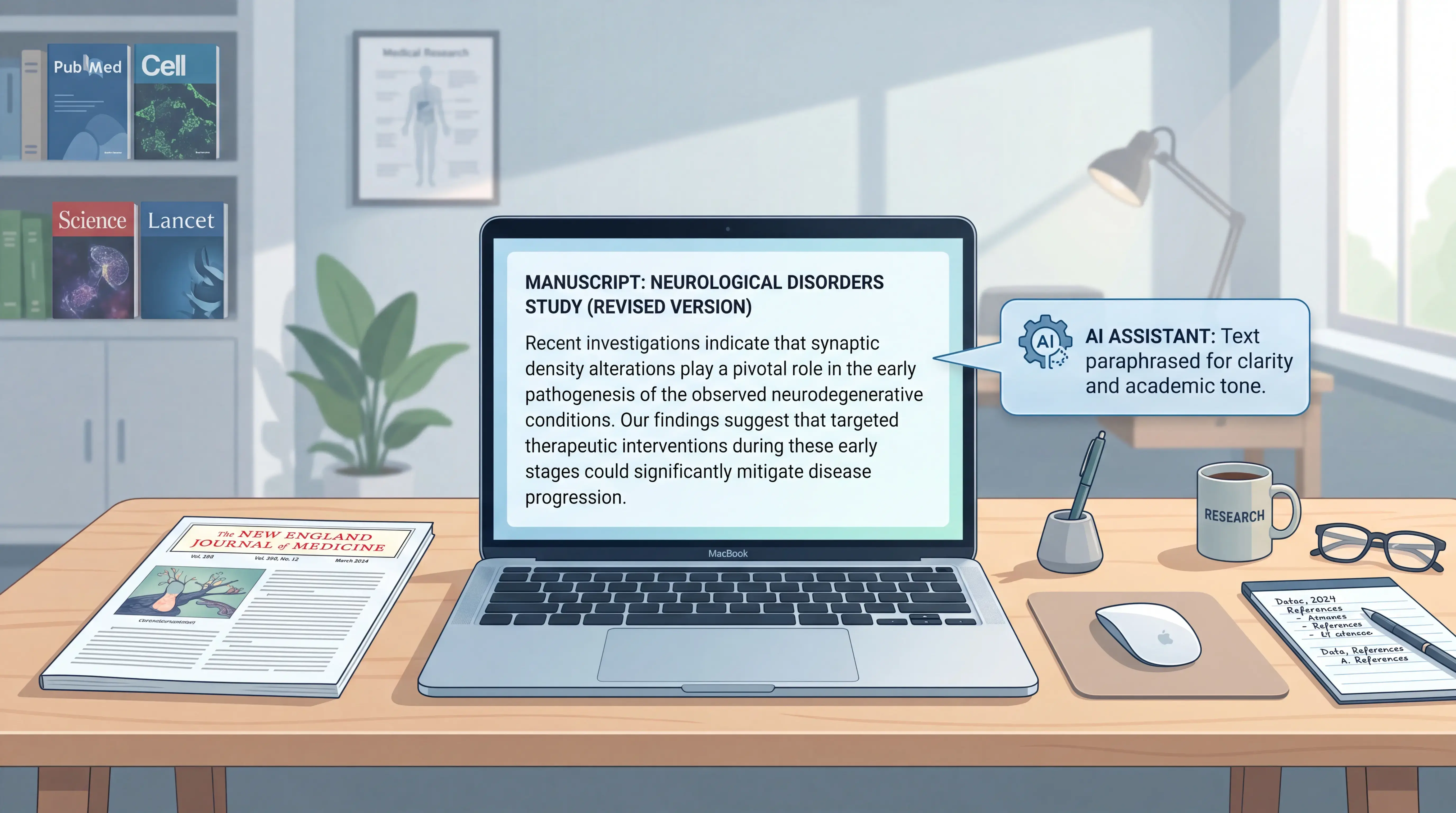
For busy medical students, physicians, and researchers, paraphrasing takes time. This is where scifocus.ai can be useful. It can support drafting, rephrasing, and refining academic text while helping you maintain a professional tone.
Used properly, it can save time in literature synthesis, background writing, and revision. It is best viewed as a writing assistant, not a substitute for critical thinking.
8.2 Why human review is still essential
Even the best tool cannot fully judge scientific context, nuance, or journal expectations. You still need to verify terminology, data, and tone. That final review is what keeps the writing trustworthy.
The best workflow is simple: use scifocus.ai to accelerate drafting, then apply your expert judgment to ensure accuracy and consistency. For any serious academic essay, that combination is far more reliable than either method alone.
Conclusion
Effective paraphrasing is a structured skill. Start with full comprehension. Rebuild the sentence structure. Use transitions wisely. Change words carefully. Then review for accuracy, originality, and flow. For medical students, doctors, and researchers, this approach improves both writing quality and scholarly credibility. If you want to speed up the process without losing control, try scifocus.ai as a practical support tool for your next academic essay.
Did you like this article? Explore a few more related posts.
Start Your Research Journey With Scifocus Today
Create your free Scifocus account today and take your research to the next level. Experience the difference firsthand—your journey to academic excellence starts here.