

Single-Spaced vs. Double-Spaced Word Count
Introduction
The essay word count changes more than many writers expect when spacing changes. A single-spaced page can hold far more text than a double-spaced page, which affects submission limits, page planning, and formatting decisions. For medical students, doctors, and researchers, this is not a minor detail. It can determine whether a manuscript, report, or application meets strict requirements. This article explains the difference clearly, with practical guidance you can use before submitting any essay.
1. What Single-Spaced and Double-Spaced Mean
1.1 Basic formatting difference
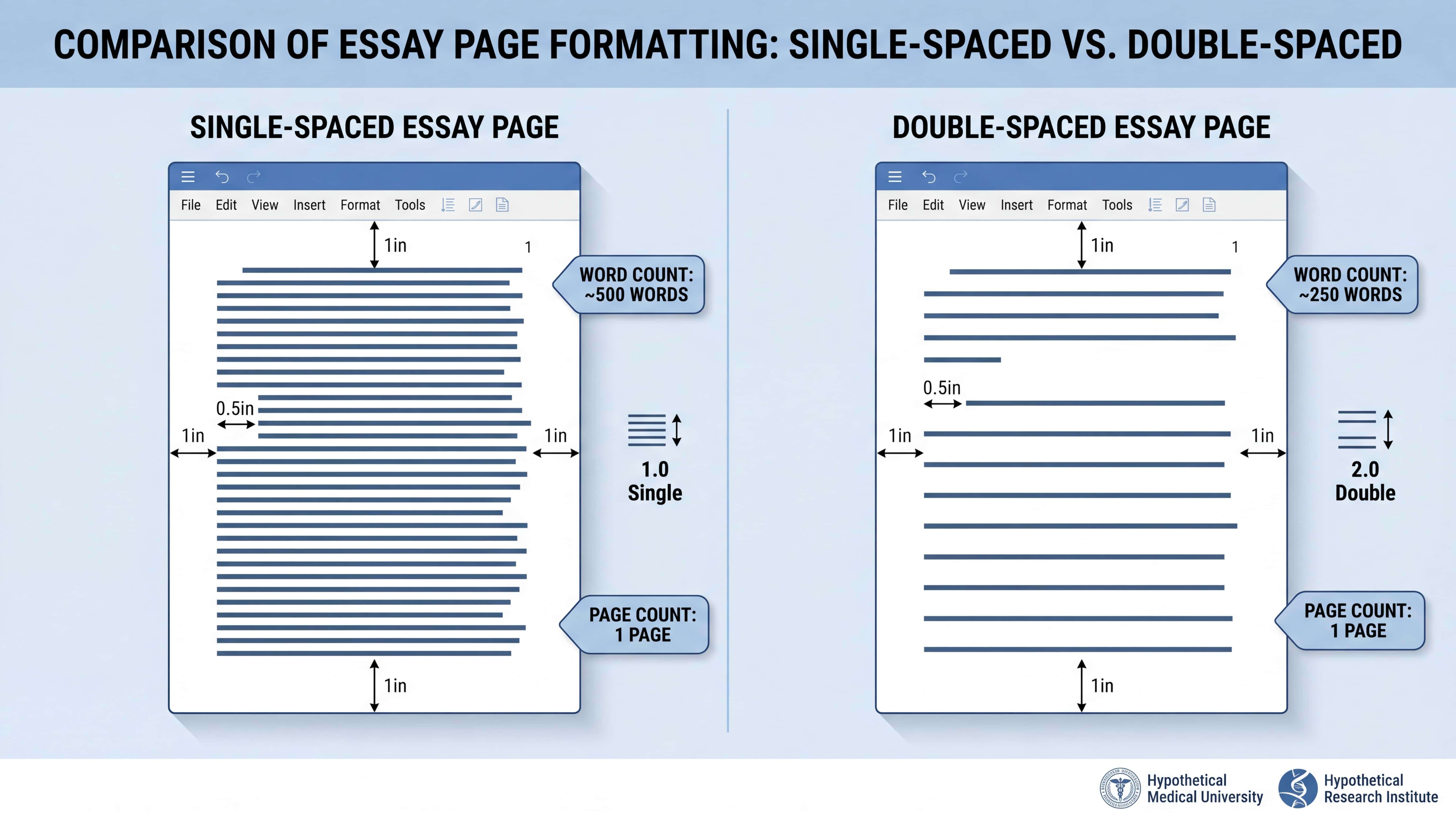
Single spacing means lines sit close together, with minimal vertical space between them. Double spacing inserts extra space between lines, making the text easier to read and mark up.
In academic writing, the spacing rule is usually set by the institution, journal, or supervisor. That is why the same essay can look very different on the page, even when the word count is identical.
1.2 Why spacing affects page count, not word count
The number of words in an essay does not change when you switch from single to double spacing. What changes is how much space each line occupies.
This means:
- Word count stays the same.
- Page count changes significantly.
- Review readability changes.
- Submission length may appear longer or shorter.
For writers in medicine and research, page count often matters in grant drafts, case write-ups, reflective pieces, and personal statements.
2. How Spacing Changes Essay Length in Practice
2.1 Typical page capacity
A double-spaced page usually holds about half as much text as a single-spaced page. In standard academic formatting, a double-spaced page often contains roughly 250 to 300 words, depending on font size, margins, and paragraph breaks. A single-spaced page can hold around 500 to 600 words under similar conditions.
These are not fixed numbers. The actual count in an essay depends on:
- Font type and size.
- Margin width.
- Paragraph indentation.
- Headings and references.
- Tables, figures, and block quotes.
2.2 Why the estimate is never exact
Two papers with the same word count may still have different page counts. A manuscript with many short paragraphs will use more space than one with dense paragraphs. Headings, bullet points, and citation style also change layout.
That is why page-based rules should never be guessed. For any essay, the safest approach is to check the required formatting before writing the final draft.
2.3 Common academic use cases
Different settings use spacing differently.
For example:
- Double spacing is common in coursework, peer review, and many application essays.
- Single spacing is common in final publication drafts, reference lists, and some tables.
- Some journals require specific line spacing for submission systems.
If you write for medical school, residency, or research publication, always verify the exact rule before formatting the essay.
3. Single-Spaced vs. Double-Spaced Word Count: What Actually Changes
3.1 Word count remains identical
The phrase single-spaced vs. double-spaced word count can be misleading if taken literally. Spacing does not alter the number of words in the text itself. One 1,000-word essay is still 1,000 words, whether it is single spaced or double spaced.
What changes is how the text is displayed on the page. This affects perceived length, not actual content volume.
3.2 Page limit conversion matters more
Many submission rules are written in pages rather than words. In that case, spacing becomes critical.
A rough planning guide:
- 1 double-spaced page, about 250 to 300 words.
- 1 single-spaced page, about 500 to 600 words.
- 2 double-spaced pages, about 500 to 600 words.
- 2 single-spaced pages, about 1,000 to 1,200 words.
Use these ranges only as estimates. Final layout can vary with the required formatting of the essay.
3.3 A simple planning example
If a program asks for a 2-page double-spaced essay, you should expect to write about 500 to 600 words. If the same program asks for 2 single-spaced pages, the target may rise to about 1,000 to 1,200 words.
This is why writers must read instructions carefully. A format error can make an otherwise strong submission seem too short or too long.
4. How Medical and Research Writers Should Format Essays
4.1 Follow the requirement first
In academic medicine, formatting compliance is part of professionalism. A well-written essay can still be penalized if it ignores spacing instructions.
Before drafting, confirm:
- Required spacing.
- Required font and size.
- Margin settings.
- Page limit or word limit.
- Citation style.
If the instructions conflict, follow the one stated by the editor, professor, or application portal.
4.2 Use spacing strategically during drafting
Many writers draft in double spacing even if the final version will be single spaced. This makes editing easier. Reviewers and supervisors can add comments more clearly, and the text is easier to scan.
For research-heavy work, double spacing can improve readability during revision. For final formatting, however, the requirements of the essay should take priority over convenience.
4.3 Avoid common formatting mistakes
Frequent errors include:
- Confusing page count with word count.
- Leaving inconsistent spacing between paragraphs.
- Adding extra blank lines that distort length.
- Changing spacing after the draft is nearly complete.
These errors can distort the apparent length of the essay and create avoidable submission issues.
5. Practical Rules You Can Apply Immediately
5.1 Use a conversion mindset
When a guideline is page-based, think in words. That gives you more control over planning. If the submission is word-based, spacing is secondary, except for readability and compliance.
A reliable workflow is:
- Draft the full content first.
- Check the word count.
- Apply required spacing.
- Review page count at the end.
This approach reduces last-minute reformatting for any essay.
5.2 Build a margin of safety
Do not aim exactly at the limit. Leave a small buffer. Formatting changes, citation additions, and paragraph breaks can push the document over the threshold.
For important submissions, keep a small reserve of about 5 to 10 percent. That gives room for revisions without forcing cuts in the final essay.
5.3 Match spacing to the goal
Different goals justify different layouts.
- For drafting and feedback, double spacing is often better.
- For final submission, use the required spacing.
- For publication or compact reports, single spacing may be preferred.
The best format is the one that fits the rule and the purpose of the essay.
6. How SciFocus.ai Can Help You Write Faster and Format Better
6.1 A practical solution for academic writers
If you regularly produce essays, case reports, or research drafts, formatting and structure can waste time. SciFocus.ai helps streamline the writing process so you can focus on content quality, clarity, and submission readiness.
It is especially useful when you need to move quickly from outline to polished draft while keeping the essay organized and professional.
6.2 Where the tool adds value
A platform like SciFocus.ai can support:
- Faster drafting of structured academic content.
- Cleaner organization of arguments and sections.
- Improved consistency across revisions.
- More efficient preparation for submission.
For medical students, clinicians, and researchers, that means less time formatting and more time refining the scientific message of the essay.
6.3 Why this matters for high-stakes writing
In academic and medical contexts, small formatting mistakes can create unnecessary friction. A tool that supports structured writing can reduce that risk. It helps you stay aligned with page limits, draft expectations, and presentation standards.
If your workflow includes frequent essay writing, SciFocus.ai can be a practical way to improve speed, consistency, and submission confidence.
Conclusion
The difference between single spacing and double spacing does not change the word count of an essay, but it does change page length, readability, and compliance with submission rules. For medical students, doctors, and researchers, that difference can affect grading, review, and publication readiness. The safest method is simple. Check the required format, plan by words, and confirm the final page count before submission. If you want to write and organize academic content more efficiently, consider using SciFocus.ai to support a faster, cleaner workflow.
Did you like this article? Explore a few more related posts.
Start Your Research Journey With Scifocus Today
Create your free Scifocus account today and take your research to the next level. Experience the difference firsthand—your journey to academic excellence starts here.