

What Is the Sampling Method in Research?
Introduction
Sampling is the core step that turns a research question into usable evidence. In clinical research, medical students, doctors, and researchers often face the same problem. They want results that are valid, but they cannot study every person in the population. That is why the sampling method in research matters. It determines whether your sample can truly represent the target group, or whether your findings are biased and weak.
1. What Sampling Means in Research
1.1 Population and Sample
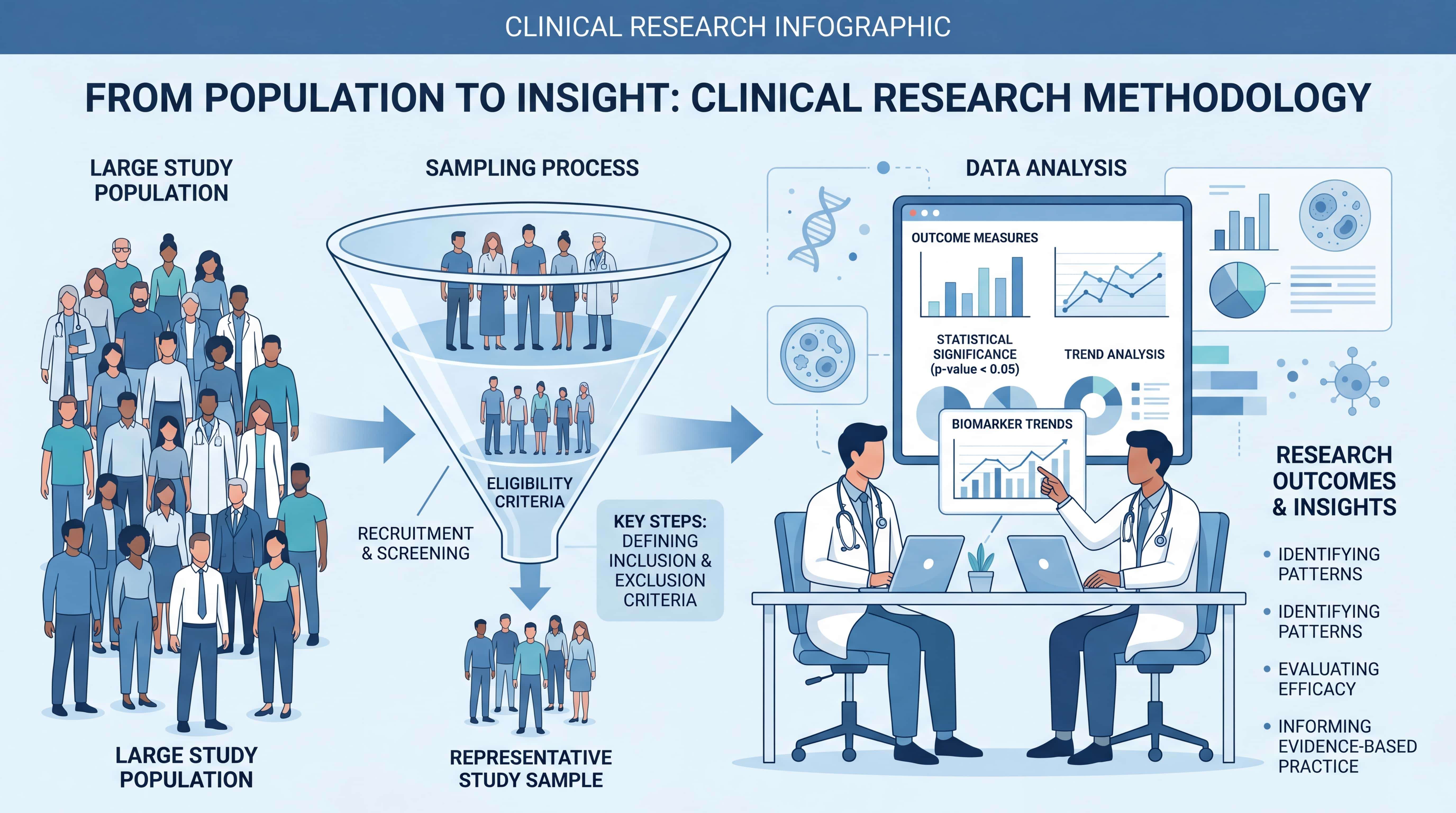
In research, the population is the full group you want to understand. It is not “everyone.” It is the specific group that matches your study question. For example, it may be all adolescents with asthma, or all patients with early invasive breast cancer in one hospital system.
A sample is a subset of that population. A good sample should reflect the key features of the population. If it does not, the result may look precise but still be wrong.
Researchers usually distinguish between the target population and the accessible population. The target population is the group to which you want to generalize the findings. The accessible population is the part you can actually reach in a certain place and time.
1.2 Why Sampling Is Essential
Sampling is not a minor technical detail. It is a major source of study quality. If the sample is too small, random error rises. If the sample is poorly chosen, selection bias becomes a threat.
The goal of sampling is not just to collect data. It is to collect representative data. That is what allows you to infer something meaningful from a smaller group to a larger one.
2. Main Types of Sampling Method in Research
2.1 Probability Sampling
Probability sampling means every person in the population has a known chance of being selected. This is usually the strongest option when feasibility allows it.
Common forms include:
- Simple random sampling. Each person has an equal chance.
- Systematic sampling. Every k-th person is selected after a random start.
- Stratified sampling. The population is divided into strata, then sampled within each stratum.
- Cluster sampling. Groups, not individuals, are sampled first.
These methods are useful when representativeness is a priority. They are especially important in epidemiology and public health studies.
2.2 Non-Probability Sampling
Non-probability sampling does not give every individual a known chance of selection. It is more common in clinical practice, retrospective studies, and feasibility-based projects.
Two frequent forms are:
- Convenience sampling. Select whoever is easiest to access.
- Consecutive sampling. Enroll every eligible case during a defined period, such as all patients admitted between January and December.
Consecutive sampling is often used in clinical papers because it is practical and transparent. It is not as strong as probability sampling, but it is often realistic in hospital-based research.
3. How to Choose the Right Sampling Method
3.1 Start With the Research Design
The sampling method must match the research design. Cross-sectional studies often use probability sampling or large convenience-based samples. Case-control studies usually select cases and controls based on eligibility. Cohort studies may use consecutive recruitment or registry-based sampling.
If the design is not clear, the sampling plan will also be weak. That is why sample selection should never be separated from the study question.
3.2 Define Inclusion and Exclusion Criteria
Before sampling, define who belongs in the study and who should be excluded. This is one of the most important steps.
Good criteria should consider:
- Demographic features
- Clinical features
- Geographic factors
- Time window of the study
- Data quality and safety issues
For example, if you study a drug response in children, adults should not be included. If you study a disease outcome in a specific hospital period, cases outside that period should be excluded.
Clear criteria improve consistency and reduce noise in the final dataset.
3.3 Consider Feasibility, Size, and Representativeness
Three practical rules guide sampling choice:
- The study must be feasible within time and budget.
- The sample must be large enough to control random error.
- The sample must be representative enough to support inference.
In clinical research, these three rules often compete with each other. A method may be ideal statistically but impossible operationally. In that case, a simpler method may be more appropriate, as long as limitations are stated clearly.
4. Sampling and Sample Size Are Not the Same
4.1 Why Sample Size Matters
Sampling method and sample size are related, but they are not the same thing. A perfect sampling method cannot fix a sample that is too small.
Sample size depends on the research aim and the study design. A prevalence study, for example, needs a different calculation from a cohort study or randomized trial.
A common clinical example is estimating disease prevalence. If a researcher expects a prevalence of 10% and wants a 1% margin of error, the required sample may be in the thousands. In one classic example from public health teaching, the calculated sample size for estimating a 10% carrier rate with 1% precision was about 3,458 participants.
4.2 Why This Matters in Clinical Writing
Reviewers often ask why a paper used 100 patients instead of 200. The answer should not be based on convenience alone. It should be based on the study question, the design, and the sample size rationale.
If only 100 cases are available, that limitation should be acknowledged. If more cases can be added, that usually improves stability and credibility.
5. Common Mistakes in Sampling Method in Research
5.1 Selecting Easy Cases Only
One of the most common mistakes is choosing only the easiest patients to access. This creates convenience bias. The sample may become unbalanced and overrepresent certain characteristics.
5.2 Ignoring Missing Data or Follow-Up Loss
In cohort studies, loss to follow-up can reduce quality. When follow-up is expected to be difficult, researchers may increase the planned sample size by around 20% to offset attrition.
5.3 Mixing Eligibility With Sampling
Eligibility criteria define who can enter the study. Sampling defines how eligible people are selected. These are different steps. When they are mixed together, the study becomes hard to reproduce and harder to defend in peer review.
5.4 Using a Method That Does Not Fit the Question
Not every question needs the same sampling strategy. A cross-sectional survey, a case-control study, and a randomized trial all require different logic. The wrong method can produce data that look complete but answer the wrong question.
6. Practical Sampling Advice for Medical Researchers
6.1 Retrospective Studies
For beginners, retrospective studies are often easier. Existing records can be collected without active recruitment. Consecutive sampling is common in this setting and is usually acceptable when the inclusion window is clearly defined.
6.2 Cross-Sectional Studies
Cross-sectional studies are useful for prevalence or mean estimation. They can show association, but not causation. If you use this design, the sample should be large enough and the selection rule should be explicit.
6.3 Cohort Studies
Cohort studies require careful follow-up. If you expect dropouts, plan for them early. A stronger sampling frame and a realistic follow-up strategy are essential.
6.4 Randomized Controlled Trials
In randomized trials, sampling comes before randomization. First, define who is eligible. Then randomize the selected participants into groups. A trial is only as strong as the sample that enters it.
7. How scifocus.ai Can Help
Writing a strong research essay takes more than knowledge. It also takes structure, clarity, and fast iteration. This is where scifocus.ai can help medical students, clinicians, and researchers save time.
Use it to:
- Organize your research idea into a logical outline
- Improve academic wording and readability
- Refine section transitions and argument flow
- Turn rough notes into a polished clinical research essay
If you are preparing a manuscript, a thesis chapter, or a research summary, scifocus.ai can reduce drafting time and help you present methods more clearly. For busy clinicians and researchers, that efficiency is valuable.
Conclusion
The sampling method in research decides whether your findings are trustworthy, generalizable, and worth publishing. A strong sample is not just a collection of cases. It is a deliberate choice linked to the study design, the target population, the sample size, and the research objective.
For medical students, doctors, and researchers, the key is simple. Define the population clearly. Set inclusion and exclusion criteria carefully. Choose the sampling method that fits the design. Then justify it with logic, not convenience.

If you want to write a stronger research essay faster, try scifocus.ai and turn your method section into a clear, publication-ready draft.
Did you like this article? Explore a few more related posts.
Start Your Research Journey With Scifocus Today
Create your free Scifocus account today and take your research to the next level. Experience the difference firsthand—your journey to academic excellence starts here.