

Randomized Controlled Trials vs Observational Studies
Introduction
Choosing between an essay on randomized controlled trials vs observational studies can be difficult when you need clear, accurate guidance for clinical research. Med students, physicians, and researchers often face the same problem: which design gives stronger evidence, and when is each one appropriate? The answer depends on the research question, ethics, feasibility, and the type of bias you can tolerate.
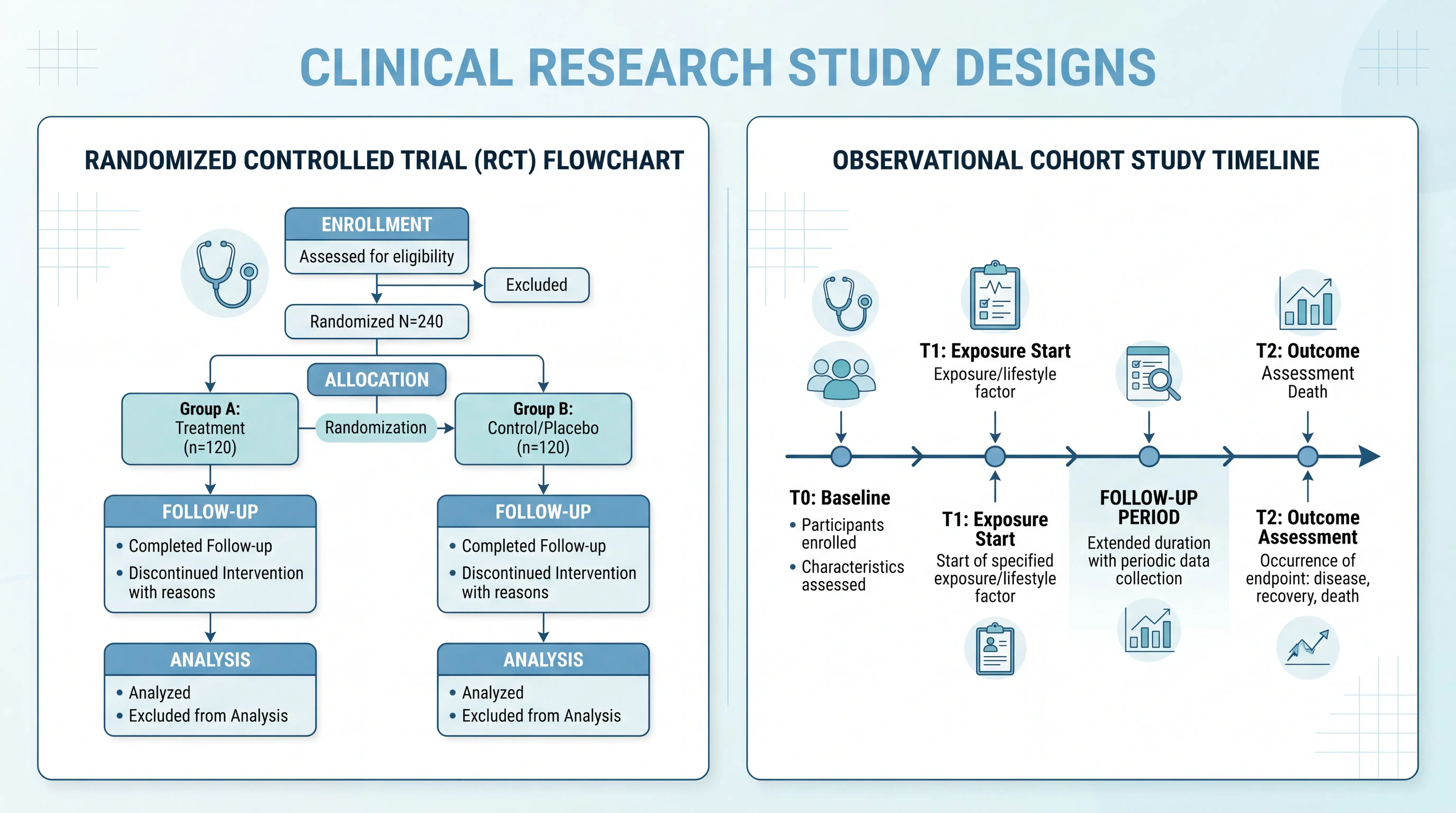
1. What Makes These Two Study Designs Different?
1.1 Randomization is the core strength of RCTs
A randomized controlled trial, or RCT, assigns participants to groups by chance. This is its biggest advantage. Randomization reduces selection bias and balances known and unknown confounders across groups. That makes group comparisons more credible.
RCTs also make blinding easier. In many settings, researchers can use blind or masked assessment to reduce expectation bias. Statistical analysis is usually more standardized as well. Because the intervention is assigned prospectively, the outcome comparison is often cleaner and easier to interpret.
1.2 Observational studies measure what happens in real life
Observational studies do not assign treatment. They observe exposures, treatments, or outcomes as they occur naturally. Common forms include cohort studies, case-control studies, and cross-sectional studies.
These studies are especially useful when randomization is unethical or impossible. For example, you cannot randomly assign harmful exposures. You also cannot always control patient behavior, environmental factors, or existing treatment decisions. That is why observational studies remain essential in clinical and public health research.
1.3 The key trade-off is control versus realism
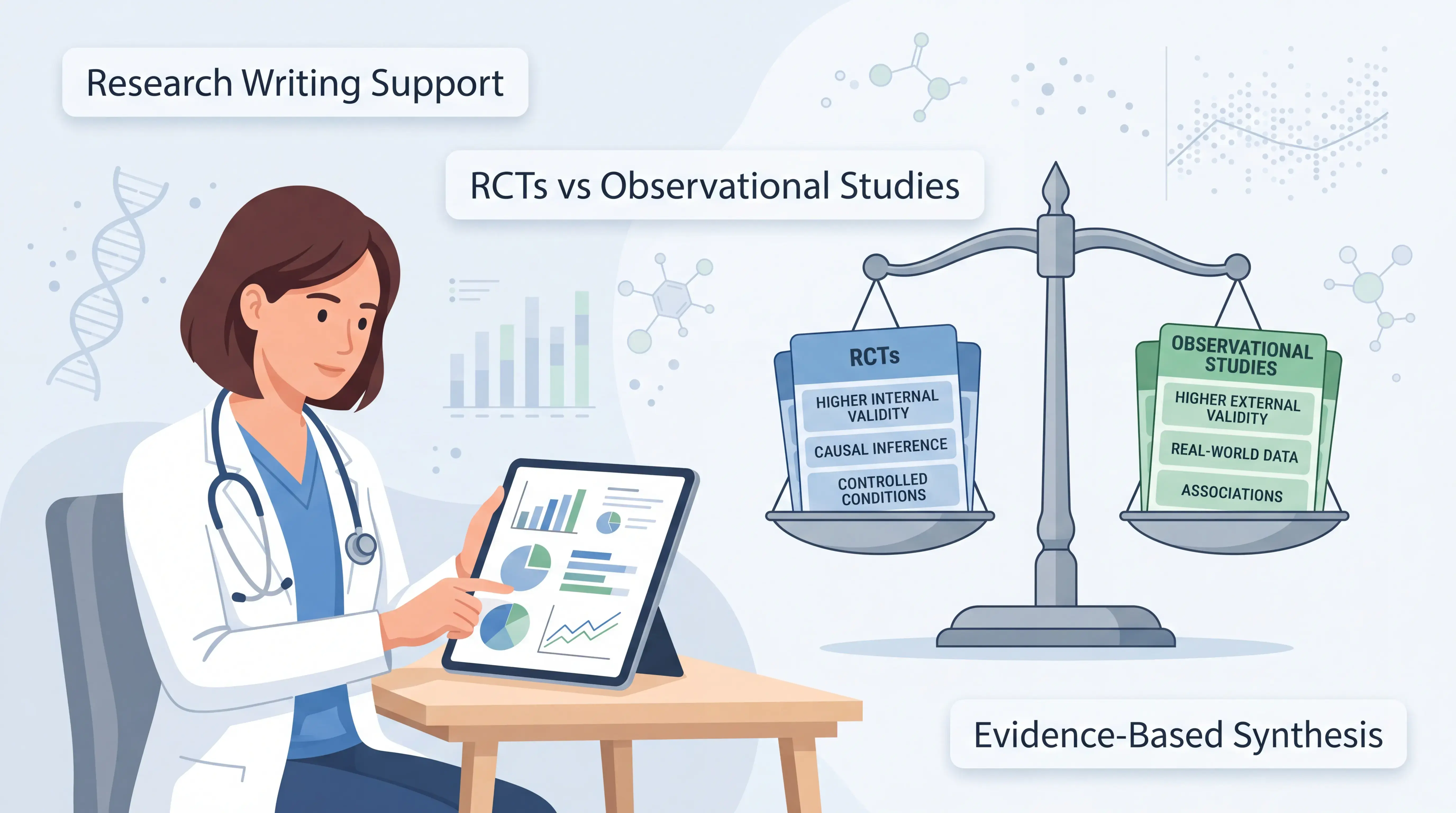
RCTs maximize internal validity. Observational studies often maximize external validity. RCTs are stronger for causal inference because they control allocation. Observational studies are often better for studying real-world practice, rare harms, long-term outcomes, and risk factors.
In practice, these designs do not compete as much as they complement each other. A strong research program often uses both.
2. When an RCT Is the Better Choice
2.1 Use RCTs when you need the highest level of causal evidence
If the question is whether a treatment works, an RCT is usually the best design. This is especially true when the intervention has uncertain benefit and the effect size may be modest. In such cases, randomization helps prevent confounding from distorting the result.
RCTs are also useful when the intervention is clinically actionable. If the findings will guide treatment decisions, an RCT often provides the most reliable evidence. This is why RCTs are widely used in drug trials, procedure evaluation, and comparative effectiveness research.
2.2 RCTs are strongest when bias control matters most
Because RCTs can use placebo control, blinding, and standardized outcomes, they are ideal when subjective judgment may influence results. They also allow more structured follow-up and predefined endpoints. That improves consistency.
Some RCT formats are especially practical:
- Parallel-group trials for standard treatment comparisons
- Crossover trials for stable conditions
- Cluster trials for hospital, community, or policy interventions
- Sequential designs when stopping early could save resources
Each design serves a different purpose. The right choice depends on feasibility and outcome type.
2.3 RCTs have important limits
RCTs are not always easy to run. They take more time and money. They may also suffer from volunteer bias, meaning participants may not represent the full patient population. Follow-up loss is another major issue. If participants cannot be contacted later, the result becomes less complete.
Ethics is the biggest limit. You cannot randomize people to harmful exposures. You also cannot use RCTs for every question in medicine. An RCT is not a universal solution. It is a powerful tool with boundaries.
3. When Observational Studies Are the Better Choice
3.1 Observational studies answer questions RCTs cannot
Observational studies are essential when the exposure cannot be randomized. This includes smoking, occupational hazards, disease risk factors, and long-term environmental effects. They are also valuable when the treatment is already part of routine care and random assignment would be impractical.
They are often the only realistic option for rare outcomes or very long latency periods. If a study must follow people for years or decades, an observational design may be more feasible than an RCT.
3.2 They are better for real-world practice
Observational studies often reflect actual clinical behavior. That matters. Patients in real practice are heterogeneous. They differ in age, comorbidity, adherence, and access to care. Observational research can capture that complexity better than a tightly controlled trial.
This makes observational studies particularly useful for:
- Health services research
- Comparative safety studies
- Prognostic research
- Post-marketing surveillance
- Screening effectiveness in routine settings
For policy and population-level decisions, observational data can be highly informative.
3.3 Their main weakness is confounding
The biggest problem in observational studies is confounding. Treatment groups may differ before the intervention begins. That difference can create false associations.
For example, healthier patients may be more likely to receive a specific therapy. If they do better, the improvement may reflect baseline health rather than the treatment itself. Researchers use adjustment methods, matching, and sensitivity analyses to reduce this problem. But they cannot eliminate it completely.
That is why observational studies usually provide weaker causal evidence than RCTs. Still, when designed well, they can produce important and credible findings.
4. How to Interpret Evidence Without Overrating Either Design
4.1 Do not confuse statistical significance with clinical value
A large RCT may find a statistically significant difference that is too small to matter clinically. Conversely, an observational study may show a large effect that later disappears after confounding is addressed.
Strong evidence is not only about p-values. It is about effect size, bias control, and clinical relevance. Researchers should look at absolute risk, confidence intervals, follow-up duration, and outcome definitions.
4.2 External validity matters as much as internal validity
RCTs can be highly controlled but less generalizable. Strict inclusion criteria may exclude older adults, patients with comorbidities, or those with poor adherence. Observational studies often include broader populations, so they may better reflect everyday practice.
This is one reason the best evidence often comes from a sequence:
- Early mechanistic or observational signals
- RCT confirmation
- Real-world observational follow-up
That combination gives a fuller picture than either design alone.
4.3 Design choice should match the question
A good study design starts with the question:
- Does the treatment work under controlled conditions?
- Does it work in routine practice?
- What are the harms?
- What is the natural history of the disease?
- Which patients benefit most?
If the aim is efficacy, RCTs are usually better. If the aim is risk, prognosis, safety, or population behavior, observational studies may be more suitable.
5. Practical Quality Checks for Researchers
5.1 For RCTs, ask these questions
Before trusting an RCT, check whether:
- Randomization was truly concealed
- Blinding was used when possible
- Follow-up loss was low
- Outcomes were predefined
- Analysis matched the original protocol
- Sample size was justified
A well-run RCT should explain all of these clearly. If not, the risk of bias rises.
5.2 For observational studies, check confounding control
For observational research, examine:
- How participants were selected
- Whether exposure was measured accurately
- What confounders were adjusted for
- Whether follow-up was complete
- Whether sensitivity analyses were performed
- Whether results were consistent across subgroups
A strong observational study is transparent about its limitations and careful in its adjustment strategy.
5.3 Use the right research support
Writing, organizing, and refining research evidence takes time. Tools like scifocus.ai can help medical writers and researchers structure an essay, sharpen arguments, and keep the logic aligned with the study question. That is especially useful when comparing complex designs such as randomized controlled trials vs observational studies.
6. Which One Should You Trust More?
6.1 The short answer
If your goal is causal inference for an intervention, RCTs usually deserve higher trust. If your goal is to understand real-world exposure, safety, prognosis, or feasibility, observational studies are often indispensable.
6.2 The best answer is context-based
The best study design is the one that fits the clinical question, the ethical constraints, and the available resources. There is no single gold standard for every research problem. RCTs are not automatically superior in every context. Observational studies are not automatically weaker in every situation.
The strongest evidence base in medicine usually comes from combining both:
- RCTs for efficacy
- Observational studies for effectiveness, safety, and generalizability
That is how researchers avoid oversimplified conclusions.
Conclusion
Randomized controlled trials and observational studies each have clear strengths. RCTs reduce bias and support causal claims. Observational studies capture real-world patterns and answer questions RCTs cannot. For medical students, clinicians, and researchers, the key is not to choose one design blindly. It is to match the design to the question.
If you need to write a high-quality essay on this topic, or organize a publication-ready comparison, scifocus.ai can help you build a clearer structure and stronger argument flow. Use the right design. Then present it with precision.
Did you like this article? Explore a few more related posts.
Start Your Research Journey With Scifocus Today
Create your free Scifocus account today and take your research to the next level. Experience the difference firsthand—your journey to academic excellence starts here.