

Introduction
In medical sciences, choosing the right research approach can define the quality of your essay, study design, and final conclusions. Many students and researchers struggle to decide between qualitative and quantitative methods. The real challenge is not only understanding the difference, but also knowing when each method is appropriate, how to reduce bias, and how to present findings with clinical value. A strong medical research essay must connect method choice with research purpose, ethics, and statistical rigor.
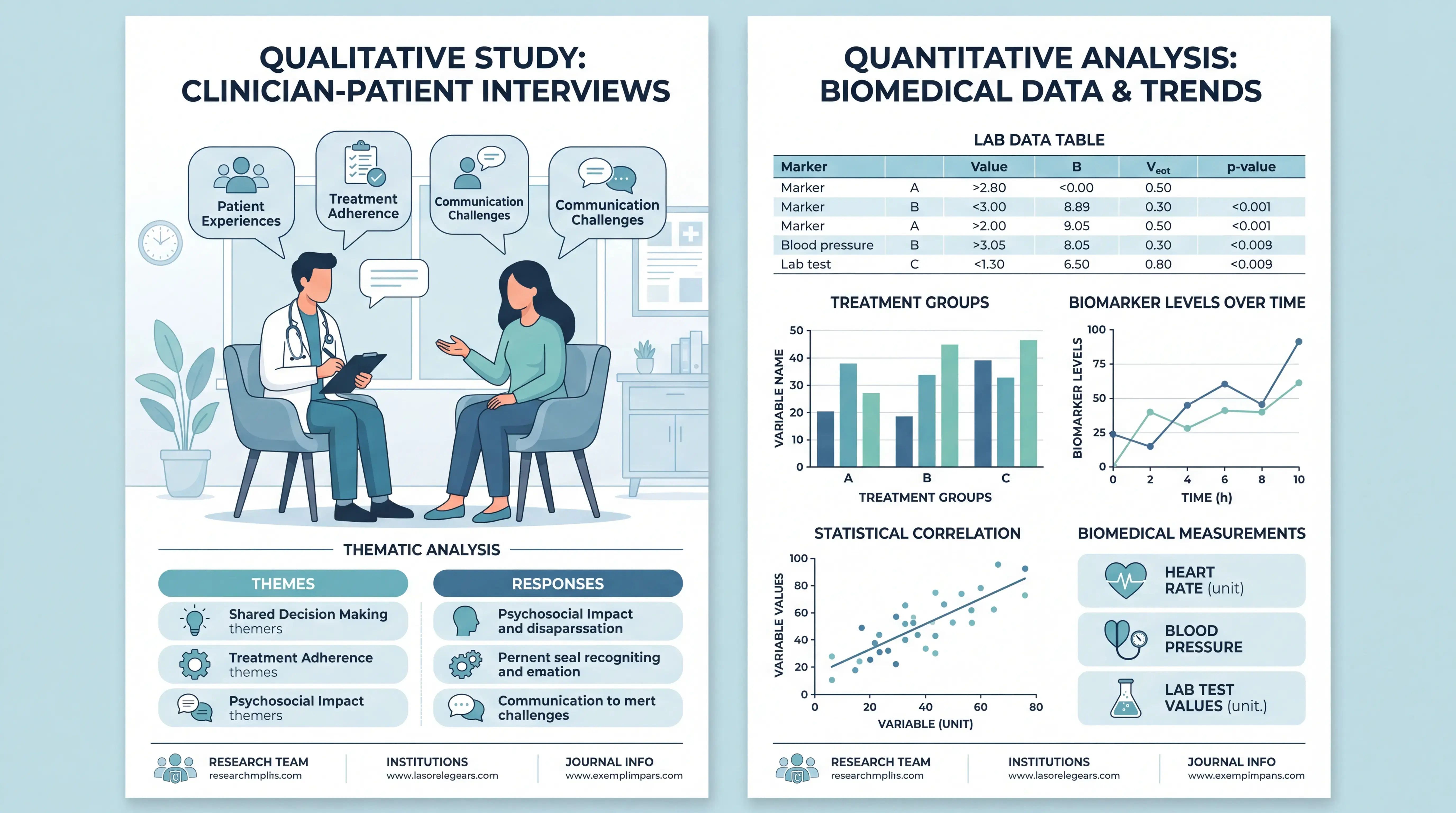
1. Understanding the Core Difference
1.1 What Qualitative Research Focuses On
Qualitative research explores experiences, meanings, and behaviors. In medical sciences, it is useful when the goal is to understand patient perceptions, treatment barriers, communication, or decision-making. It often uses interviews, focus groups, and open-ended observations.
This approach is especially valuable in areas where numbers alone cannot explain the full picture. For example, a patient may show good clinical indicators but still feel that treatment is unbearable. A qualitative study can capture that gap.
1.2 What Quantitative Research Focuses On
Quantitative research measures variables with numbers. It asks how much, how often, and whether differences or associations exist. In medical sciences, this includes clinical trials, cohort studies, cross-sectional studies, and statistical comparisons.
According to the clinical statistics framework in the knowledge base, quantitative methods support:
- Description of data, such as mean and median.
- Comparison of samples and populations.
- Inference about parameters and treatment effects.
If qualitative research explains “why,” quantitative research tests “how much” and “whether.” That difference is the foundation of any strong medical research essay.
2. Why the Choice Matters in Medical Sciences
2.1 Medical Research Involves Human Complexity
Clinical research studies humans, and humans are not controlled laboratory objects. They are biologically and psychologically complex. That is why medical research must follow ethical review and standardized procedures.
This complexity makes qualitative work important for understanding lived experience. It also makes quantitative work essential for testing interventions under measurable conditions. In practice, many medical questions require both.
2.2 Clinical Research Has Uncertainty and Bias
The knowledge base highlights a key point. Clinical research is affected by compliance, dropout, selection bias, information bias, and confounding. Unlike basic experiments, patients may not follow protocol, and conditions are often uncontrollable.
This is one reason clinical studies often need larger samples. Larger samples help reduce random error and improve reliability. But sample size alone is not enough. Researchers must also:
- Use strict inclusion and exclusion criteria.
- Control time, location, and population characteristics.
- Apply randomization, matching, stratification, or multivariable analysis when needed.
A good medical research essay should show that method choice is also a bias-control decision.
3. When to Use Qualitative Research
3.1 Best Use Cases in Medicine
Qualitative research is best when the goal is to explore experience or process. Common examples include:
- Patient attitudes toward chronic disease management.
- Barriers to medication adherence.
- Communication between doctors and patients.
- Reasons for refusal of treatment or follow-up.
It is also useful in early-stage research, when the topic is not yet well defined. A small number of interviews can reveal patterns that later inform a larger survey or trial.
3.2 Strengths and Limits
The main strength of qualitative research is depth. It provides context, nuance, and meaning. It helps researchers understand the human side of medicine.
Its limitation is that results are usually not designed for statistical generalization. That means sample size is smaller, and findings are more interpretive. In medical sciences, this is not a weakness if the research question is exploratory.
Use qualitative methods when the problem is human behavior, patient experience, or clinical communication.
4. When to Use Quantitative Research
4.1 Best Use Cases in Medicine
Quantitative research is the right choice when the research question needs measurable comparison. Typical cases include:
- Comparing treatment outcomes between groups.
- Testing whether a drug changes a biomarker.
- Estimating disease prevalence.
- Studying risk factors in cohort or case-control designs.
The knowledge base also notes standard statistical choices for quantitative data, such as:
- One-sample and two-sample mean comparison.
- Paired and independent t-tests.
- ANOVA for multi-group comparisons.
- Chi-square test for categorical data.
- Survival analysis, such as log-rank test and Cox regression.
4.2 Strengths and Limits
Quantitative research is strong in precision, reproducibility, and inference. It is essential for evidence-based medicine because it can estimate effect size and test clinical significance.
However, numbers alone may miss context. A treatment can be statistically significant but clinically meaningless. The knowledge base stresses this point clearly. Researchers must always consider clinical significance, not just p-values.
That is why every medical research essay should discuss both statistical results and practical impact.
5. Research Design, Data Collection, and Ethics
5.1 Clinical Research Requires Careful Design
Medical research is not just about choosing a method. It is about building a valid design. In quantitative studies, design may include:
- Group design.
- Paired design.
- Factorial design.
- Repeated-measures design.
- Crossover design.
In observational studies, design may include:
- Cross-sectional studies.
- Cohort studies.
- Case-control studies.
- Descriptive studies.
For retrospective research, the knowledge base emphasizes choosing control groups from the same source population and controlling time, region, and demographic traits. This improves comparability and reduces bias.
5.2 Data Collection Must Match the Study Goal
Data collection is where many studies fail. Researchers should collect baseline demographics, history, comorbidities, risk factors, and outcome indicators. After collection, data cleaning and proper coding are essential.
Common collection methods in clinical research include:
- Face-to-face questionnaires.
- Take-home questionnaires.
- Online scans or QR-code surveys.
- Telephone follow-up.
Each method has trade-offs in response rate, quality, and compliance. In other words, method selection affects data quality before analysis even begins.
5.3 Ethics Cannot Be Ignored
Because medical research involves people, ethics is mandatory. Even if the material seems simple, such as hair, urine, or stool, human research still needs ethical review. This is a core requirement of clinical research and a major distinction from non-human experiments.
Ethics, compliance, and standardization are not side issues. They are central to valid medical science.
6. How to Choose the Right Method for Your Essay
6.1 A Practical Decision Framework
If you are writing an essay on research methods in medical sciences, use this simple framework:
- Define the research question.
- Decide whether you need depth or measurement.
- Check whether the study aims to explore or compare.
- Consider feasibility, ethics, and sample access.
- Match the method to the statistical plan.
If the question is about patient experience, use qualitative methods. If the question is about effect size, risk, prevalence, or treatment comparison, use quantitative methods.
6.2 Writing the Essay with Academic Strength
A strong medical essay should not just define the two methods. It should explain:
- Why the method fits the question.
- How bias will be handled.
- What sample size logic applies.
- Which statistical tools are appropriate.
- How clinical meaning will be judged.
This structure shows real understanding, not memorization. It also aligns with E-E-A-T principles by demonstrating expertise, accuracy, and practical judgment.
The best essay does more than compare definitions. It shows clinical reasoning.
7. How SciFocus.ai Can Help You Write Better Medical Research Essays
7.1 From Topic Selection to Final Draft
If you need to turn a research idea into a clear, publishable medical essay, SciFocus.ai can help streamline the process. It supports structured thinking, topic refinement, and academic writing workflows for medical users.
Instead of starting from a blank page, you can organize your argument around the research question, method choice, and statistical logic. That is especially useful for students, doctors, and researchers working under time pressure.
7.2 Better Clarity, Faster Output
SciFocus.ai can help you:
- Build a clearer essay outline.
- Improve academic flow.
- Keep the focus on evidence and method.
- Reduce weak, generic writing.
- Save time in drafting and revision.
For medical sciences, that means your essay stays aligned with research goals, ethical standards, and logical structure. A better workflow leads to a stronger final paper.
Conclusion
Qualitative and quantitative research are not competing tools. They answer different medical questions. Qualitative research explains experience and behavior. Quantitative research measures effect, frequency, and association. In medical sciences, the strongest studies often begin with the right question, use the right design, and evaluate both statistical and clinical significance. If you are preparing a medical essay, focus on method fit, bias control, ethics, and practical value. For faster, more structured academic writing, explore scifocus.ai and build your next medical paper with more precision and less friction.
Did you like this article? Explore a few more related posts.
Start Your Research Journey With Scifocus Today
Create your free Scifocus account today and take your research to the next level. Experience the difference firsthand—your journey to academic excellence starts here.