

Introduction
In clinical research, many readers confuse prospective and retrospective studies, especially when writing an essay, protocol, or paper. The problem is not the names. It is the timeline, the data source, and the logic of inference. If you are a medical student, physician, or researcher, this distinction affects study design, bias control, and how strong your conclusions really are. Understanding the difference helps you choose the right design and avoid serious methodological mistakes.
1. What These Study Types Really Mean
1.1 The core logic is cause to outcome
A cohort study always follows a cause-to-outcome logic. Participants are grouped by exposure, treatment, or a clinical feature, and then outcomes are assessed. For example, smokers and non-smokers can be followed to compare lung cancer incidence. The logic is not “who got disease first.” It is “who had the exposure first.”
This is the main point many learners miss: prospective and retrospective describe how data are collected, not the basic cohort logic itself.
1.2 The difference is data collection direction
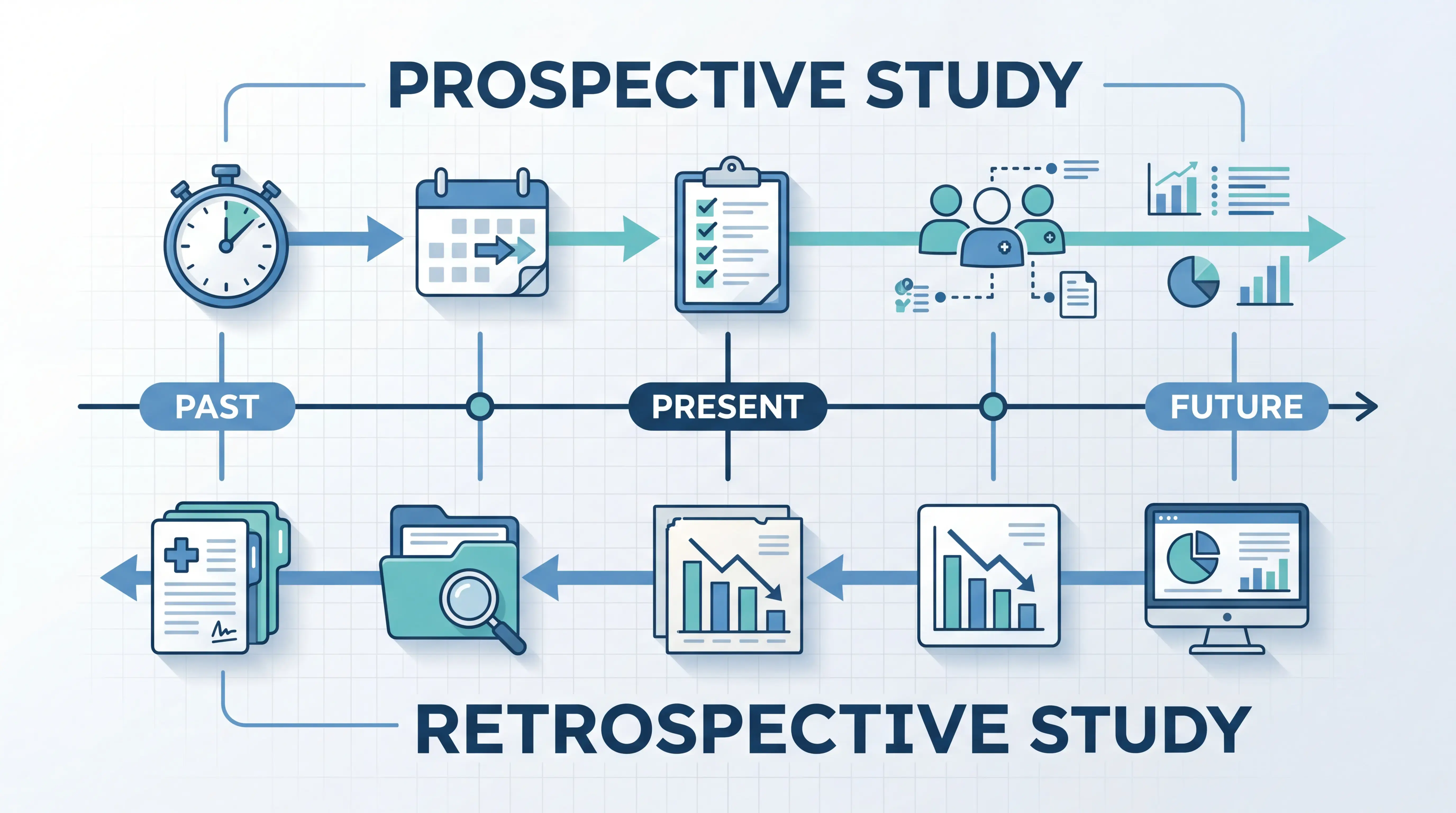
A prospective study starts now and collects data into the future. A retrospective study starts from past records and looks backward. In retrospective cohort research, baseline data, exposure history, treatment information, and confounders are retrieved from the past, while outcomes may already have happened, be happening now, or occur later.
That means a study is not prospective just because the outcome happens in the future. If exposure and baseline information were collected from past records, the study remains retrospective.
1.3 Why this matters in an essay or protocol
When you write an essay or research plan, mislabeling the design weakens credibility. Reviewers care about whether the study is truly prospective, retrospective, or mixed. The label affects expected bias, follow-up feasibility, and statistical planning.
2. Prospective Studies: Strengths and Limits
2.1 Prospective studies begin before outcomes occur
In a prospective cohort study, the researcher defines the exposure groups first, then follows participants over time. A classic example is following asbestos-exposed workers and non-exposed controls for 20 years to compare pleural mesothelioma risk.
This design is especially useful when:
- the exposure is known now,
- the outcome has not yet occurred,
- long-term follow-up is feasible.
2.2 Data quality is usually stronger
Prospective studies often use standardized definitions, planned follow-up, and pre-set outcome measures. That improves internal validity. You can also reduce missing data and measure confounders more carefully.
Prospective studies usually provide cleaner data because the protocol is designed before the outcome is known.
2.3 But they cost more time and money
The main weakness is feasibility. You may need years of follow-up. That means more funding, more staff, and more loss to follow-up risk. In clinical research, this is a real barrier, especially for rare outcomes or busy hospital settings.
3. Retrospective Studies: Practical and Efficient
3.1 Retrospective studies use existing records
A retrospective cohort study looks at past exposure groups and then checks outcomes using records already available. For example, you may identify workers who were exposed to asbestos 20 years ago and compare them with non-exposed relatives or similar controls, then assess mesothelioma incidence at the current time point.
This is often the first choice when:
- the disease is rare,
- follow-up would take too long,
- historical records are accessible.
3.2 Retrospective studies are faster to complete
The biggest advantage is speed. You can analyze data without waiting years. This is why many clinical researchers start here. It is a practical entry point for medical students and junior physicians.
However, speed comes with trade-offs. You cannot fully control data quality, because the records were not created for your exact research question.
3.3 Selection bias and confounding are major risks
In retrospective work, group balance is hard to guarantee. For example, patients receiving one treatment may differ systematically from those receiving another. Severity, comorbidity, socioeconomic status, and referral pattern can all distort the results.
A retrospective study can be valuable, but only if you clearly control bias with design and analysis.
4. Key Differences You Must Know
4.1 Time direction
- Prospective: from present to future.
- Retrospective: from past to present, or past to a later recorded outcome.
4.2 Data source
- Prospective: planned data collection.
- Retrospective: existing records, databases, charts, or registries.
4.3 Control over variables
- Prospective: stronger control over inclusion criteria, measurement, and follow-up.
- Retrospective: limited control, more dependence on what was already recorded.
4.4 Feasibility
- Prospective: more expensive, slower, harder to organize.
- Retrospective: cheaper, faster, easier to launch.
4.5 Evidence quality
In general, prospective studies often have better data quality and stronger internal validity. Retrospective studies are more practical and can have better real-world applicability, but they usually face more bias.
5. Mixed, Longitudinal, and Bidirectional Cohorts
5.1 Mixed designs combine both directions
In real clinical research, you may use both retrospective and prospective data in one project. This is often called a mixed cohort. For example, researchers studying a gene mutation and glioblastoma prognosis may first extract past cases from a database, then continue recruiting new cases prospectively from the same time point.
This saves time and increases sample size.
5.2 Bidirectional cohort studies extend observation
A bidirectional cohort can begin in the past, assess outcomes up to the present, and then continue follow-up into the future. This is useful when current events are not enough to answer the question.
5.3 The logic remains the same
Whether the study is prospective, retrospective, or mixed, the grouping still depends on exposure, treatment, or clinical feature. The causal logic remains cause to outcome.
6. How to Choose the Right Design
6.1 Start from the research question
Choose the design based on the question, not the trend. If the outcome is rare, retrospective data may be best. If measurement accuracy is critical and time allows, prospective follow-up may be better.
6.2 Define groups carefully
Your grouping must be clinically meaningful. In exposure research, “exposed” should represent real exposure, not occasional contact. For smoking research, one cigarette every few years should not be treated the same as daily smoking.
6.3 Control confounding early
If randomization is not possible, use:
- restriction,
- matching,
- stratification,
- multivariable analysis.
These methods do not eliminate bias completely, but they improve credibility.
6.4 Follow-up matters in every design
All clinical studies need follow-up. The difference is duration and completeness. A good study is not just one with data. It is one with usable outcome data.
Strong follow-up is one of the most overlooked requirements in clinical research.
7. Common Mistakes in Medical Writing
7.1 Confusing exposure with intervention
A frequent mistake is calling an observational study an interventional study simply because different treatments were compared. If the treatment was already chosen in routine care and the researcher only collected records later, the study is observational.
7.2 Mixing up retrospective and prospective labels
Another common error is saying a study is prospective just because the outcome occurred after data extraction. That is incorrect. The key issue is when the baseline and exposure data were collected.
7.3 Ignoring baseline imbalance
If the two groups differ greatly at baseline, your conclusion becomes weaker. This is especially important in retrospective research, where the researcher has limited control.
8. A Practical Framework for Researchers
8.1 A simple workflow
- Define the clinical question.
- Decide whether the outcome is already known.
- Check whether past records are enough.
- Assess sample size and follow-up feasibility.
- Choose prospective, retrospective, or mixed design.
- Plan bias control and statistical analysis.
8.2 Typical statistical tools
Depending on the outcome, researchers may use:
- logistic regression,
- linear regression,
- Kaplan-Meier analysis,
- Cox proportional hazards models,
- subgroup and sensitivity analyses.
These tools do not fix a weak design, but they strengthen interpretation when used correctly.
8.3 Why this is important for publication
Top journals care about methodology. A clear design, clean grouping, and transparent follow-up often matter more than a flashy topic. That is why many researchers struggle at the first stage: they have data, but not a robust structure for analysis and writing.
A good essay on study design should explain not only what the study is, but why the design is appropriate.
9. How SciFocus.ai Can Help
If you are preparing a research essay, protocol, or manuscript, scifocus.ai can help you organize the study logic faster. It supports clearer structuring of research questions, comparison tables, and draft writing. For busy medical students and clinicians, this saves time and reduces confusion between study types.
When you need to explain prospective vs retrospective studies clearly, SciFocus.ai helps turn complex methodology into a clean, publishable narrative. That makes it easier to build a strong introduction, methods section, and discussion with less trial and error.
Conclusion
Prospective and retrospective studies are not opposite worlds. They are two ways of collecting cohort data. The real differences are time direction, data source, control over variables, and feasibility. Prospective studies usually offer stronger control and better internal validity. Retrospective studies are faster and more practical, but they require careful attention to selection bias and confounding. For medical students, doctors, and researchers, mastering this distinction improves study design and writing quality.
If you are drafting an essay or research paper and want a clearer structure, consider using scifocus.ai to streamline your workflow and present your methodology with more confidence.
Did you like this article? Explore a few more related posts.
Start Your Research Journey With Scifocus Today
Create your free Scifocus account today and take your research to the next level. Experience the difference firsthand—your journey to academic excellence starts here.