
Preprints vs. Journal Publication
Introduction
For medical students, physicians, and researchers, choosing between essay-style early sharing and formal journal publication is not trivial. The wrong decision can affect visibility, credit, and timing. Preprints move fast. Journal articles carry peer review and stronger academic weight. Understanding the difference between preprints and journal publication helps you protect priority, avoid policy mistakes, and publish with confidence.
1. What Is a Preprint?
1.1 A fast way to share research
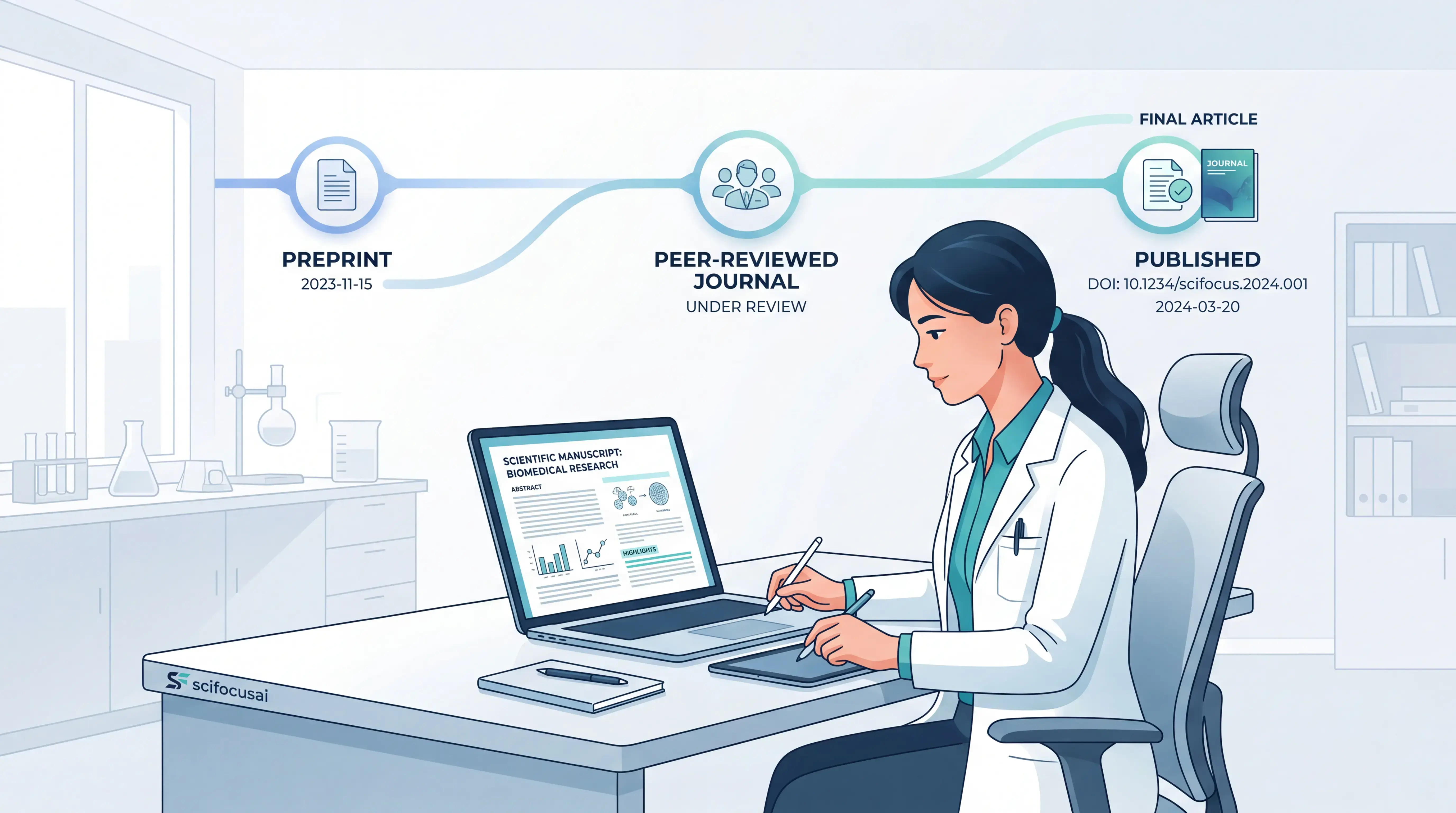
A preprint is a research manuscript shared publicly before formal journal publication. It is usually uploaded to a preprint server or presented online for rapid academic exchange.
The key point is simple. A preprint has not yet completed peer review. That is what separates it from a journal article in the strict academic sense.
For researchers working in competitive fields, this speed matters. A preprint lets others see your findings early. It can establish priority and open the door to comments before submission.
1.2 Main features of a preprint
Preprints are often used because they are:
- Fast to distribute
- Usually free to access
- Useful for early feedback
- Helpful for claiming early scientific priority
However, speed comes with a tradeoff. Since the work has not passed peer review, readers must interpret it with caution. The data may be solid, but the manuscript has not yet been formally validated by journal reviewers.
2. What Is Journal Publication?
2.1 The peer-reviewed standard
Journal publication is the formal route most clinicians and researchers know best. A paper is submitted to a journal, screened by editors, reviewed by experts, revised by the authors, and accepted only after meeting the journal’s standards.
Peer review is the main difference between a preprint and journal publication. It is also the main reason journal articles are trusted more in clinical and academic settings.
For medical audiences, this matters because published evidence is often used to guide discussion, teaching, and clinical decisions. A peer-reviewed article usually carries more authority than an unreviewed manuscript.
2.2 Why journal publication takes longer
The process is slow for a reason. A typical manuscript may go through:
- Initial editorial screening
- External peer review
- Major or minor revisions
- Resubmission
- Final acceptance
- Copyediting and publication
This can take months. In some cases, it can take over a year. That delay frustrates many authors, especially when the research is time-sensitive or highly competitive.
3. Preprints vs. Journal Publication: Core Differences
3.1 Speed, review, and credibility
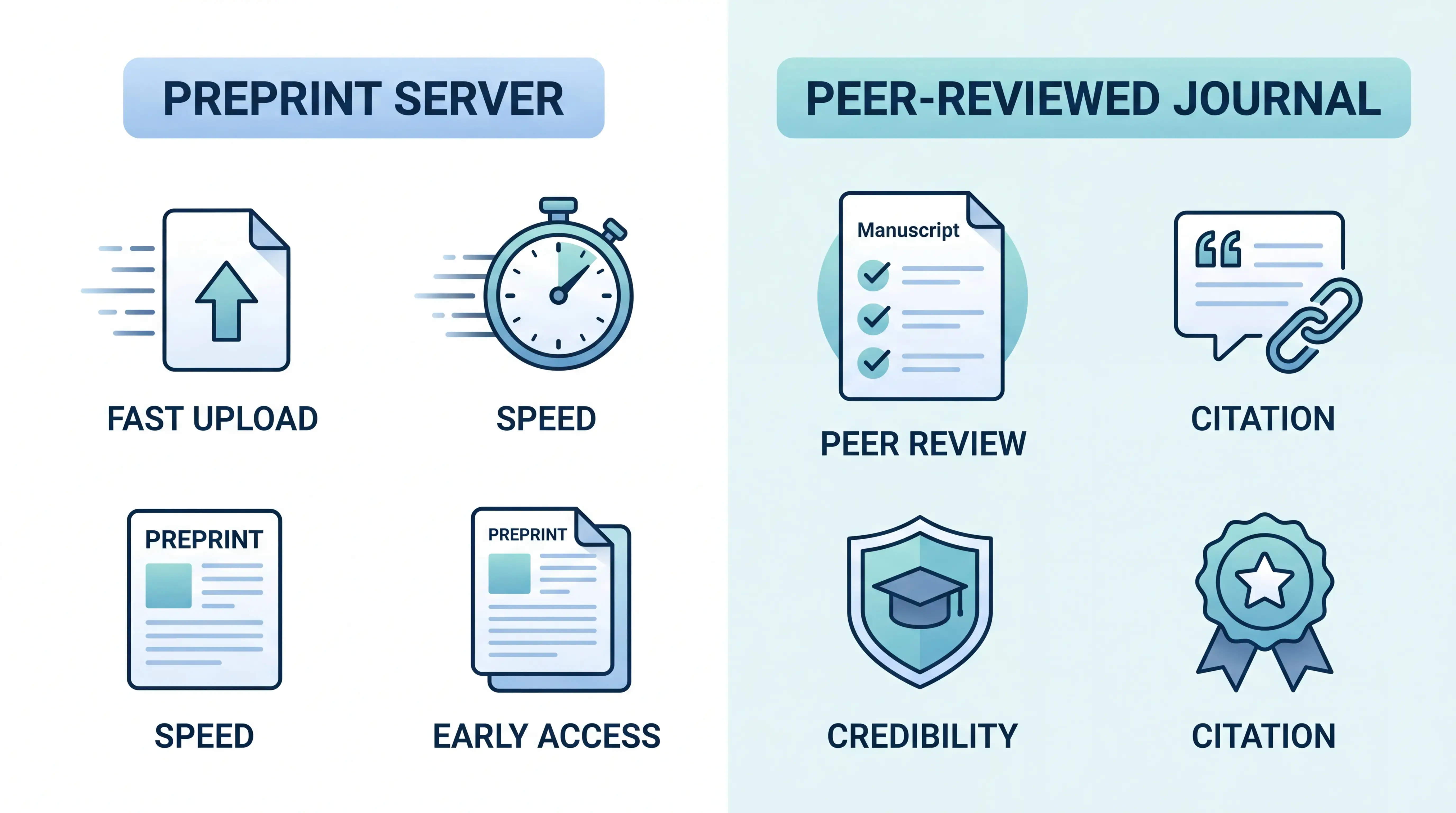
The most practical way to compare preprints and journal publication is to look at three factors.
- Speed: Preprints are much faster.
- Review: Journal papers undergo peer review; preprints do not.
- Credibility: Journal articles usually have higher formal credibility.
That does not mean preprints are unreliable by default. It means they are preliminary. They are best viewed as early scientific communication, not final validated evidence.
3.2 Ownership, visibility, and priority
In research, timing can affect recognition. A preprint can serve as public proof that you had the idea, data, and conclusions at a specific time.
This is especially useful in fast-moving fields. If another team is studying the same topic, a preprint helps document priority. It also increases visibility before formal journal acceptance.
Still, visibility alone does not replace publication. For promotions, funding applications, and many academic evaluations, peer-reviewed journal articles remain the stronger currency.
4. Advantages and Limitations of Preprints
4.1 Why researchers choose preprints
Researchers often choose preprints to:
- Share findings quickly
- Receive early feedback
- Reduce publication delay
- Claim precedence
- Build momentum before journal submission
In some cases, preprints also increase attention. A paper may be discussed earlier and cited sooner once it becomes a journal article.
4.2 Risks and practical limits
Preprints also have clear limitations.
- They are not peer reviewed.
- They may contain errors that still need revision.
- Some journals have specific policies about prior preprint posting.
- Plagiarism checks may still detect preprint content, so transparency is essential.
Before posting a preprint, always check the target journal’s policy. Some journals accept preprints without issue. Others may require disclosure. If you later submit the manuscript to a journal, you should clearly state that a preprint version already exists and provide the DOI or link if available.
5. When Journal Publication Is the Better Choice
5.1 Situations that favor formal publication
Journal publication is usually the better choice when the work needs:
- Peer-reviewed validation
- Clinical credibility
- Stronger academic recognition
- A stable citation record
- Acceptance for formal career evaluation
For medical students and physicians, this is often important when applying for training, promotion, grants, or academic appointments.
5.2 Why peer review still matters
Peer review does more than add prestige. It can improve the manuscript. Reviewers may identify statistical issues, missing controls, unclear conclusions, or ethical concerns.
In many cases, the final journal article is stronger than the original submission because it has been challenged and refined. That is a major reason journal publication remains the gold standard.
6. How to Decide Between the Two
6.1 Use your goal as the filter
Ask one question first. What do you need most right now?
- If you need speed, choose a preprint.
- If you need maximum credibility, prioritize journal publication.
- If you need both, use a staged approach.
A staged approach is common. Researchers post a preprint to share findings early, then submit the manuscript to a journal for peer review. This can give the best of both worlds, as long as the journal allows it.
6.2 A practical workflow for researchers
A simple decision process looks like this:
- Check journal preprint policy.
- Confirm your data and analysis are ready.
- Decide whether early visibility is worth the tradeoff.
- Post a preprint only if transparency is clear.
- Submit to a suitable journal with disclosure.
This workflow reduces risk. It also helps you avoid duplicate-publication problems and unintentional policy violations.
7. Writing and Submission Support for Busy Academics
7.1 The real pain point
For many authors, the biggest challenge is not the science. It is the writing, formatting, and submission workflow. Manuscripts must be clear, consistent, and journal-ready. That takes time.
This is where tools like scifocus.ai can help. It supports researchers who need to move from draft to submission more efficiently. For busy clinicians and academics, that can mean fewer delays and a smoother publication process.
7.2 How scifocus.ai can reduce friction
A focused writing platform can help you:
- Organize ideas faster
- Improve manuscript clarity
- Prepare content for academic submission
- Save time during revision cycles
If you are balancing research with clinical work, scifocus.ai can help you write more efficiently and stay closer to publication goals. That is especially useful when you want to share a preprint quickly and still prepare a strong journal submission.
Conclusion
Preprints and journal publication serve different purposes. Preprints help you share research early, protect priority, and gather feedback. Journal publication gives you peer review, higher credibility, and stronger academic value. The best choice depends on your goal, your timeline, and the journal’s policy. For researchers who want both speed and quality, a careful workflow matters. If you want to write faster, revise more smoothly, and move toward submission with less friction, consider using scifocus.ai as part of your academic writing process.
Did you like this article? Explore a few more related posts.
Start Your Research Journey With Scifocus Today
Create your free Scifocus account today and take your research to the next level. Experience the difference firsthand—your journey to academic excellence starts here.