

Passive Voice in Research Papers
Introduction
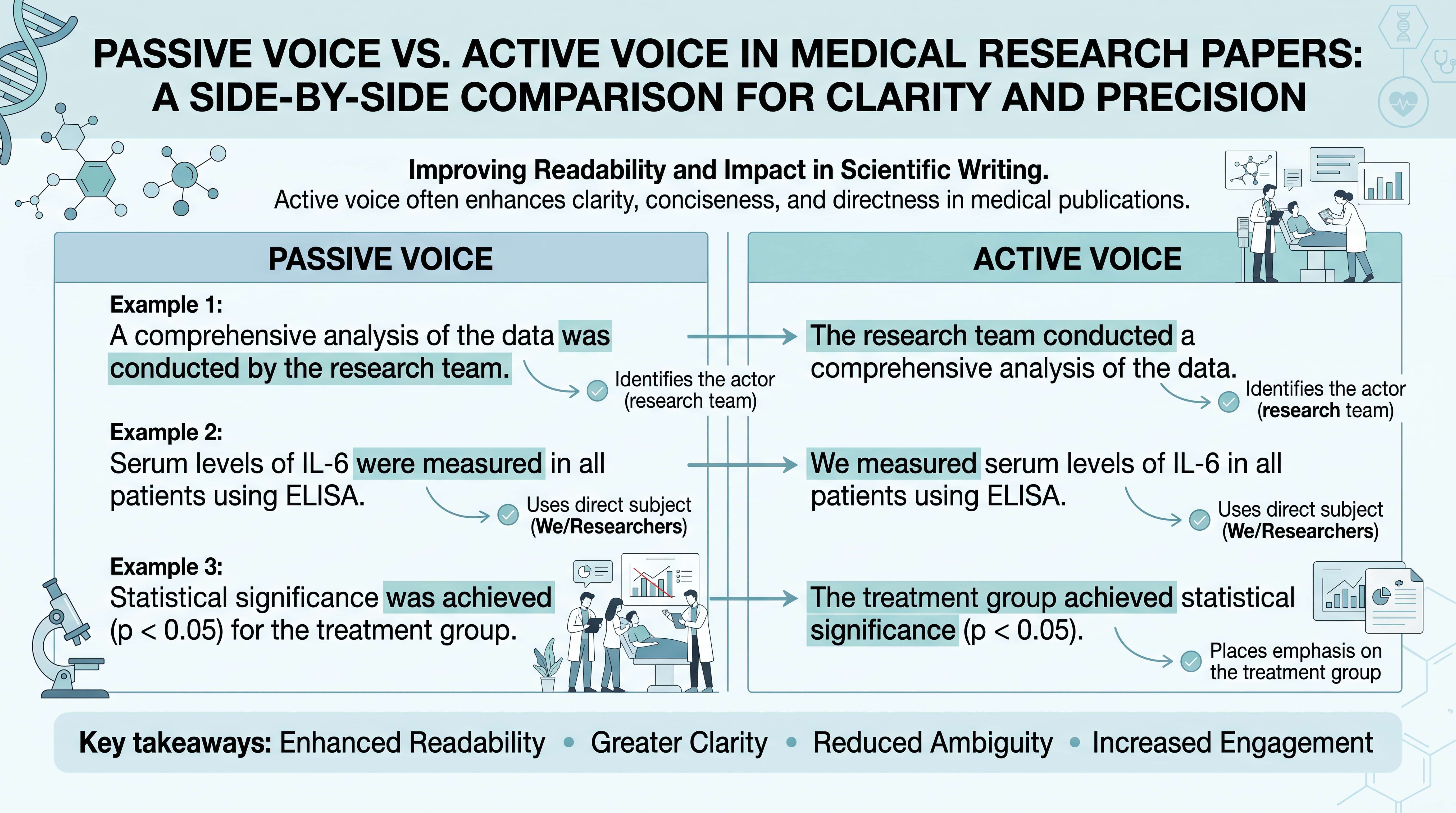
Passive voice in a research paper can make an essay sound formal, but it often weakens clarity, adds length, and hides who did what. For medical students, doctors, and researchers, this creates a real problem. Reviewers expect precise writing. Readers expect fast understanding. The best scientific writing is not the most complicated. It is the clearest. In this article, we explain when passive voice hurts your essay, when it still works, and how to revise sentences for stronger academic impact.
1. Why Passive Voice Still Appears in Research Writing
1.1 The Tradition Behind It
Passive voice has a long history in scientific writing. Many authors once believed it sounded more objective. The idea was simple. If the writer removed the subject, the text would feel more neutral. That style still appears in many drafts, especially in laboratory reports and early-stage essays.
But modern research writing has changed. Most leading journals now prefer direct, active sentence structure when possible. Active voice usually improves readability, shortens sentences, and makes responsibility clear. That matters in clinical and academic writing, where precision is not optional.
1.2 Why Authors Still Use It
Writers often turn to passive voice for three reasons:
- They want to sound formal.
- They think passive voice is required in science.
- They are unsure how to name the actor clearly.
In many cases, the result is weaker prose. A sentence like “The samples were analyzed” feels incomplete unless the context already makes the analyst obvious. “We analyzed the samples” is more direct. It also reads faster.
For an essay in a research setting, this difference matters. Editors and reviewers notice when the sentence flow is clean. They also notice when it is vague.
2. When Passive Voice Reduces Quality
2.1 It Hides the Actor
The biggest problem with passive voice is not grammar. It is responsibility. When a sentence says “The experiment was conducted,” the reader must guess who conducted it. In a paper, that can be acceptable in limited contexts. In most cases, however, it slows comprehension.
This becomes more serious in medical and scientific writing. Readers need to know who performed the test, who interpreted the data, and who made the claim. If the subject matters, do not hide it. Use a clear subject instead.
2.2 It Makes Sentences Longer and Less Efficient
Passive voice often adds extra words. Compare these two versions:
- Passive: “The blood samples were collected by the research team.”
- Active: “The research team collected the blood samples.”
The meaning is the same. The active version is shorter and cleaner. In a dense essay, that difference accumulates. A paper with 30 or 40 passive constructions can become harder to scan and easier to misread.
This is one reason writing coaches and journal editors often recommend cutting passive voice during revision. It is not about style only. It is about communication efficiency.
2.3 It Can Create Vague or Unnatural Claims
Another common issue is grammatical misuse. Some writers let objects perform human actions. That creates awkward language. For example, “The results found that…” is incorrect, because results do not find anything. Researchers find results. Results show, demonstrate, or suggest.
The same problem appears with subjects that are too abstract. Clear scientific writing should match the verb to the real actor.
Use these patterns instead:
- “We found that…”
- “The results showed that…”
- “The study demonstrated that…”
- “The data suggested that…”
These forms are more accurate. They also sound more natural in a research essay.
3. When Passive Voice Is Still Acceptable
3.1 Materials and Methods Often Allow It
Passive voice is not forbidden. In some sections, it can be useful. The most common example is the Materials and Methods section. Here, the focus is usually on the procedure, not the researcher. “The samples were centrifuged at 3,000 rpm for 10 minutes” is acceptable because the method matters more than the actor.
That said, even here, many journals still allow active voice if it improves clarity. For example, “We centrifuged the samples at 3,000 rpm for 10 minutes” is perfectly acceptable in many modern papers. The key is consistency and readability.
3.2 It Can Work When the Actor Is Obvious or Irrelevant
Passive voice can also work when the actor is already known from context or does not matter. For example:
- “The questionnaire was distributed to all participants.”
- “The samples were stored at -80°C.”
- “The patient records were reviewed before analysis.”
These sentences are clear enough if the surrounding paragraph explains who acted. Still, if overused, they make the essay feel flat and mechanical.
Use passive voice as a tool, not as a habit.
4. How to Replace Passive Voice in a Research Essay
4.1 Start by Finding the Real Subject
Revision begins with one question. Who did the action? Once you identify the actor, rewrite the sentence around that subject.
Example:
- Passive: “The data were analyzed using SPSS.”
- Active: “We analyzed the data using SPSS.”
If the writer is not the real actor, name the actual one:
- “The laboratory team analyzed the data using SPSS.”
- “The statistician analyzed the data using SPSS.”
This approach improves accuracy and avoids vague phrasing.
4.2 Use Strong Verbs
Many passive sentences become stronger when you replace a weak verb chain with a single verb.
Examples:
- “An evaluation was performed” → “We evaluated”
- “An investigation was carried out” → “We investigated”
- “A comparison was made” → “We compared”
This is not only shorter. It is also more readable. In academic prose, strong verbs reduce clutter. They help the reader move through the essay without interruption.
4.3 Check for Agreement and Time Consistency
While revising passive voice, watch for other common errors in research writing:
- subject-verb agreement
- unclear pronoun reference
- tense inconsistency
- confusing word choice
For example, if you write about completed experiments, use past tense for the action. If you describe a well-established fact, present tense may be better. Good writing is not only about voice. It is about consistency across the whole essay.
5. Common Mistakes Chinese Authors Make in English Research Writing
5.1 Overusing Passive Voice for “Academic Tone”
Some writers believe passive voice automatically sounds more scholarly. That is not true. Many top journals prefer active, direct writing. A clear sentence usually sounds more professional than a vague one.
For example:
- Weak: “It was observed that the tumor size decreased.”
- Stronger: “We observed that the tumor size decreased.”
The second version is easier to read and easier to trust.
5.2 Misusing Grammar and Word Choice
Passive voice often appears together with other writing problems. Common issues include:
- comma splices
- unclear antecedents
- incorrect plural forms, such as “researches” instead of “studies”
- incorrect subject-verb agreement
- nested parentheses
- vague modifiers
These errors weaken an essay even if the science is strong. Reviewers may question the writing before they reach the methods or results.
5.3 Letting Revision Become Too Mechanical
Sometimes authors replace every passive sentence with an active one without checking meaning. That can also create problems. Not every passive sentence is bad. Not every active sentence is better.
A careful editor asks:
- Does the actor matter?
- Is the sentence shorter in active voice?
- Does the revision preserve scientific accuracy?
- Does the paragraph stay consistent in tone?
If the answer is yes, active voice is usually the better choice.
6. A Practical Editing Workflow for Researchers
6.1 Revise Sentence by Sentence
When editing your essay, do not search for passive voice randomly. Work through the draft section by section.
A simple workflow looks like this:
- Highlight every “was,” “were,” “is being,” or “has been.”
- Check whether the sentence is passive.
- Identify the real actor.
- Rewrite in active voice if clarity improves.
- Read the paragraph aloud.
Reading aloud helps you hear awkward rhythm. It also reveals hidden repetition.
6.2 Use Tools, Then Verify Manually
Software can help, but it cannot fully replace expert review. Grammar tools may miss context, tense, or scientific meaning. A sentence can be grammatically correct and still be weak.
This is where a research-focused writing assistant becomes valuable. A platform like scifocus.ai can support revision by helping researchers refine sentence structure, reduce passive constructions, and improve clarity without losing academic tone. For busy medical students and clinicians, that can save time and reduce editing stress.
6.3 Aim for Clarity, Not Just Correctness
The final goal is not to eliminate passive voice completely. The goal is to write with precision. In scientific communication, clarity improves credibility. It also improves the chance that readers will understand your argument the first time.
A strong essay does not hide behind formal-sounding language. It communicates evidence clearly.
Conclusion
Passive voice in a research paper is not always wrong, but it is often overused. In most academic essays, active voice improves clarity, reduces wordiness, and makes your argument easier to follow. Use passive voice only when the actor is unimportant or when the method section calls for it. For everything else, choose direct language, strong verbs, and consistent tense. If you want to write faster and revise smarter, try scifocus.ai as a practical support tool for research writing, sentence refinement, and publication-ready editing.

Did you like this article? Explore a few more related posts.
Start Your Research Journey With Scifocus Today
Create your free Scifocus account today and take your research to the next level. Experience the difference firsthand—your journey to academic excellence starts here.