
Introduction
Natural language processing, or NLP, is changing how clinicians and researchers handle the flood of medical papers. For students, doctors, and scientists, the main problem is not access. It is speed, relevance, and signal quality. Medical literature mining is now less about finding papers and more about finding the right evidence fast. In this essay, we explain how NLP helps turn broad searches into actionable insight, with fewer missed studies and less manual screening.
1. Why Medical Literature Mining Needs NLP
1.1 The volume problem
Medical publishing grows constantly. PubMed alone indexes millions of records, and new papers appear every day. Manual screening is slow. It also increases fatigue and the risk of missing relevant studies.
Traditional searches often return too many results. If the query is too narrow, important papers are lost. If it is too broad, the list becomes unmanageable. This is where natural language processing improves medical literature mining by helping systems understand language, not just match exact terms.
1.2 Better search logic than keyword matching
Simple keyword search has limits. A paper on “lncRNA in disease” may use different wording than a paper on “long non-coding RNA and pathology.” A human researcher can recognize the connection. A basic search engine may not.
NLP tools can identify synonyms, related concepts, and context. This supports broader but still relevant retrieval. It is especially useful when terms vary across journals, specialties, and regions. For medical literature mining, that means fewer blind spots.
1.3 A practical research mindset
One useful strategy is to start with broader terms first. Then refine by reading titles and abstracts. In many cases, three to five minutes of abstract review can reveal the core hypothesis and relevance of a paper.
This approach matches how experienced researchers work. They do not search for perfection in one query. They search for clusters of evidence, then filter intelligently.
2. How NLP Improves Search Precision and Recall
2.1 Entity recognition and concept extraction
NLP systems can identify entities such as diseases, genes, proteins, drugs, and phenotypes. This helps convert unstructured text into searchable concepts.
For example, if a researcher is studying a disease and a specific molecular pathway, NLP can help connect papers that mention the same biological process using different phrasing. That makes medical literature mining more complete.
2.2 Synonyms and semantic matching
In medicine, one concept may have several names. NLP can map related expressions together. This is valuable for drug names, disease subtypes, and molecular markers.
Semantic search is stronger than exact-match search because it captures meaning. For clinical and biomedical research, that can reduce missed evidence and improve retrieval quality.
2.3 Ranking the most relevant evidence
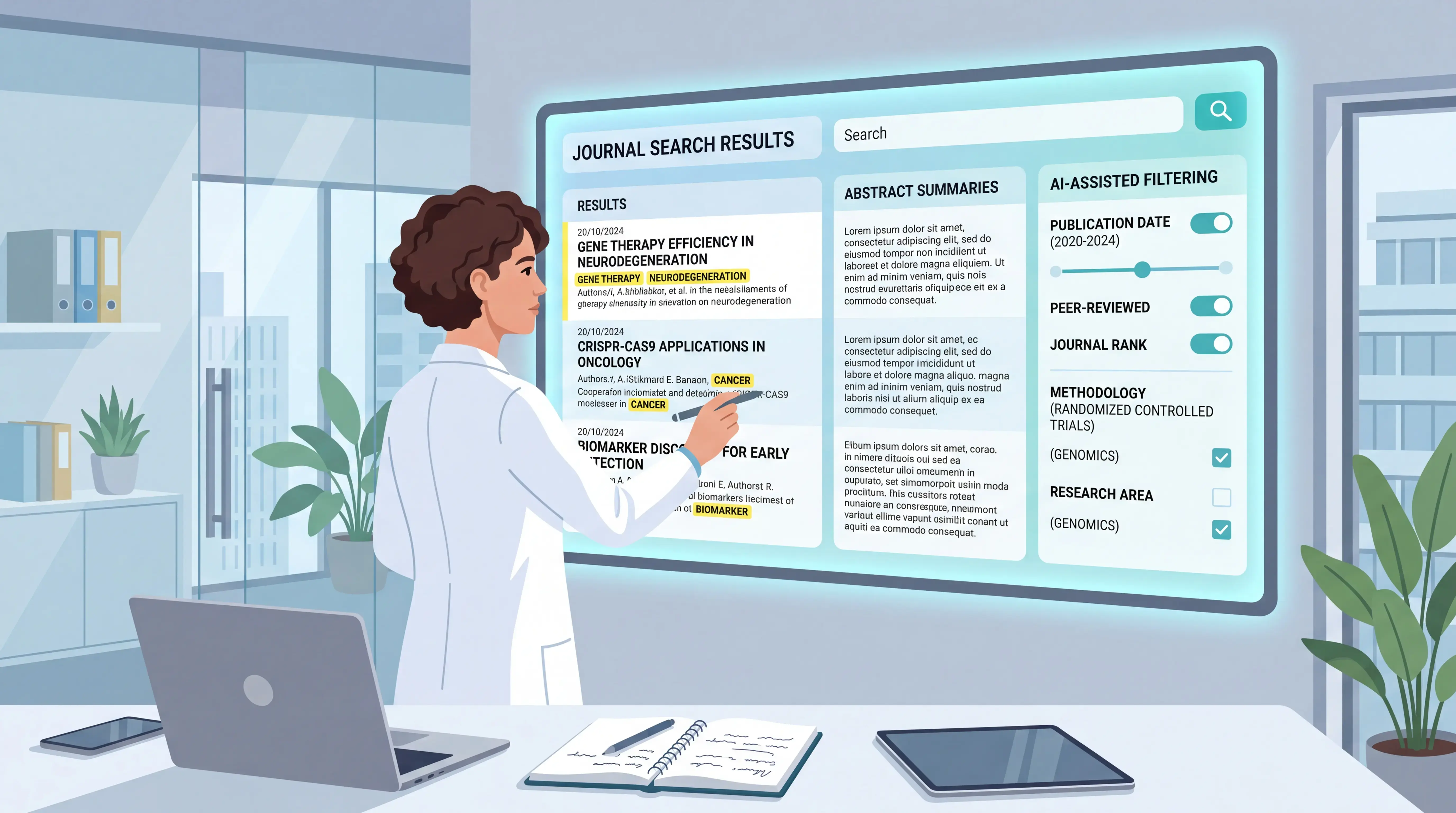
NLP does more than find papers. It can rank them. Systems can prioritize studies based on title relevance, abstract content, topic alignment, and likely scientific value.
That matters when a search returns hundreds of results. A ranked list saves time. It helps doctors and researchers focus on papers most likely to answer the question.
3. NLP in Real Research Workflows
3.1 From broad search to focused screening
A strong literature workflow usually starts with a broad query. Search terms may include the disease, a phenotype, a biological process, or a molecular class such as lncRNA. The goal is not to be overly specific at first.
After retrieval, NLP can support screening by clustering similar papers, extracting key terms, and highlighting abstracts that match the research question. This is especially helpful in systematic reviews and early-stage projects.
3.2 Faster hypothesis discovery
Medical papers are not only sources of answers. They are also sources of hypotheses. NLP can surface patterns across titles and abstracts that a human reader might overlook.
For example, if many papers mention a disease together with the same pathway or biomarker, that may suggest a research direction worth exploring. This makes medical literature mining more strategic, not just faster.
3.3 Less friction for students and clinicians
Many medical students and practicing doctors avoid deep literature searches because the process feels overwhelming. NLP reduces that barrier. It can organize information, summarize text, and surface the most relevant content first.
That does not replace expert reading. It supports it. The researcher still evaluates evidence. But the amount of irrelevant material drops sharply.
4. What Good NLP Tools Should Do
4.1 Support broad and flexible queries
A good system should accept general terms and still return useful results. Overly narrow search filters can hide important studies. In medicine, broad entry points are often better.
This is consistent with practical literature search advice. Start with a wider net. Then narrow using abstract review and topic refinement.
4.2 Help users understand abstracts quickly
A useful tool should make abstracts easier to scan. It should help identify population, intervention, mechanism, outcome, or hypothesis where relevant. That makes early screening faster.
If a tool cannot help a user judge relevance in seconds, it adds friction instead of reducing it.
4.3 Fit into real academic workflows
Researchers need tools that save time without sacrificing trust. They need a workflow that supports PubMed-style searching, concept grouping, and fast relevance assessment.
That is where modern AI-assisted platforms add value. A well-designed assistant can help users move from question to evidence with less manual effort.
5. Why scifocus.ai Can Help
5.1 A practical next step for literature mining
For medical students, physicians, and researchers, the challenge is not whether information exists. It is whether it can be found, filtered, and used efficiently. Scifocus.ai is positioned to support that workflow.
It can help users structure searches, organize results, and focus on relevant evidence faster. That matters when time is limited and the literature is expanding.
5.2 Turning search into output
Strong literature mining should lead to action. That may mean a better research question, a cleaner review outline, or a faster manuscript draft. A tool like scifocus.ai can support that transition by reducing search noise and speeding up early-stage analysis.
The real value of NLP is not just better search. It is better decision-making at every step of the research process.
5.3 A smarter way to work
If you routinely search PubMed, read abstracts, or prepare an essay, review, or manuscript, an AI-supported workflow can save hours. It can also help you stay focused on scientific judgment instead of repetitive screening.
Conclusion
Natural language processing is improving medical literature mining by making searches broader, smarter, and faster. It helps researchers capture synonyms, identify concepts, rank evidence, and reduce manual screening. For medical students, doctors, and scientists, that means less time lost in irrelevant results and more time spent on meaningful analysis.
If you want to improve your literature workflow, explore scifocus.ai and see how AI-assisted search can help you move from question to insight with greater efficiency.
Did you like this article? Explore a few more related posts.
Start Your Research Journey With Scifocus Today
Create your free Scifocus account today and take your research to the next level. Experience the difference firsthand—your journey to academic excellence starts here.