

Narrative Review vs Systematic Review: Which One Should You Write
Introduction
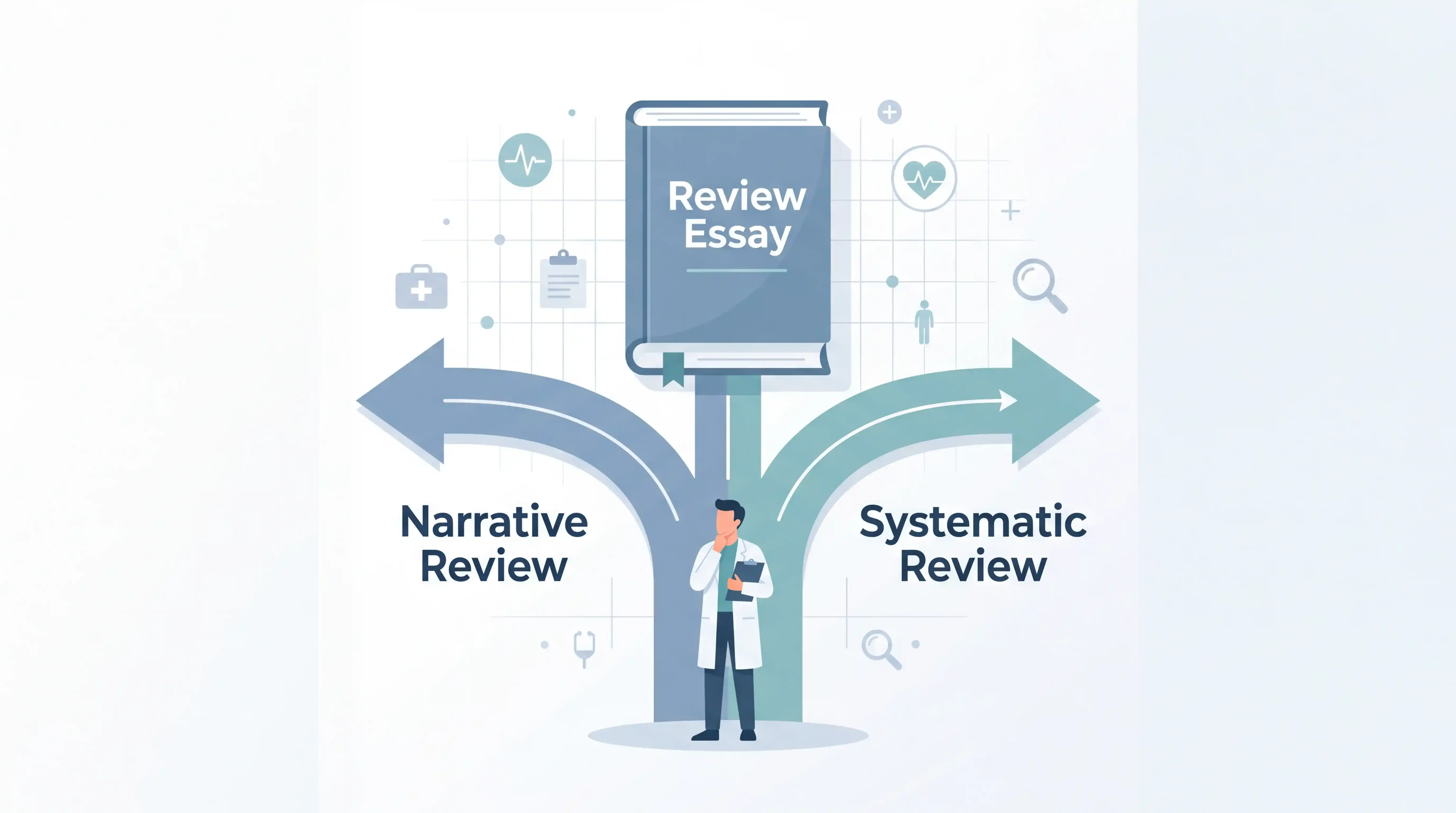
Choosing between a narrative review and a systematic review is a common challenge for medical students, clinicians, and researchers. Both are valid forms of an academic essay, but they serve different goals, require different methods, and lead to different outcomes. If you pick the wrong one, you may waste weeks on a paper that does not fit your research question, journal target, or timeline.

1. What a Review Essay Is Really For
1.1 Two review types, two different purposes
A review essay is not just a summary of papers. It is a structured academic argument built from existing evidence. According to common literature review principles, it should do two things: describe the current research progress and identify gaps or limitations in that research.
A narrative review is usually broader and more flexible. It helps you explain a topic, trace developments, and connect ideas across studies.
A systematic review is more rigid. It answers a focused question using predefined methods to search, select, and appraise studies.
For medical and research audiences, this difference matters. A narrative review is often better when the topic is wide, evolving, or conceptual. A systematic review is better when you need a transparent, reproducible answer to a narrow question.
1.2 Why the distinction affects quality
Many papers fail because the review type does not match the purpose. A broad topic written like a systematic review can become unmanageable. A narrow clinical question written as a narrative review may look incomplete or biased.
The right choice depends on your aim, evidence base, and publication standard.
If your goal is to map a field, compare viewpoints, or build a theoretical argument, a narrative review fits well. If your goal is to reduce uncertainty in clinical practice, a systematic review is usually the stronger option.
2. Narrative Review: When Flexibility Is an Advantage
2.1 Best use cases
A narrative review is useful when the literature is diverse, the question is broad, or the field is still developing. This format is common in medicine when authors want to explain mechanisms, summarize trends, or provide expert interpretation.
Typical use cases include:
- Broad disease overviews
- Emerging therapies
- Historical development of a topic
- Conceptual or theoretical discussions
- Topics with mixed evidence
This format gives you room to synthesize ideas rather than only list findings. It is especially useful when you need to frame a field for readers who want context, not just an answer.
2.2 Strengths and limitations
The main strength of a narrative review is depth of interpretation. You can connect clinical relevance, biological mechanisms, and future directions in one paper. You can also highlight gaps in a way that supports a new research proposal.
But there is a trade-off. Because the methods are less rigid, the review may be seen as more subjective. That means your credibility depends heavily on source quality, logic, and clarity.
To make a narrative review strong, you must show discipline, not just flexibility.
Use a focused scope. Cite recent and influential studies. Explain why some findings matter more than others. And be explicit about limitations in the literature.
2.3 How to write it well
A strong narrative review still needs structure. Start with the question or theme. Then organize the body by mechanism, timeline, clinical application, or controversy. End by identifying unresolved issues.
A practical approach is:
- Define the topic boundary.
- Select high-quality and representative sources.
- Group studies into themes.
- Compare viewpoints critically.
- End with clear implications.
This method keeps the review readable and expert-led. It also helps the essay feel purposeful rather than descriptive.
3. Systematic Review: When Precision Matters Most
3.1 Best use cases
A systematic review is designed for a precise question. In clinical and biomedical research, it is often used to evaluate interventions, diagnosis, prognosis, or harms. The method is transparent and reproducible.
Use a systematic review when you need:
- A narrowly defined research question
- A structured search strategy
- Clear inclusion and exclusion criteria
- Evidence synthesis with minimal selection bias
- A basis for clinical decision-making
This type of review is ideal when the evidence is large enough to justify formal screening and appraisal.
3.2 Why it is trusted
A systematic review is valued because its methods are explicit. Readers can see how studies were found, screened, and selected. That transparency increases trust.
It also helps reduce bias. Instead of choosing studies informally, you search according to a protocol. You then assess study quality and synthesize findings based on predefined rules.
This is why systematic reviews are often treated as higher on the evidence hierarchy than narrative reviews.
That said, they are not automatically better. They are better for the right question. A weak question or sparse literature can make the process inefficient or misleading.
3.3 What it requires
A systematic review takes more time and planning. You need a clear protocol, a database strategy, and often a screening workflow. Many projects also require dual reviewers, data extraction tables, and quality appraisal.
A basic workflow looks like this:
- Formulate a focused question.
- Define eligibility criteria.
- Search multiple databases.
- Screen titles, abstracts, and full texts.
- Extract data consistently.
- Assess study quality.
- Synthesize the findings.
For many students and clinicians, this is the main barrier. The method is rigorous, but it is also labor-intensive. That is why choosing this format should be a deliberate decision, not a default one.
4. Narrative Review vs Systematic Review: How to Choose
4.1 Use your research question as the starting point
The fastest way to choose is to ask what your paper must accomplish. If you need interpretation, breadth, and expert context, choose a narrative review. If you need reproducibility, precision, and a defensible evidence summary, choose a systematic review.
A simple rule helps:
- Broad question, mixed evidence, conceptual goal → narrative review
- Specific question, sufficient studies, decision-oriented goal → systematic review
This is the most practical way to match format to purpose.
4.2 Consider your timeline and resources
A systematic review often takes substantially more time because every step must be documented. If you have limited time, limited database access, or a topic with very few studies, a narrative review may be more realistic.
But speed should not be your only criterion. If your institution, supervisor, or target journal expects a systematic design, a narrative review may not be acceptable.
Always align the format with the assignment, journal scope, and available evidence.
That alignment saves time and reduces revision risk.
4.3 Match the format to the reader
Think about who will read your essay. Clinicians usually want clear implications for practice. Researchers may want gaps and future directions. Students may need a readable overview before diving into primary studies.
A narrative review often serves the reader who wants orientation. A systematic review serves the reader who wants a defensible answer.
5. Common Mistakes to Avoid
5.1 Mistaking summary for synthesis
A weak review often becomes a long list of studies. That is not enough. Whether you write a narrative or systematic review, you must compare, interpret, and organize evidence.
Do not write:
- isolated study summaries
- vague claims like “many studies found”
- unsupported conclusions
- overly broad scope
Instead, explain what the studies collectively show and where they disagree. That is what turns a paper into a strong academic essay.
5.2 Choosing the wrong scope
Another common problem is scope mismatch. Some writers choose a systematic review for a question that is too broad. Others write a narrative review for a question that needs a precise clinical answer.
If the scope is too wide, the paper becomes shallow. If it is too narrow, the paper becomes forced.
A well-designed review begins with a well-defined question.
5.3 Ignoring reporting standards
Even a narrative review should be organized and transparent. A systematic review should follow established reporting logic and clearly describe methods. Readers should be able to understand how conclusions were reached.
This is especially important in medical writing, where trust depends on method quality as much as on writing quality.
6. How SciFocus Helps You Write Faster and Better
6.1 A practical solution for review writing
Review writing is time-consuming because the hard part is not only collecting papers. It is also finding the gap, organizing the argument, and keeping the structure consistent. This is where scifocus.ai can help.
SciFocus supports the writing process by helping you move from topic confusion to structured output. That matters for students and researchers who need a clean, evidence-based draft without losing academic rigor.
6.2 Where it reduces friction
A tool like SciFocus is especially useful when you are deciding between a narrative and systematic format. It can help you:
- clarify the review goal
- organize key themes
- support faster drafting
- improve structure and readability
- reduce repetitive rewriting
The result is a more efficient workflow and a cleaner final manuscript.
For busy medical writers, that can mean less time spent on formatting and more time spent on critical thinking.
6.3 Why this matters for publication
A strong review essay is not just about collecting references. It is about building a logical, defensible manuscript that fits your purpose. When your structure is clear from the start, your chances of producing publishable work improve.
If you want to write faster, stay organized, and keep your review academically sound, scifocus.ai is worth exploring.
Conclusion
The choice between a narrative review and a systematic review depends on one thing: your purpose. If you need breadth, context, and expert interpretation, a narrative review is usually the better fit. If you need precision, transparency, and reproducible evidence synthesis, a systematic review is the stronger choice.
Do not choose the format by habit. Choose it by question, evidence, and audience.
That is the safest way to write a high-quality academic essay. If you want help structuring the process more efficiently, try scifocus.ai and turn a difficult review task into a clearer writing workflow.
Did you like this article? Explore a few more related posts.
Start Your Research Journey With Scifocus Today
Create your free Scifocus account today and take your research to the next level. Experience the difference firsthand—your journey to academic excellence starts here.