

Lose vs. Loose
Introduction
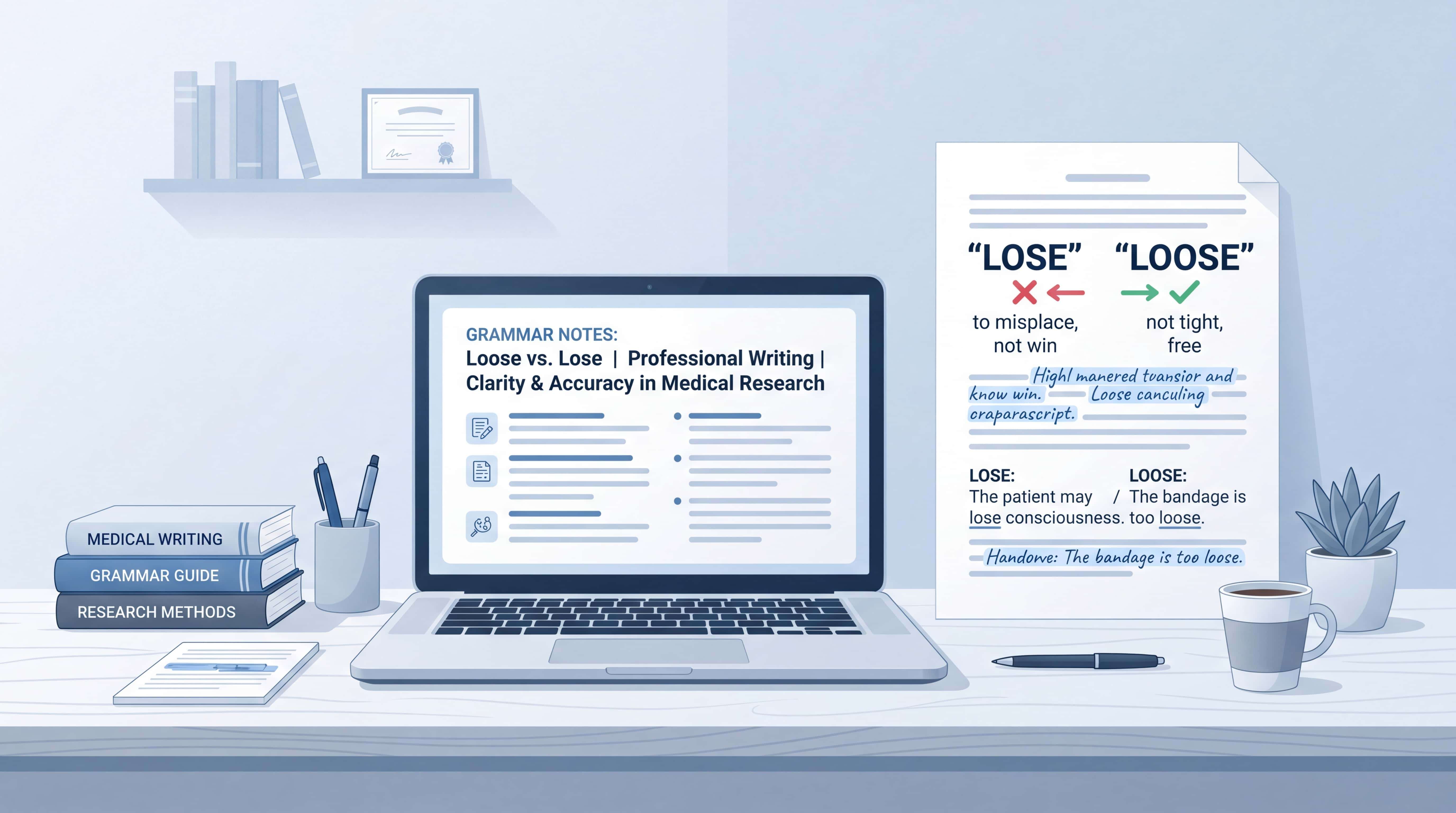
If you write an essay for medical school, a journal draft, or a research report, one small spelling error can weaken your credibility. Lose vs. loose is one of the most common confusions in English writing. The words look similar, but they mean different things and follow different grammar rules. In academic and clinical writing, using the wrong one can make an otherwise strong essay look careless. This guide explains the difference clearly, with examples you can use right away.
1. The Core Difference Between Lose and Loose
1.1 “Lose” Is a Verb
Lose means to fail to keep something, to be unable to find something, or to be defeated. It is an action word.
Examples:
- I may lose my notes before the presentation.
- The patient may lose weight during treatment.
- Researchers do not want to lose data during analysis.
In professional writing, lose often appears in contexts related to outcomes, memory, access, and control. In an essay, it should always function as a verb.
1.2 “Loose” Is an Adjective
Loose means not tight, not fixed, or not firmly attached. It describes a noun.
Examples:
- The glove is loose.
- The screw is loose.
- The sample cap was loose during transport.
In scientific and medical settings, loose may describe clothing, joints, teeth, stool, tissue, or equipment. It is not an action. It modifies a noun.
1.3 A Fast Memory Rule
A practical rule helps prevent errors in any essay or manuscript:
- Lose has one “o.” Think of losing one thing.
- Loose has two “o’s.” Think of something that is wider or less tight.
This simple letter difference is often enough to prevent a repeated grammar mistake in academic writing.
2. Why This Mistake Matters in Academic and Medical Writing
2.1 Small Errors Affect Reader Confidence
In medicine and research, precision matters. A spelling mistake like lose vs. loose may seem minor, but readers notice patterns. If a manuscript contains several basic language errors, reviewers may question the author’s attention to detail.
This matters especially in:
- Personal statements
- Clinical case reports
- Research essays
- Abstracts
- Grant applications
A polished essay signals discipline, care, and professionalism.
2.2 Grammar Errors Can Disrupt Meaning
The wrong word can change the message completely. Consider the difference:
- The patient may lose consciousness.
- The bandage is loose.
These sentences are not interchangeable. One describes a clinical outcome. The other describes fit or attachment. In a medical essay, that distinction is essential.
2.3 Editing Standards in Research Writing
Many editors and supervisors expect clear, standard English. Even if the science is strong, language issues can slow review or reduce readability. Writers should review common confusions, especially words like lose vs. loose, then revise carefully before submission.
3. How to Use Lose Correctly in a Sentence
3.1 Common Medical and Academic Uses
Lose is often used in professional contexts where something is no longer present, available, or retained.
Examples:
- Patients may lose appetite after surgery.
- A study can lose reliability if methods are unclear.
- Teams may lose track of samples without proper labeling.
- Researchers should avoid losing critical records.
These examples show how lose functions as an action in a formal essay.
3.2 Verb Forms to Watch
Because lose is a verb, it changes form:
- lose
- lost
- losing
Examples:
- We may lose follow-up data.
- The team lost access to the archive.
- They are losing time due to delays.
If the word changes form, it is a strong sign you need lose, not loose.
3.3 Common Error Pattern
Writers often misuse loose when they mean lose because the words sound similar in casual speech. In a written essay, pronunciation does not matter. Grammar and function matter more.
4. How to Use Loose Correctly in a Sentence
4.1 Describing Physical Fit or Attachment
Loose is used when something is not tight, secure, or stable.
Examples:
- The sutures were loose.
- The fit of the mask was loose.
- The joint felt loose after injury.
In clinical notes and scientific writing, this word often appears in descriptions of physical condition, equipment, or specimen integrity.
4.2 Common Academic and Clinical Contexts
You may also see loose in phrases such as:
- loose stool
- loose connection
- loose clothing
- loose soil
- loose tissue
These uses are descriptive. If you are writing an essay on patient symptoms, device safety, or lab procedures, loose may be the correct choice.
4.3 A Useful Check
Ask this question:
- Am I describing something that is not tight?
If yes, use loose.
If no, and the sentence means “fail to keep” or “misplace,” use lose.
5. Side-by-Side Examples for Quick Review
5.1 Sentence Comparisons
Here are direct comparisons that help in an essay or manuscript:
-
I do not want to lose my citation list.
-
The binder is loose and may fall apart.
-
The patient may lose blood during surgery.
-
The bandage is too loose to protect the wound.
-
We cannot lose the data file.
-
The screw is loose on the instrument.
-
He will lose access if the account expires.
-
The cap is loose after sterilization.
5.2 A Simple Editing Test
When revising, replace the word with a clearer phrase:
- If you can replace it with “misplace,” “fail to keep,” or “be defeated,” use lose.
- If you can replace it with “not tight” or “not secure,” use loose.
This test is fast and reliable for any essay.
5.3 Why This Helps in Scientific Drafts
Scientific writing rewards precision. A small confusion may not change a diagnosis, but it can lower the quality of the text. Careful word choice improves readability, supports peer review, and strengthens trust in your work.
6. Practical Writing Tips to Avoid the Mistake
6.1 Read the Sentence Aloud, Then Check the Grammar
Reading aloud can help, but do not rely on sound alone. In English, lose vs. loose may sound close in speech, especially for non-native writers. Always check the word’s role in the sentence.
6.2 Use a Two-Step Revision Method
For every essay, especially in medicine or research, use this quick review process:
- Check the part of speech.
- Confirm the meaning in context.
If the word is an action, choose lose.
If it describes a noun, choose loose.
6.3 Build a Personal Error List
Many experienced writers keep a list of their frequent mistakes. Add lose vs. loose to that list. This simple habit reduces repeated errors in future manuscripts, reports, and submissions.
7. A Final Word for Medical Writers, Doctors, and Researchers
7.1 Precision Strengthens Professional Writing
A strong essay is not only about ideas. It is also about exact language. In medicine and research, exact language supports credibility. Knowing the difference between lose vs. loose is a small skill with a real impact.
7.2 Use Tools That Support Accuracy
If you write often, you need a workflow that catches errors before submission. That is where scifocus.ai can help. It supports clearer drafting, better structure, and more consistent language in academic writing. For medical students, doctors, and researchers, that means less time fixing basic mistakes and more time improving the substance of the work.
If you want your next essay or manuscript to read with more clarity and less risk of avoidable language errors, consider using scifocus.ai as part of your writing process.
Conclusion
Lose vs. loose is a small grammar issue, but it matters in professional writing. Lose is a verb. Loose is an adjective. If you remember that rule, check the sentence role, and revise carefully, you will avoid one of the most common English mistakes in an essay. For medical students, doctors, and researchers, accuracy builds trust. Use the right word, strengthen your writing, and explore scifocus.ai to make your academic workflow more efficient.

Did you like this article? Explore a few more related posts.
Start Your Research Journey With Scifocus Today
Create your free Scifocus account today and take your research to the next level. Experience the difference firsthand—your journey to academic excellence starts here.