

Is Your Research Really “New”? A 4-Step Framework to Evaluate Scientific Innovation
Introduction
Is your research truly innovative, or just a polished repetition of existing work? For many medical students, doctors, and researchers, this is the hardest question in grant writing and manuscript submission. In practice, scientific innovation is often judged less by big claims and more by whether your hypothesis, evidence, and mechanism can stand up to scrutiny. If you want to polish your research idea into something fundable and publishable, you need a clear method.
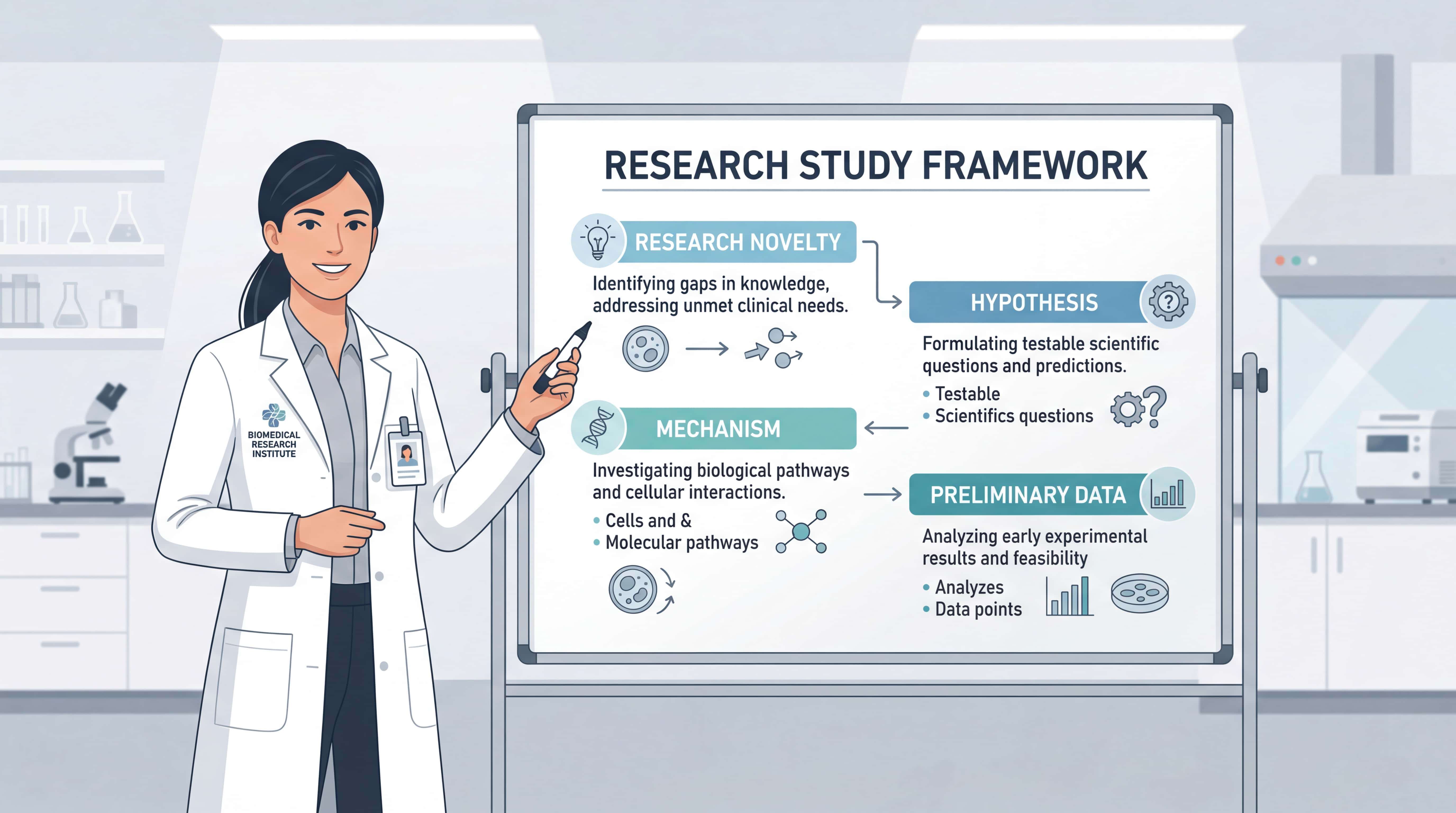
1. Start by Defining What “Innovation” Really Means
1.1 Novelty Is Not the Same as Complexity
Many projects look advanced on the surface. They may use a new dataset, a new model, or a new statistical term. But that does not automatically make them innovative. In academic review, true innovation usually comes from a new question, a new hypothesis, a new mechanism, or a new connection between known elements.
This is especially important in medical research. A project that only describes a correlation is often weak. For example, if factor A and factor B rise together, that is interesting, but it is not enough. Reviewers will ask whether A drives B, whether B affects A, or whether both are controlled by a third factor. Without causal logic, the study remains at the level of description.
1.2 Innovation Must Be Visible to Reviewers
If you cannot clearly explain the innovation yourself, reviewers will not infer it for you. That is why many successful proposals and papers share one feature: their innovation can be stated in one or two precise sentences. Not vague language. Not broad praise. Clear scientific value.
A practical way to judge innovation is to ask:
- What exactly is new?
- Is it a question, a method, or a mechanism?
- What evidence shows this is not just a repeat of prior work?
- Why does it matter clinically?
These questions help turn a vague idea into a reviewable research argument.
2. Use the 4-Step Method to Evaluate Research Innovation
2.1 Step 1: Check Whether the Scientific Hypothesis Is Strong
Among the many parts of a proposal, the scientific hypothesis is often a better marker of innovation than the topic title or abstract. A strong hypothesis explains the research problem more directly and more deeply. It should connect the known evidence with the unknown gap.
In grant writing, a hypothesis diagram is often more persuasive than a text-only summary. A visual model helps reviewers quickly see the logical chain:
- What is already known.
- What remains unclear.
- What you believe is happening.
- How you will test it.
This is where many projects fail. They list facts, but they do not form a testable mechanism. A real hypothesis should predict a cause-and-effect relationship, not just a co-occurrence.
2.2 Step 2: Examine the Preliminary Work
A project may sound novel, but without preliminary data it can look like a template. In competitive funding, reviewers usually want evidence that the team has already built a foundation. This includes:
- Pilot data.
- Early experimental results.
- Logical supporting evidence.
- Prior publications or technical feasibility.
A strong foundation makes the innovation believable. If the preliminary work only shows a surface association, the reviewer may still doubt whether the mechanism exists. If the preliminary work supports a real causal path, the proposal becomes much stronger.
This is why “polished” writing alone is not enough. You need evidence beneath the writing. The text can be refined, but the logic must be real.
2.3 Step 3: Judge Whether the Study Goes Beyond Phenomenon Description
A common weakness in many projects is that they stop at description. They identify a trend, summarize a pattern, and then stop. But modern biomedical research usually expects more than that. Mechanistic investigation is the core of strong scientific applications.
A descriptive study may answer:
- What is associated with what?
- Which group has a higher rate?
- How often does a phenomenon occur?
A mechanistic study asks:
- Why does this happen?
- What drives the change?
- What happens if we intervene?
- Which pathway or factor explains the effect?
This difference matters. A study that only reports correlations may be publishable, but it is often not enough to support high-level innovation claims. To be more innovative, your research should move toward cause, mediation, pathway, or functional validation.
2.4 Step 4: Check Whether the Design and Analysis Add Real Value
Innovation is not only about the idea. It can also come from the design. For example:
- A special population.
- Strict inclusion and exclusion criteria.
- Multicenter data.
- Large sample size.
- A newer diagnostic standard.
- Stronger statistical validation.
For cross-sectional studies, true novelty is hard. Still, some studies can improve value by focusing on a special population or by using more rigorous criteria. For example, research in a Chinese cohort, a minority population, or another well-defined clinical group may fill a gap left by Western datasets. Similarly, updated diagnostic criteria can make the findings more relevant.
In analysis, robustness matters too. Sensitivity analyses, subgroup analyses, and validation across methods can strengthen confidence in the result. Innovation is stronger when the study design reduces uncertainty and improves interpretability.
3. What Makes a Project Look Innovative in Practice?
3.1 The Three Most Convincing Innovation Signals
When reviewers read a proposal, they often look for three things.
- A clear gap in existing knowledge.
- A credible hypothesis supported by prior evidence.
- A mechanism that has not yet been fully explained.
If your project has all three, it is easier to defend. If it only has one, it may feel repetitive. If it has none, it may look like a routine exercise.
This is also why many “formulaic” proposals fail. They imitate the structure of successful applications but do not bring new logic. A template is not the same as a breakthrough.
3.2 How to Make the Innovation Statement More Precise
A strong innovation statement should be specific enough to test. For example, instead of saying “this study is innovative,” try framing it as:
- It addresses a population not well represented in prior studies.
- It applies a newer diagnostic standard.
- It tests a causal mechanism rather than only a correlation.
- It connects two factors in a way that has not been established before.
This style is more credible. It helps the reviewer understand what is new and why the study deserves attention.
3.3 A Better Way to Present the Research Story
One practical strategy is to organize the proposal around a simple logic chain:
- What clinical problem exists.
- What previous studies showed.
- What they did not explain.
- What your hypothesis adds.
- How your methods verify the claim.
This structure is especially useful in medical research. It keeps the story clinically relevant and scientifically grounded. It also helps the reader see that the project is not just a polished idea, but a meaningful step forward.
4. A Practical Template for Medical Researchers
4.1 Cross-Sectional Studies: Where Innovation Can Still Come From
Cross-sectional studies are often criticized for limited novelty. That criticism is fair. But they can still be improved.
Possible innovation angles include:
- A special population.
- Strict and refined criteria.
- A multicenter sample.
- A large and representative dataset.
- Newer diagnostic definitions.
- More robust statistical modeling.
These do not guarantee innovation. But they can strengthen the value of the study if the question is relevant and the logic is clear. The key is not to force novelty, but to make the contribution precise.
4.2 Mechanism-Oriented Research: The Strongest Path to Novelty
When possible, move beyond association. In medical science, mechanism-oriented studies usually carry more weight because they explain why a phenomenon happens. They can also support translational value.
A strong mechanism paper often shows:
- A clinical observation.
- A molecular or biological explanation.
- A validation step.
- A functional test.
- A disease-related implication.
This is where innovation becomes more than a word. It becomes a chain of evidence.
4.3 Why the Research Question Must Be Carefully Polished
To polish a research idea means more than improving language. It means refining the logic, narrowing the hypothesis, and strengthening the evidence chain. This is especially important when preparing manuscripts or funding applications. A well-polished idea is easier to defend because every claim has a place in the argument.
Tools like scifocus.ai can help researchers organize ideas, sharpen the hypothesis, and improve the clarity of scientific writing. For busy medical professionals, this kind of support can reduce revision time and make the innovation story easier to present. If your project feels promising but unclear, a structured writing tool may help you turn scattered points into a coherent scientific narrative.
Conclusion
A research project is not “new” simply because it sounds advanced. Real innovation depends on a strong hypothesis, solid preliminary evidence, mechanistic depth, and a design that adds meaningful value. For medical students, doctors, and researchers, the best way to evaluate novelty is to ask whether the project explains a real gap, moves beyond description, and offers clinical significance.
If you want to polish your next proposal or manuscript, focus on the logic first, then the language. And if you need a smarter way to shape the research story, consider using scifocus.ai to help refine the hypothesis, structure the argument, and present your innovation more clearly.

Did you like this article? Explore a few more related posts.
Start Your Research Journey With Scifocus Today
Create your free Scifocus account today and take your research to the next level. Experience the difference firsthand—your journey to academic excellence starts here.