

Intention-to-Treat vs Per-Protocol Analysis
Introduction
In clinical research, choosing the wrong analysis set can distort treatment effects and weaken trust in your trial results. This is why the essay on intention-to-treat-vs-per-protocol-analysis matters for medical students, physicians, and researchers. The core issue is simple: should you analyze patients as randomized, or only as treated per protocol? The answer affects bias, validity, and clinical interpretation.
1. Why This Comparison Matters in Clinical Trials
1.1 Randomization Is the Starting Point
Randomized controlled trials are designed to preserve comparability between groups. Once patients are randomized, the main advantage is balance in known and unknown confounders. If you remove patients later because they did not adhere, dropped out, or switched treatments, that balance can be lost.
This is the key reason intention-to-treat-vs-per-protocol-analysis is not just a statistical choice. It is a validity choice. In real trials, non-adherence and missing follow-up are common. They are rarely random. Patients with poor response or adverse events may be more likely to stop treatment. Excluding them can bias the estimate.
1.2 Trial Reality Is Messy
In practice, no study has perfect adherence. Some participants withdraw. Some violate the protocol. Some cross over to another treatment. If analysis only keeps the “clean” cases, the result may look stronger than reality.
That is why regulatory and academic communities often prefer intention-to-treat for efficacy analysis. It reflects what happens when a treatment is offered in real clinical settings. It is also more conservative, which can be safer for decision-making.
2. What Intention-to-Treat Analysis Means
2.1 Core Principle
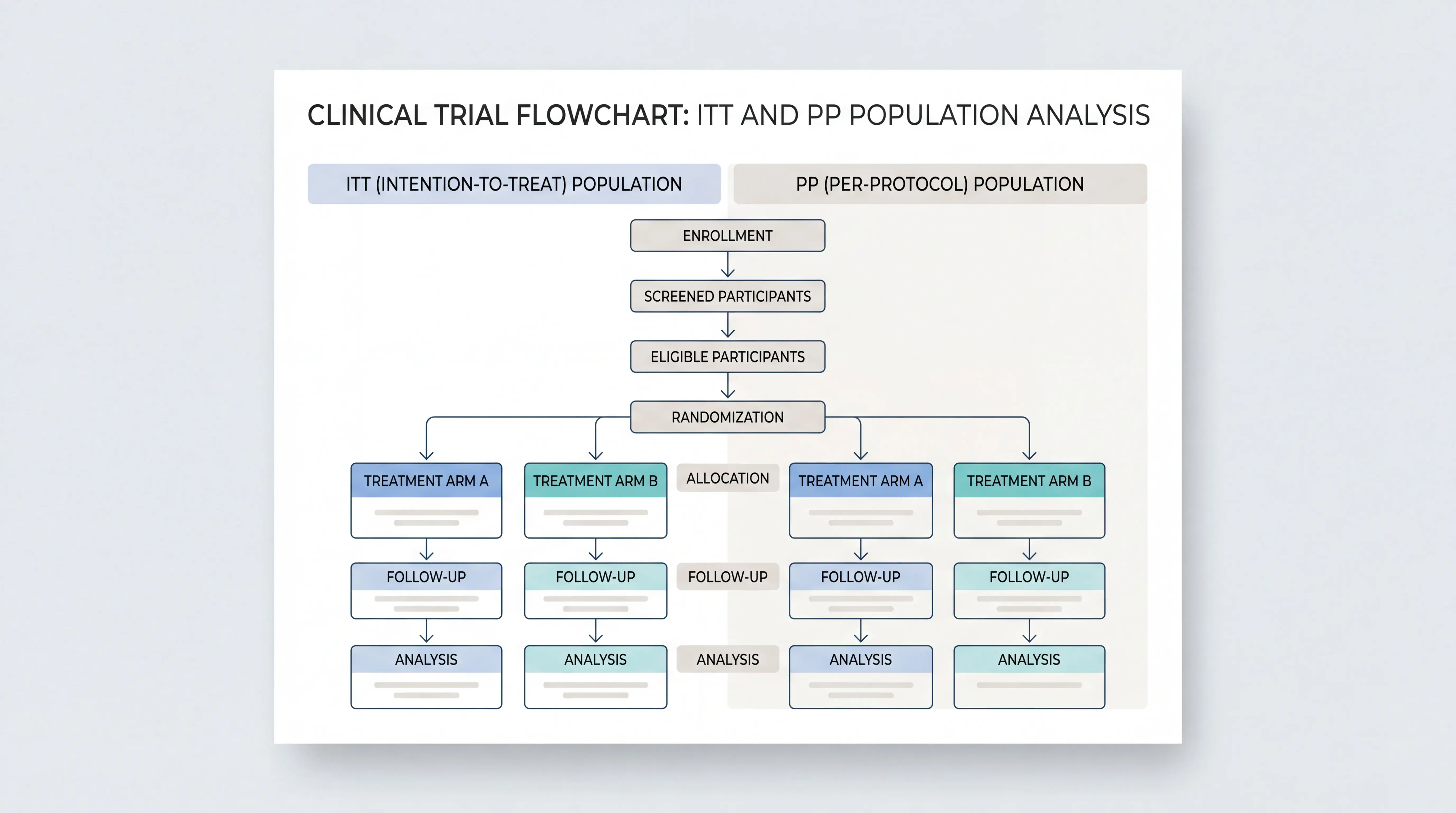
Intention-to-treat analysis includes all randomized participants in the groups to which they were originally assigned. The three basic rules are: do not exclude randomized patients, do not reassign them to another group, and handle missing outcome data carefully.
This approach preserves the benefit of randomization. It reduces selection bias. It also reflects the practical effectiveness of an intervention rather than its ideal performance under perfect adherence.
2.2 Why ITT Is Often Preferred
When follow-up is incomplete or adherence is poor, intention-to-treat analysis usually gives a more conservative estimate of treatment effect. In a placebo-controlled setting, missing outcomes are sometimes treated as failures in the primary analysis. That can lower the apparent efficacy estimate, but it protects against overstatement.
For clinicians, this matters because a treatment that still works under less-than-perfect adherence is often more credible. If a drug appears beneficial even when analyzed under ITT, confidence in the result increases.
2.3 Common Strengths and Limits
Strengths of intention-to-treat analysis include:
- Better preservation of randomization.
- Lower risk of bias from post-randomization exclusions.
- Stronger relevance to real-world effectiveness.
Its limits include:
- It may dilute treatment effects if many patients do not adhere.
- Missing data handling can influence results.
- It may underestimate the biological efficacy of a treatment.
3. What Per-Protocol Analysis Means
3.1 Core Principle
Per-protocol analysis includes only participants who followed the protocol sufficiently well. This usually means they completed the assigned intervention, avoided major protocol deviations, and provided usable data.
3.2 Why Researchers Use It
Per-protocol analysis estimates the effect of treatment under ideal adherence. It can be useful when researchers want to know whether the intervention works when used as intended. This is especially relevant for explanatory trials and for sensitivity analysis.
However, it has an important limitation. Patients who remain in the per-protocol set are not a random subset of the original trial population. They may be healthier, more motivated, or less likely to experience adverse events. That creates selection bias.
3.3 Risk of Overestimation
Because the sickest, least adherent, or most treatment-limited patients may be excluded, per-protocol results can overestimate efficacy and underestimate harms. This is why it should not be the only analysis in a superiority trial.
4. Intention-to-Treat vs Per-Protocol Analysis: Practical Differences
4.1 What Each Method Answers
These two approaches answer different questions.
- Intention-to-treat asks, “What is the effect of assigning this treatment?”
- Per-protocol asks, “What is the effect of receiving this treatment as planned?”
That difference is clinically important. The first aligns with public health and real-world decision-making. The second aligns more with biological efficacy under ideal conditions.
4.2 How They Differ in Bias
Intention-to-treat reduces bias by keeping the randomized groups intact. Per-protocol can introduce bias because exclusions are linked to post-randomization behavior.
If non-adherence is related to prognosis, per-protocol analysis can give a misleadingly favorable result. This is one of the most important points to understand in any essay on clinical trial analysis.
4.3 Typical Use in Reporting
A well-conducted trial often reports both. The main efficacy analysis is commonly ITT. Per-protocol can serve as a sensitivity analysis. If both lead to similar conclusions, confidence in the findings increases. If they diverge, investigators should explain why.
5. A Simple Example from a Randomized Trial
5.1 Trial Flow
Imagine 500 patients randomized to Drug A or placebo. During follow-up:
- 40 patients discontinue treatment.
- 25 patients switch arms.
- 15 are lost to follow-up.
Under intention-to-treat analysis, all 500 remain in their original groups. Under per-protocol analysis, some of those patients are excluded.
5.2 Why Results May Change
If most discontinuations happened because of adverse events or lack of response, the per-protocol group is no longer comparable to the original randomization. The treatment effect may appear larger than it truly is.
This is why intention-to-treat-vs-per-protocol-analysis can produce different conclusions even from the same trial. The difference is not just mathematical. It reflects different assumptions about missing data and adherence.
6. How to Choose the Right Analysis
6.1 For Efficacy
For superiority trials, intention-to-treat is usually the primary choice for efficacy. It protects randomization and supports a conservative estimate.
6.2 For Sensitivity Checks
Per-protocol is useful as a secondary or sensitivity analysis. It helps test whether the main result is robust among participants who adhered to the protocol.
6.3 For Safety
Safety analysis is usually based on all patients who received at least one dose of the intervention. This is closer to the safety analysis set than to either ITT or PP in a strict sense.
6.4 A Practical Decision Rule
Use this simple framework:
- Define the primary endpoint before the trial starts.
- Pre-specify the main analysis set.
- Report protocol deviations transparently.
- Compare ITT and PP results.
- Explain any major disagreement.
7. Common Mistakes to Avoid
7.1 Switching the Analysis After Seeing Results
This is a major error. Choosing ITT or PP after looking at the data can create reporting bias.
7.2 Calling Any Exclusion “Clean Data”
Excluding patients because of non-adherence may look neat, but it can damage validity. Clean data is not the same as unbiased data.
7.3 Ignoring Missing Outcomes
Missing follow-up data must be handled carefully. In some settings, especially placebo-controlled studies, missing outcomes are assumed to represent treatment failure in conservative analyses.
7.4 Overclaiming Per-Protocol Findings
Per-protocol findings should not be presented as the definitive truth. They describe a selected subgroup, not the full randomized population.
8. Why This Matters for Medical Writing and Research
8.1 Better Manuscripts
Clear reporting of analysis sets improves trial transparency. It also helps reviewers and readers judge risk of bias.
8.2 Better Clinical Decisions
Doctors need evidence that matches real practice. ITT is often closer to that goal. PP can still add value, but only as a complement.
8.3 Better Research Workflow with scifocus.ai
If you are preparing a manuscript, thesis, or trial report, scifocus.ai can help organize your research draft, refine academic language, and structure sections more efficiently. It is especially useful when you need to present ITT and PP methods clearly, consistently, and in a journal-ready format. For researchers managing multiple outcomes and reporting requirements, this can save time and reduce writing errors.
Conclusion
Intention-to-treat and per-protocol analysis answer different questions, and both have a place in clinical research. ITT preserves randomization and supports real-world effectiveness. PP focuses on adherent participants and may show ideal efficacy, but it carries a higher risk of bias. For most randomized trials, the strongest approach is to pre-specify ITT as the primary analysis and use PP as a sensitivity check. If you want to write, structure, or polish your research faster, consider using scifocus.ai to support a clearer and more professional academic workflow.

Did you like this article? Explore a few more related posts.
Start Your Research Journey With Scifocus Today
Create your free Scifocus account today and take your research to the next level. Experience the difference firsthand—your journey to academic excellence starts here.