

How to Write Figure Legends That Stand Alone
Introduction
Writing an essay on scientific figures is not the goal. But writing figure legends that stand alone is essential. Many medical students, doctors, and researchers lose clarity because the legend repeats too little, assumes too much, or forces readers back to the main text. A strong legend should explain the figure on its own, with enough detail to be understood without guessing.
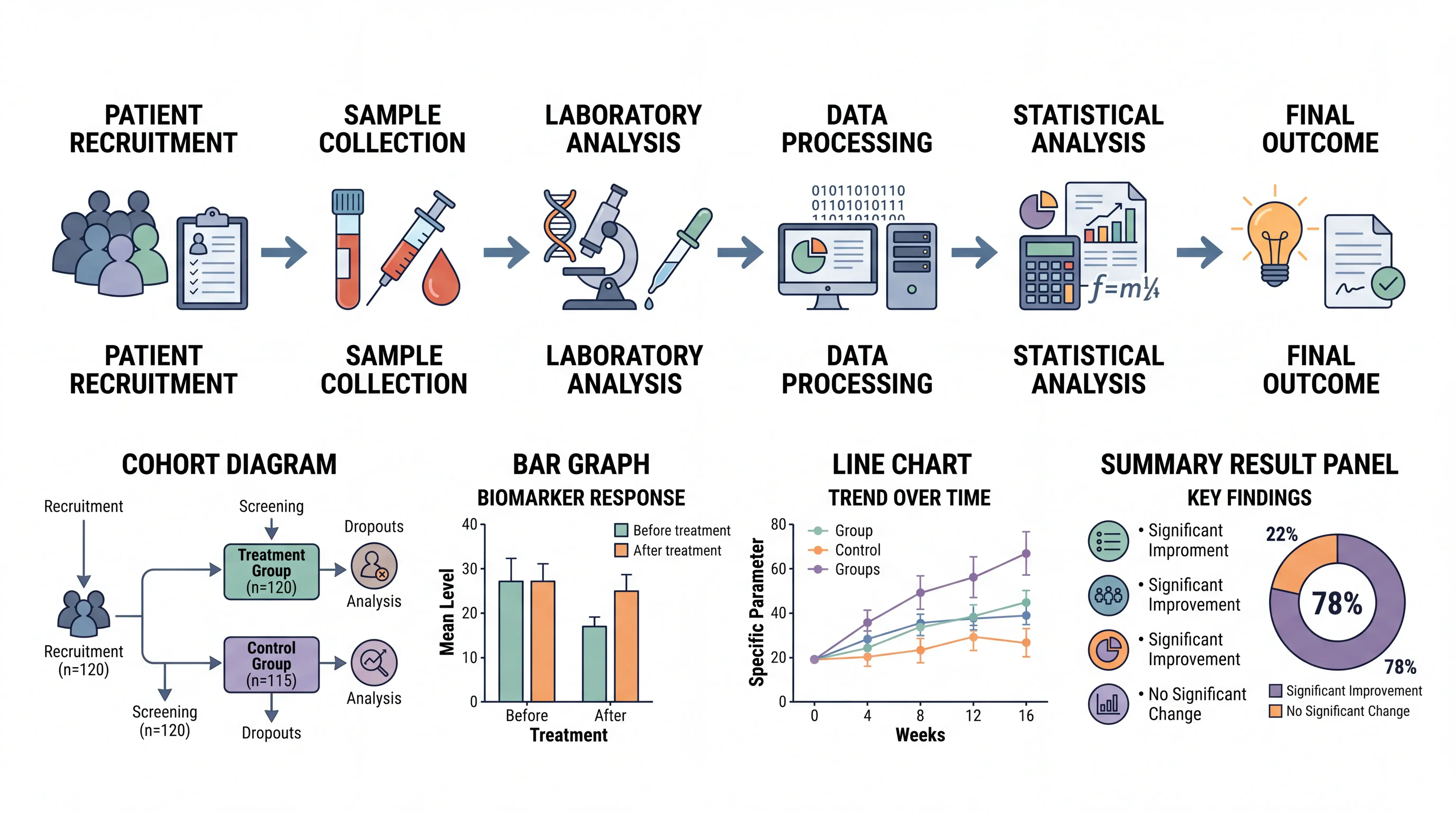
1. Why stand-alone figure legends matter
A figure legend is not a caption decoration. It is part of the scientific record. Readers should understand what the figure shows, how it was generated, and why it matters, even if they only scan the figure page.
This matters in clinical writing because figures often carry the core message. A pathway diagram, flowchart, or outcome graph may be the fastest way to show study design, patient flow, or intervention results. If the legend is weak, the figure loses value.
A stand-alone figure legend improves readability, reproducibility, and editorial review. It also reduces the risk of revision requests, because reviewers do not need to ask basic questions about what the figure means.
1.1 What readers need from a legend
A useful legend answers five questions:
- What is shown.
- What the symbols or labels mean.
- What groups or time points are compared.
- What abbreviations are used.
- What statistics or error bars represent.
If the legend does not answer these points, the figure is incomplete. For an essay or research manuscript, that is a common weakness.
1.2 Common mistakes to avoid
Many authors make the same errors:
- Using vague phrases like “results are shown below.”
- Copying the figure title instead of explaining the data.
- Putting the interpretation in the legend instead of the result section.
- Using abbreviations without defining them.
- Hiding key methods that are needed to read the figure.
These problems make the figure harder to use and harder to trust.
2. The core structure of a strong legend
A good legend follows a simple logic. Start with a short title or opening sentence. Then explain the main content. After that, define symbols, abbreviations, and statistics.
For most scientific figures, this order works well:
- Brief descriptive title.
- What the figure shows.
- Study population, group, or dataset.
- Meaning of panels, colors, lines, or symbols.
- Statistical details if needed.
The best legends are specific, not long. They provide enough context for understanding, but they do not repeat the full Results section.
2.1 Write the opening sentence clearly
The first sentence should identify the figure type and purpose. For example, say “Figure 1. Flowchart of patient selection in the cohort study.” This is direct and useful.
Avoid opening with general language. Do not write “This figure illustrates…” unless the rest of the legend is already precise. In scientific writing, direct nouns are clearer than filler phrases.
2.2 Explain panels and visual elements
If the figure has multiple panels, label them in the legend in the same order as they appear in the figure. For example, “(A) baseline characteristics, (B) treatment response, (C) survival analysis.”
Also explain:
- Colors.
- Lines.
- Shapes.
- Error bars.
- Asterisks or significance markers.
If a reader cannot decode the visual system in seconds, the legend is not doing its job.
3. How to make the legend stand alone
A stand-alone legend must work without the main text. That does not mean it should repeat the entire manuscript. It means it should include the minimum information needed to interpret the figure correctly.
For clinical and academic readers, that minimum usually includes the sample, the comparison, and the analytical context. If the figure contains a flowchart, the legend should state what the flow describes. If it contains a statistical chart, the legend should define the measure and the test.
A stand-alone figure legend should be readable in one pass. The reader should not need to search the Methods section just to understand the axes.
3.1 Define abbreviations on first use
In figure legends, abbreviations should be defined the first time they appear. This is a standard rule in manuscript preparation.
For example:
- CRP, C-reactive protein.
- CI, confidence interval.
- HR, hazard ratio.
Do not assume an abbreviation is clear because it appeared in the abstract. The abstract and the main text are treated separately in manuscript editing. Use the full term again when needed.
3.2 Include only essential methods
A legend is not a Methods section, but it may need one or two technical details. For example:
- “Data are presented as mean ± SD.”
- “Error bars indicate 95% confidence intervals.”
- “P values were calculated using the log-rank test.”
These details help readers interpret the figure correctly. Keep them short and factual.
3.3 Keep interpretation in balance
A legend can guide interpretation, but it should not overstate the conclusion. Say what is shown. Do not convert the legend into a mini-discussion.
For example, write:
- “Patients receiving treatment A showed lower inflammatory markers than the control group.”
Avoid:
- “Treatment A was clearly superior and should be adopted immediately.”
The first is descriptive. The second is interpretive and too strong for a legend.
4. Practical rules for medical manuscripts
In medical publishing, figure legends are usually placed after the reference list and before tables, depending on journal format. This keeps the manuscript editable and easier for production teams to handle.
Also, most journals expect figures to be separate files. Do not place the legend inside the image itself. Text embedded in the figure can be difficult to edit during layout and may create formatting problems.
4.1 Use consistent style across figures
Consistency improves professionalism. Keep the following elements uniform:
- Tense.
- Abbreviation style.
- Order of panel labels.
- Statistical format.
- Capitalization of figure titles.
If Figure 1 uses “Mean ± SD,” Figure 2 should not switch to “average and standard deviation” unless the journal style requires it.
4.2 Respect journal limits and submission rules
Many journals limit the number of figures and tables. Some allow figures and tables together only up to a fixed number. Others require that legends be submitted in a separate section.
Before submission, check:
- Maximum number of figures.
- Whether tables can appear in the manuscript body.
- Required font and spacing.
- Figure file format.
- Whether legends must be editable text.
These details save time during revision.
4.3 Use formatting that supports readability
For embedded text in workflow diagrams or flowcharts, simple fonts and clear sizing matter. Common manuscript standards include:
- 10-point or 12-point font.
- 1.5 line spacing.
- Standard fonts such as Times New Roman.
- A4 or US letter page size, unless the journal specifies otherwise.
These are not decorative choices. They affect clarity and submission quality.
5. A simple checklist before submission
Before you submit your essay or manuscript, check every figure legend against this list:
- Does it explain the figure without the main text.
- Does it define all abbreviations.
- Does it identify all panels, symbols, and colors.
- Does it state the statistical meaning of error bars or markers.
- Does it avoid unnecessary interpretation.
- Is it consistent with the figure file and manuscript style.
If a legend fails any of these points, revise it before peer review. Small edits now can prevent major revision later.
5.1 Example of a strong legend
A concise example might look like this:
“Figure 2. Serum biomarker changes after treatment. (A) CRP levels at baseline and week 4. (B) IL-6 levels at baseline and week 4. Data are mean ± SD. CRP, C-reactive protein; IL-6, interleukin-6; SD, standard deviation.”
This is short, direct, and self-contained.
5.2 Where scifocus.ai can help
If you draft figures, tables, and legends under tight deadlines, scifocus.ai can help streamline the writing process. It can support clearer scientific phrasing, help standardize manuscript language, and reduce time spent rewriting technical text. For medical students, physicians, and researchers, that means faster preparation and fewer avoidable formatting errors.
Conclusion
A strong figure legend is precise, concise, and independent. It should let readers understand the figure without hunting through the manuscript. For scientific writing, that is not optional. It is part of quality control. If you want cleaner legends, fewer revisions, and faster submission-ready drafting, use scifocus.ai as a practical writing aid for your next essay or manuscript.

Did you like this article? Explore a few more related posts.
Start Your Research Journey With Scifocus Today
Create your free Scifocus account today and take your research to the next level. Experience the difference firsthand—your journey to academic excellence starts here.