

How to Write a Systematic Review
Introduction
Writing a systematic review is difficult when the literature is large, fragmented, and inconsistent. Many medical students, doctors, and researchers know the evidence exists, but struggle to turn it into a clear essay with a logical structure, transparent methods, and a defensible conclusion. That is the real challenge of how to write a systematic review: not just collecting papers, but selecting, comparing, and synthesizing them with rigor.
1. What a Systematic Review Is and Why It Matters
1.1 Define the review question clearly
A systematic review is not a broad summary of a topic. It is a focused, methodical review of research evidence on a specific question. It is designed to identify what is known, what is uncertain, and where the field still has gaps.
A strong systematic review starts with a precise question, not a general topic.
For example, instead of “diabetes treatment,” define the population, intervention, comparison, and outcome. This keeps the review narrow enough to manage and strong enough to defend.
1.2 Understand the purpose of the review
The knowledge base shows that a review has two core functions. First, it maps research progress. Second, it critiques limitations in existing studies. This balance is essential for an academic essay in medicine.
A good review should do more than list studies. It should explain:
- what previous studies found,
- where findings conflict,
- what methods were weak,
- and why your review is necessary.
If you cannot explain the gap, your review has no clear academic value.
1.3 Choose a review type that fits the aim
The course material highlights several review types, including:
- status quo reviews,
- history reviews,
- issue-focused reviews,
- theory or model-based reviews.
For most medical writers, the systematic review format is best when the goal is to evaluate evidence on one clinical or research question. If your scope is too broad, the paper becomes a narrative summary and loses precision.
2. Build a Strong Structure Before You Write
2.1 Draft the outline first
One of the most common mistakes is writing without a framework. The result is a list of studies with weak flow. A better approach is to draft the structure before writing the main text.
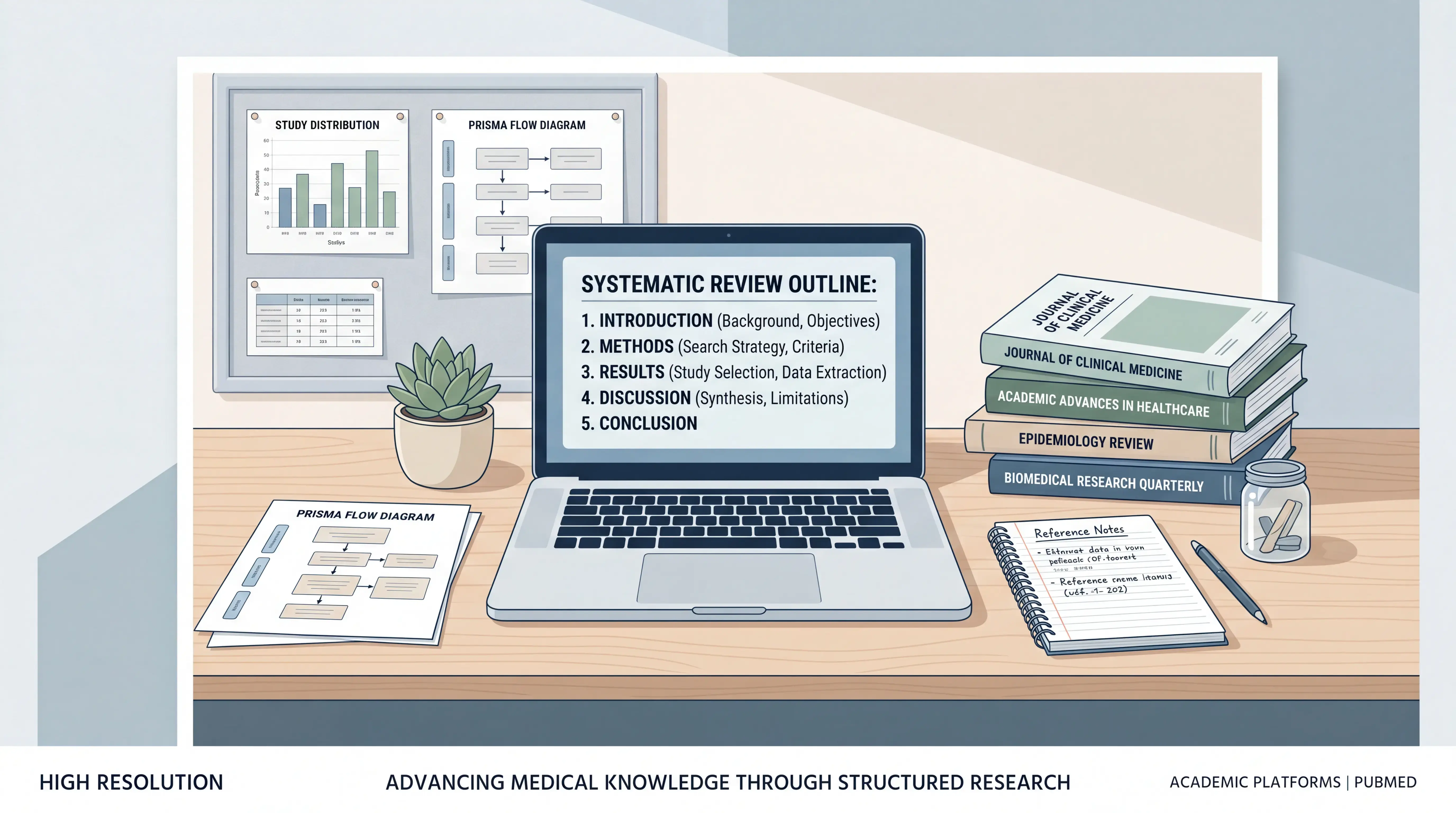
A practical outline usually includes:
- title,
- abstract,
- introduction,
- methods,
- results or main body,
- discussion,
- conclusion,
- references,
- tables and figures.
A systematic review becomes clearer when each section has one job and one job only.
2.2 Organize the body with logic
The knowledge base recommends arranging content by causality, chronology, or contrast between mainstream and non-mainstream views. This is especially useful in medicine, where evidence often develops in stages.
You can organize the body in three ways:
- By time, showing how evidence evolved.
- By theme, grouping studies by mechanism or intervention.
- By debate, comparing conflicting findings.
For an academic essay, thematic structure is often the most readable. It helps the reader follow the evidence without losing the central question.
2.3 Keep the title focused and searchable
A good title should be short, clear, and keyword-rich. It should include the main concept and avoid vague wording. This improves both readability and discoverability.
A weak title sounds broad and generic.
A strong title signals:
- topic,
- scope,
- and review intent.
For SEO and academic clarity, the title should reflect the exact content of the review.
3. Search and Select the Evidence Properly
3.1 Use reliable databases
The provided knowledge base mentions common sources such as PubMed, Scopus, Excerpta, and Web of Science. These databases are standard starting points for a medical literature search.
A disciplined search should define:
- keywords,
- inclusion and exclusion criteria,
- date range,
- study design,
- and language limits if relevant.
A systematic review is only as strong as its search strategy.
If the search is incomplete, the review cannot be trusted.
3.2 Record your selection criteria
Transparency is a major part of E-E-A-T. Readers should understand how studies were chosen. That means stating the logic behind inclusion and exclusion clearly.
Common criteria include:
- population characteristics,
- intervention or exposure,
- comparison group,
- outcomes,
- study design,
- publication type.
When criteria are vague, the review feels subjective. When they are explicit, the review gains authority.
3.3 Screen studies in stages
A practical workflow is:
- identify records,
- remove duplicates,
- screen titles and abstracts,
- read full texts,
- select the final set.
This process helps prevent bias and keeps the review reproducible. Even if you are writing a short academic essay, this method protects the credibility of your work.
4. Write the Main Body With Critical Analysis
4.1 Do not just summarize
The knowledge base emphasizes critical evaluation of published work. That means you should not simply repeat what each paper says. You must compare, contrast, and interpret.
Each study should be discussed in context:
- What question did it answer?
- How strong was the design?
- Were the results consistent with other studies?
- Did the study reveal a limitation or gap?
Critical synthesis is what turns a literature list into a real systematic review.
4.2 Use evidence-based comparison
When studies disagree, do not hide the conflict. Address it directly. Conflicting findings may reflect differences in:
- sample size,
- study quality,
- patient population,
- follow-up duration,
- outcome definitions.
This is where a systematic review shows professional value. It helps readers understand why evidence does not always point in one direction.
4.3 Write in concise sections
To improve readability, break the body into subheadings. Each section should answer one part of the review question. Keep paragraphs short. Keep claims specific.
A clean medical review should present:
- the evidence,
- the limitation,
- the implication.
That three-step pattern keeps the argument clear and avoids vague academic language.
5. Strengthen the Methods and Discussion Sections
5.1 Describe the method transparently
A systematic review should explain how the literature was gathered and analyzed. This is essential for trust. Readers need to know whether the process was reproducible.
Include:
- databases searched,
- search terms,
- dates of search,
- inclusion and exclusion criteria,
- and screening process.
If you used tools such as RevMan for review management, that can support organization and analysis. The key point is consistency and traceability.
5.2 Turn findings into interpretation
The discussion section should not repeat the results. It should explain what they mean. This is where the review connects evidence to practice or future research.
Good discussion points include:
- the strength of the current evidence,
- sources of heterogeneity,
- clinical relevance,
- and unresolved questions.
The discussion should answer why the evidence matters, not just what it says.
5.3 State limitations honestly
Strong academic writing is honest about limits. If the literature is small, old, or methodologically weak, say so. If the included studies differ too much for a firm conclusion, acknowledge that.
This is not a weakness. It is part of scientific credibility. Medical readers respect precision more than overstatement.
6. Use AI Tools to Reduce Friction and Improve Quality
6.1 Where AI can help
Writing a systematic review takes time. The difficult parts are often not the ideas, but the execution:
- structuring the outline,
- sorting themes,
- identifying gaps,
- drafting concise academic language,
- and keeping the review consistent.
This is where scifocus.ai can help streamline the workflow. It can support writing efficiency, improve organization, and reduce the time spent turning notes into a polished academic draft.
6.2 How it supports the writing process
A tool like scifocus.ai is especially useful when you need to:
- convert scattered notes into a structured essay,
- refine section headings,
- improve clarity and flow,
- and keep the review aligned with a formal academic style.
For busy medical students, clinicians, and researchers, that means less time lost in formatting and more time spent on evidence evaluation.
6.3 Use AI as an assistant, not a substitute
AI should support your judgment, not replace it. You still need to verify sources, check study quality, and ensure that every claim is supported. That is the standard expected in serious academic writing.
The best results come when expert thinking and smart tools work together.
Conclusion
Learning how to write a systematic review is really about learning how to think like a researcher. Start with a focused question. Search the literature carefully. Organize the evidence with logic. Critically compare findings. Then write with clarity and precision. For medical students, doctors, and researchers, this approach turns a difficult essay into a credible academic paper.
If you want a faster and more structured writing process, try scifocus.ai. It can help you outline, draft, and refine your review with less friction, while you stay in control of the science.

Did you like this article? Explore a few more related posts.
Start Your Research Journey With Scifocus Today
Create your free Scifocus account today and take your research to the next level. Experience the difference firsthand—your journey to academic excellence starts here.