

How to Write a Strong Topic Sentence
Introduction
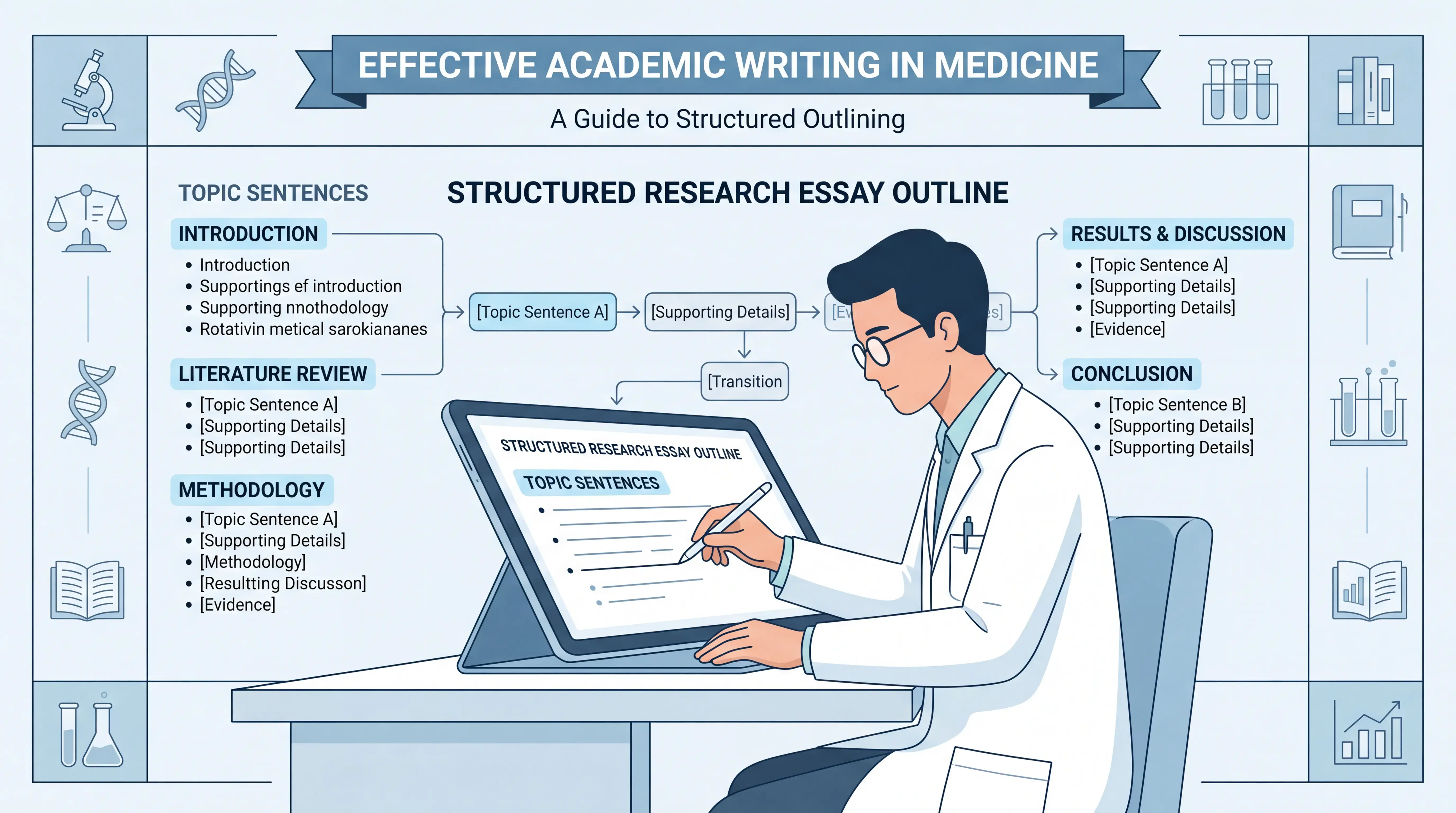
A strong essay begins with a strong topic sentence. For medical students, doctors, and researchers, that single sentence can decide whether a paragraph feels focused, credible, and easy to follow. Weak topic sentences lead to vague arguments and slow reading. Strong ones guide the reader, frame evidence, and support a clear academic line. In scientific writing, that matters. A precise topic sentence improves structure, strengthens logic, and helps the full essay read like a coherent argument.
1. What a Topic Sentence Does in an Essay
1.1 It controls paragraph focus
A topic sentence tells the reader what the paragraph is about. It works like a signpost. In an essay, each paragraph should serve one main idea. If the first sentence is too broad, the paragraph drifts. If it is too narrow, the discussion feels limited.
A good topic sentence makes the paragraph easy to scan. This is especially useful in medical and research writing, where readers often look for the key claim before reading the supporting data. The first sentence should state the paragraph’s central point with precision.
1.2 It connects evidence to argument
In academic writing, evidence is not enough by itself. The reader must understand why the evidence matters. A topic sentence gives that context. It prepares the reader for the data, citation, or observation that follows.
For example, instead of writing, “Several studies have examined inflammation,” a stronger version would be: “Inflammation remains a central mechanism in chronic disease progression.” The second version gives direction. It tells the reader how to interpret the coming evidence in the essay.
1.3 It supports readability and trust
Readers trust writing that feels organized. A clear topic sentence signals control and planning. That is important in scholarly work, where clarity often reflects discipline.
For medical students and researchers, this also reduces revision time. When each paragraph starts with one defined claim, the whole essay becomes easier to edit, expand, and defend.
2. Core Qualities of a Strong Topic Sentence
2.1 Be specific, not vague
A weak topic sentence often sounds general. It may mention a theme but fail to define the angle. For example:
- Weak: “Cancer is an important health problem.”
- Strong: “Early detection remains one of the most effective ways to improve cancer outcomes.”
The strong version tells the reader what the paragraph will argue. It is specific enough to guide the rest of the essay, but not so narrow that it blocks development.
2.2 Keep one main idea per sentence
A topic sentence should not try to do too much. If it contains two or three claims, the paragraph becomes unstable. Readers may not know which idea to follow.
A simple rule works well. One topic sentence, one main claim, one paragraph.
If you need more than one claim, split the material into separate paragraphs. This is especially useful in scientific writing, where precision matters more than style.
2.3 Make the claim arguable
A topic sentence should not be a fact alone. It should present an idea that the paragraph can explain, support, or evaluate. Facts belong in evidence. Claims belong in topic sentences.
For example:
- Fact: “Hypertension affects many adults.”
- Arguable claim: “Hypertension remains a major driver of preventable cardiovascular risk.”
The second sentence gives the paragraph direction. It allows the rest of the essay to develop analysis, not just description.
3. A Practical Formula for Writing One
3.1 Use a clear claim + scope + direction
A useful structure is:
Claim + specific focus + expected support
Example:
“Recent advances in biomarker research are improving the early diagnosis of sepsis.”
This sentence does three things at once. It states a claim, defines the topic, and suggests the paragraph’s purpose. For a medical essay, this formula keeps writing concise and purposeful.
3.2 Match the topic sentence to the paragraph purpose
Different paragraphs need different types of topic sentences. In an introduction, the sentence may frame a research problem. In a discussion, it may interpret results. In a literature review, it may compare studies.
Use the sentence to match the job of the paragraph. For instance:
- To introduce a problem: “Diagnostic delay remains a major barrier in stroke care.”
- To compare evidence: “Current studies offer useful insights, but their findings remain inconsistent.”
- To interpret a result: “These outcomes suggest that intervention timing may be more important than intervention intensity.”
Each version works because it serves a distinct role in the essay.
3.3 Place key terms early
Readers process the first part of a sentence quickly. Put the main subject near the beginning. This improves clarity, especially in technical writing.
Poor: “It may be possible to improve outcomes in some patients through earlier intervention.”
Better: “Earlier intervention may improve outcomes in selected patients.”
The improved version is direct. It removes clutter and makes the essay sound more confident.
4. Common Mistakes to Avoid
4.1 Starting too broad
Many writers begin with a sentence that sounds like a textbook heading. It may be true, but it does not guide the paragraph.
Example:
“Medicine has changed over time.”
This is too general to help the reader. A better topic sentence would narrow the scope:
“Digital tools are reshaping how clinicians monitor chronic disease.”
The second version gives the paragraph a real focus inside the essay.
4.2 Using filler phrases
Avoid empty openings such as:
- “It is important to note that...”
- “There are many reasons why...”
- “In today’s society...”
These phrases add length, not value. In a professional essay, directness is stronger than decoration. Cut any phrase that does not add meaning.
4.3 Copying the thesis sentence exactly
A topic sentence should support the thesis, not repeat it word for word. Repetition can make the writing feel flat.
Instead, each paragraph should advance one part of the larger argument. If your thesis says that a treatment is effective, one paragraph may explain the mechanism, another may discuss patient selection, and another may address limitations. Each topic sentence should move the essay forward.
5. How to Revise a Weak Topic Sentence
5.1 Ask three questions
When revising, check the sentence with three questions:
- What is the main point?
- Is it specific enough?
- Does it prepare the reader for the evidence?
If the answer to any question is unclear, revise the sentence. A strong topic sentence should pass all three tests before it enters the final essay.
5.2 Remove uncertainty where possible
Academic writing can be careful without being weak. Words like “maybe,” “sort of,” or “a little” often reduce authority. Use them only when uncertainty is truly part of the evidence.
Compare these:
- Weak: “This treatment may possibly help some patients.”
- Strong: “This treatment may improve outcomes in carefully selected patients.”
The second sentence is more professional. It is measured, but not vague.
5.3 Read it aloud
A topic sentence should sound smooth and logical. Reading aloud often reveals awkward grammar, overloaded clauses, and weak transitions.
If the sentence is hard to say, it is often hard to read. That is a practical sign it needs revision before it enters the final essay.
6. Topic Sentences in Medical and Research Writing
6.1 Build paragraphs around evidence, not opinion
In clinical and scientific writing, topic sentences should point toward data, not personal preference. The sentence should introduce an interpretable claim that can be supported by studies, guidelines, or observations.
For example:
“Current evidence suggests that early mobilization may reduce hospital stay in selected patients.”
This sentence is strong because it signals evidence-based discussion. It fits the standards expected in a professional essay for medical audiences.
6.2 Use consistent logic across sections
A good research essay should feel like a chain of reasoning. Topic sentences help maintain that chain. They show how one paragraph leads to the next.
For example:
- First paragraph: defines the clinical problem.
- Second paragraph: reviews current evidence.
- Third paragraph: discusses limitations.
- Fourth paragraph: identifies future directions.
With clear topic sentences, the essay becomes easier to follow and more persuasive.
6.3 Save time with structured writing tools
Many writers lose time rewriting paragraphs because the opening sentence is unclear. Structured drafting tools can help. scifocus.ai can support topic development, paragraph planning, and academic organization for medical students, doctors, and researchers. Used well, it can speed up outlining and improve clarity before you draft the full essay.
7. A Simple Checklist Before You Finalize
7.1 Check for clarity
A strong topic sentence should answer these questions at a glance:
- What is the paragraph about?
- Why does it matter?
- What kind of evidence will follow?
If the reader can answer all three, the sentence is doing its job.
7.2 Check for length
Most topic sentences work best when they are short and direct. Long sentences often hide the main point. Keep the structure clean. Use enough detail to guide the paragraph, but not so much that the sentence becomes difficult to read.
7.3 Check for alignment
The topic sentence, supporting evidence, and closing sentence should all match. If the paragraph starts with one idea and ends with another, the essay loses coherence. Alignment is a major part of academic quality.
Conclusion
A strong topic sentence is not just a writing rule. It is the foundation of a clear, persuasive, and professional essay. For medical students, doctors, and researchers, it improves focus, strengthens logic, and helps evidence read with purpose. Keep the sentence specific, arguable, and aligned with the paragraph’s role. If you want to write faster and with more precision, try structuring your next draft with scifocus.ai. It can help you plan better paragraphs and turn a rough outline into a stronger academic essay.
Did you like this article? Explore a few more related posts.
Start Your Research Journey With Scifocus Today
Create your free Scifocus account today and take your research to the next level. Experience the difference firsthand—your journey to academic excellence starts here.