

How to Write a Research Protocol Before You Start Collecting Data
Introduction
Before you collect a single sample or recruit a single patient, you need a clear research protocol. Without one, even a strong essay on your study topic can turn into a weak project in practice. A protocol is not paperwork for the shelf. It is the blueprint that keeps your question, methods, outcomes, and analysis aligned. If you skip this step, you risk wasted time, inconsistent data, and unusable results.

1. Define the Research Question Clearly
1.1 Start with one answerable question
A good protocol begins with a focused question. In clinical and biomedical research, that means defining the population, intervention or exposure, comparator, and outcome. If the question is too broad, your protocol will be unstable from the start.
For example, “Does Drug A reduce blood pressure in adults with hypertension over 12 weeks?” is better than “Is Drug A effective?” The first question can guide inclusion criteria, endpoints, and analysis. The second cannot.
1.2 State the primary objective first
Your protocol should identify one primary objective and a small number of secondary objectives. The source material suggests that two to three feasible objectives are usually enough. Too many objectives dilute focus and make analysis harder to defend.
Write the objective in plain language. Then translate it into measurable terms. This is where many projects fail. If the endpoint cannot be measured reliably, the entire protocol loses strength.
2. Build the Protocol Around Core Sections
2.1 Include the essential clinical elements
A complete clinical research protocol usually includes:
- Background and rationale
- Study objectives
- Study design
- Study population
- Sample size
- Intervention or exposure
- Primary and secondary outcomes
- Data collection plan
- Statistical analysis
- Ethics and informed consent
These sections are not optional. They work together. A protocol is strong only when the sections are internally consistent. For instance, your outcome measures must match your study design and follow-up period.
2.2 Explain the clinical context
The background section should not be a literature dump. It should explain why the study matters now. Use the clinical problem to justify the question. Then show where current evidence is incomplete.
For medical students, physicians, and researchers, this is the point where an essay becomes a research document. The background should lead naturally to the hypothesis. It should not feel detached from the method.
3. Use Existing Protocol Sources Wisely
3.1 Learn from laboratory tradition and expert guidance
In many labs, the best first source is the lab’s own protocol manual. Senior colleagues often refine these methods through repeated practice. But you should not copy them blindly. Different operators, instruments, and sample conditions can change the outcome.
Ask specific questions:
- What exact timing was used?
- Which reagents or brands worked best?
- What step is most sensitive to error?
- What happened when the result failed?
You need to understand both the step and the reason behind it. That is the difference between repeating a method and truly mastering it.
3.2 Cross-check with authoritative references
The knowledge base highlights several reliable sources, including:
- Nature Protocols
- Nature Protocol Exchange
- Bio-protocol
- Current Protocols
- Springer Methods collections
- JoVE
- Google Scholar
- Clinical trial registries such as ClinicalTrials.gov and ChiCTR
These sources help you verify methods, compare details, and confirm whether a protocol has been published or registered. In clinical research, study protocols may also appear in trial journals or supplements of published papers.
4. Design the Study Before Data Collection Begins
4.1 Define who will be included
Your inclusion and exclusion criteria should match the research question exactly. Be specific. Vague criteria create inconsistent enrollment and weaken reproducibility.
For example, if you are studying hypertensive adults, define age range, diagnosis criteria, treatment status, and comorbidities. If you are doing a surgical study, define operator experience, procedure type, and follow-up window.
Well-written criteria protect both validity and feasibility. They also help reduce bias before the first data point is collected.
4.2 Plan the sample size and variables
Sample size should not be an afterthought. It must be linked to the main outcome and the expected effect size. The protocol should also specify all key variables:
- Primary endpoint
- Secondary endpoints
- Baseline characteristics
- Confounders
- Safety outcomes, if applicable
The knowledge base emphasizes that a good protocol clarifies variables and endpoints early. That is essential. If you decide these later, you may end up collecting data that cannot answer the original question.
5. Build a Clear Workflow and Analysis Plan
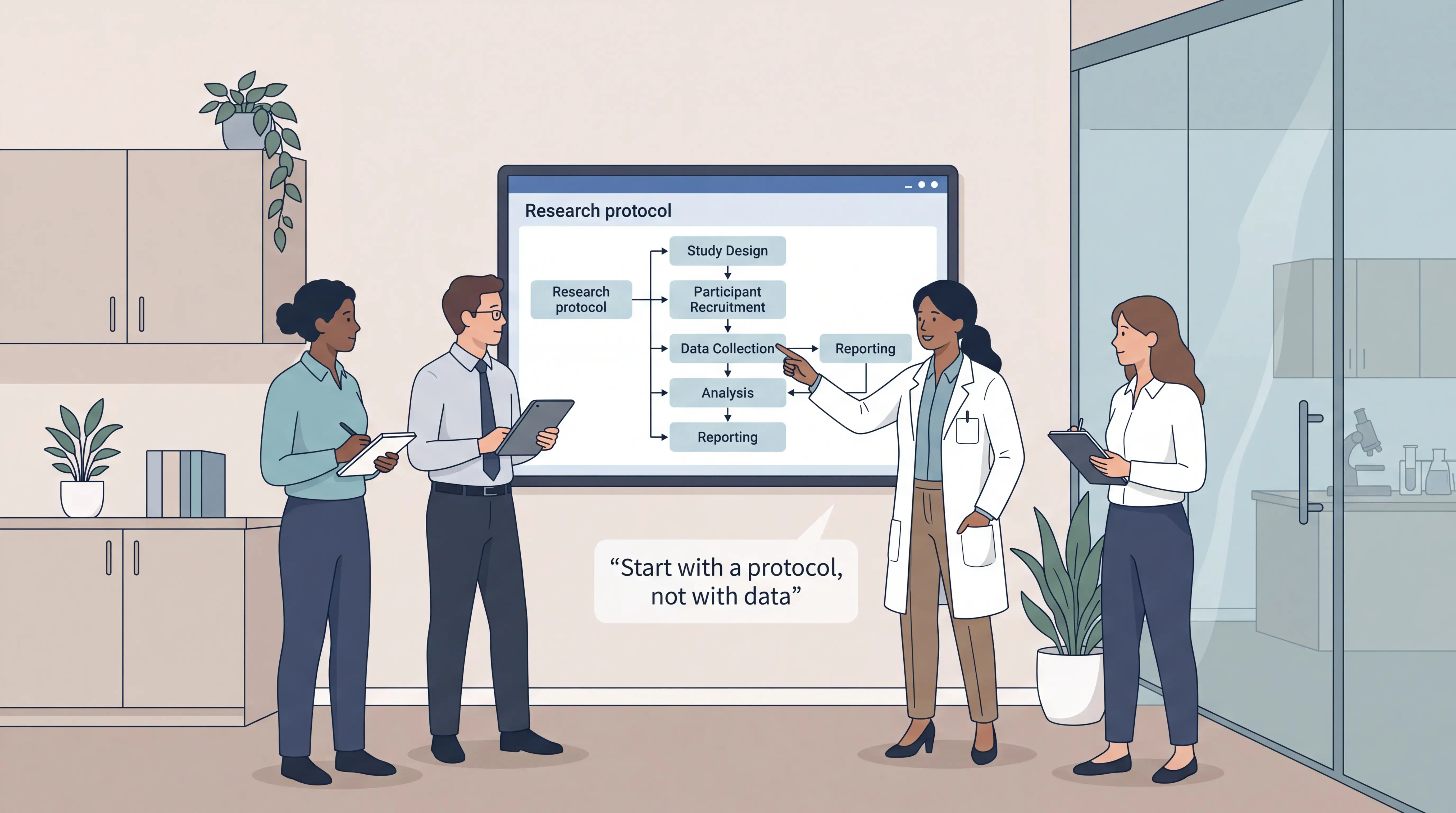
5.1 Draw the study flow
A clear flowchart helps everyone on the team understand the sequence of events. It should show:
- Screening
- Enrollment
- Allocation or grouping
- Intervention or observation
- Follow-up
- Outcome assessment
- Data analysis
This is especially useful in clinical research, where multiple staff members may collect data over weeks or months. A visual workflow reduces mistakes and improves consistency.
5.2 Predefine the statistical approach
Your statistical plan should match your design. State how you will describe the data, compare groups, manage missing data, and handle confounders. If subgroup or sensitivity analyses are planned, list them in advance.
Do not wait until after data collection to decide how to analyze the results. That invites bias and weakens credibility. A strong protocol protects the study from selective reporting.
6. Verify Feasibility, Ethics, and Registration
6.1 Check whether the study is doable
A protocol must be realistic. Consider recruitment speed, available equipment, staff time, budget, and follow-up access. The source material notes that feasibility is a key part of convincing reviewers.
If the study cannot be completed with the resources you have, it is not ready. Better to simplify the design than to launch a project that cannot be finished.
6.2 Address ethics and consent early
Ethical review is not a final checkbox. It should shape the protocol from the beginning. Include risk minimization, consent procedures, privacy protection, and handling of adverse events.
For clinical studies, registration numbers and trial registry details can also help you verify the original objectives, inclusion criteria, interventions, and endpoints. This is useful when the full protocol is not publicly available.
7. Use the Right Tools to Save Time
7.1 Let technology reduce protocol friction
Writing a protocol takes time. Reviewing the literature, checking registry entries, comparing methods, and organizing sections can become overwhelming. This is where tools like scifocus.ai can help streamline the process.
Instead of losing time on scattered notes and repeated searches, you can use a structured research workflow to organize your topic, refine your study question, and keep your protocol aligned from the start. For busy medical students, physicians, and researchers, that efficiency matters.
7.2 Turn your draft into a stronger working document
A protocol is not just a document. It is a decision-making tool. The best drafts are easy to review, easy to update, and easy to explain to collaborators and ethics committees.
If your team struggles with structure, consistency, or literature synthesis, a platform like scifocus.ai can support the drafting process and reduce avoidable delays. That means less guesswork, fewer revisions, and a better start before data collection begins.
Conclusion
A strong research protocol is the foundation of credible clinical and biomedical research. It defines the question, aligns the methods, clarifies the outcomes, and protects the study from avoidable error. Before data collection starts, make sure your objectives, criteria, sample size, workflow, analysis plan, and ethics requirements are all in place. If you want a faster, more organized way to build that foundation, explore scifocus.ai and use it to turn your protocol planning into a more efficient, structured process.
Did you like this article? Explore a few more related posts.
Start Your Research Journey With Scifocus Today
Create your free Scifocus account today and take your research to the next level. Experience the difference firsthand—your journey to academic excellence starts here.